Being away from the rest of us doesn’t mean Curiosity isn’t getting the best dirt. In fact, its latest discovery has the potential to stir up what we know about life on Mars!
Here’s Neil deGrasse Tyson to break it down for us:
As Neil asks, “Could we have Martian neighbors?” If yes, would they fancy a mid-afternoon coffee break?
It’s Monday, I’m back at work, and while things are moving along fine I’d be lying if I said I didn’t wonder what a day in space would be like instead.
Let’s take a little break and go to Mars, shall we?
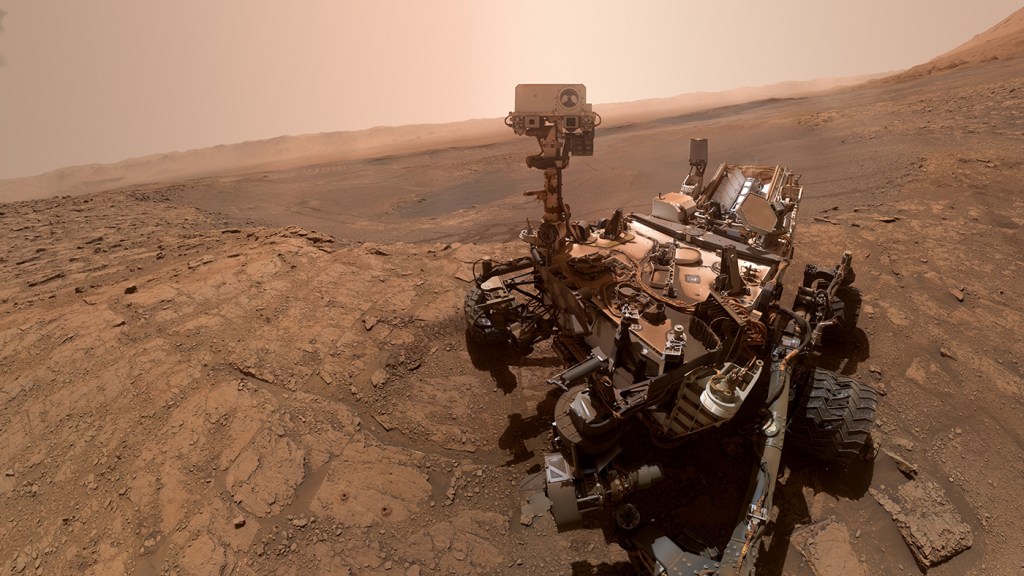
Rover drivers normally rely on Curiosity’s Hazcams to spot rocks, slopes, and other hazards that may be risky to traverse. But because the rover’s other activities were intentionally scaled back just prior to conjunction, the team decided to use the Hazcams to record 12 hours of snapshots for the first time, hoping to capture clouds or dust devils that could reveal more about the Red Planet’s weather.
So, Mars. For the NASA mission, today is the day! I posted on Mars yesterday to give you time to download any apps, plan your landing watch party (socially distanced, of course!), and look up your nearest Krispy Kreme.
Are you ready? Curiosity is! Look at the little guy waving;)
Fingers crossed, but no matter what happens, it’s an exciting day in space!
* * *
Why is Mars red, anyway?
For the same reason that so many of our barns are red: iron oxide. It’s a common compound, both here and on Mars. We use it for paint and our planetary core, among other things, but Mars is a little different. First, of course, there’s no Sherwin-Williams on Mars, but also:
Whereas the bulk of Earth’s iron sank to its core when the planet was young and molten, NASA scientists think Mars’ smaller size (and weaker gravity) allowed it to remain less differentiated. It does have an iron core, but abundant iron exists in its upper layers, also.…The planet’s bloody tinge — visible even from millions of miles away — got it strapped with the name of the Roman god of war, while other civilizations also named the planet for what was once its main distinguishing feature. The Egyptians called it “Her Desher,” meaning “the red one,” while ancient Chinese astronomers went with “the fire star.”
Oh, I love this*: the folks at the most excellent Science News have assembled a scrapbook of sorts for the Curiosity rover. It tracks the rover’s path from August 2012 to the present, and includes a date/sol-based timeline, rover tweets, photos, maps and commentary. Fun and educational. And fun!




You must be logged in to post a comment.