Feeds:
Posts
Comments

Posts Tagged ‘planets’

Today is Pluto Day!

Lowell Observatory holds I Heart Pluto Festival

On Feb. 18, 1930, the young astronomer Clyde Tombaugh discovered Pluto, considered for decades a planet and “demoted” to dwarf planet status in 2008.

A few weeks later, an 11-year old girl named Venetia Burney suggested the name Pluto because of its connection to the god of the cold dark underworld.

This in-depth discussion of Pluto covers all sorts of interesting facts, including details of its discovery, how the New Horizons spacecraft gave us a much more detailed picture, and more. (Did you know that Pluto is half the size of the Moon but has five moons of its own? And someone who weighs 180 pounds on Earth would weigh 11 pounds on Pluto.)

What Makes Pluto So Intriguing | TIME

It takes Pluto slightly over 248 Earth years to orbit the sun, which means that on March 23, 2178, one Plutonian year will have elapsed since the dwarf planet was first spotted, on Feb. 18, 1930.

Here’s a cool animation showing our increasingly detailed understanding of Pluto:

And here’s an interactive image of Pluto 3D Model – NASA Solar System Exploration.

You’ll always be a planet to me, Pluto!

* * *
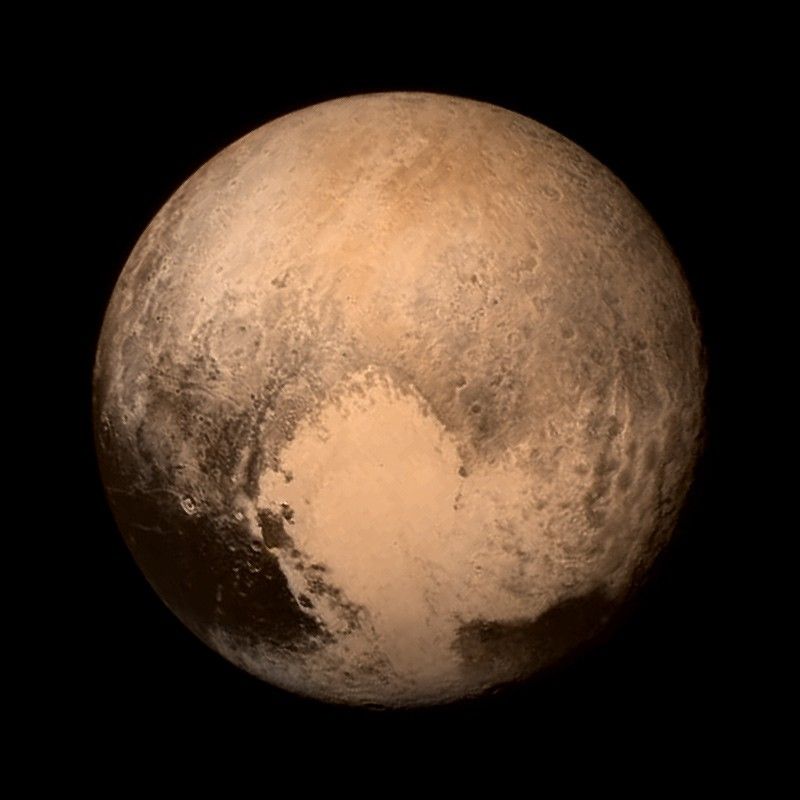
NASA/Johns Hopkins University Applied Physics Laboratory/Southwest Research Institute

Read Full Post »

What do Saturn, Venus, Neptune, Uranus, Jupiter and Mars all have in common? They’re all currently in alignment, at least from our Earthly perspective.

6 planets aligning in night sky will get even better in February

Venus, Saturn and Neptune will be bunched together low in the southwestern sky, while Mars, Jupiter and Uranus will glow higher in the southern sky.

One trick for finding the planets is to look for how they shine. Stars appear to twinkle while planets do not, making it easier to pick out planets in a star-studded sky.

Weather and light pollution permitting, four of these planets will be visible to the naked eye. Pretty cool!

* * *

Photo by Zelch Csaba on Pexels.com

Read Full Post »

Mwahaha, now this is fun:) SuperPlanetCrash is a little online game by Stefano Meschiari that lets you build your own solar system and learn something about orbital physics along the way. The goal is to keep your planets orbiting for 500 years. Click to add planets, ice giants, brown dwarfs and stars, then watch as gravity undermines your best intentions! Use the game to simulate that system you sketched out for your epic sci-fi space opera. Ponder the effects of gravity and motion while earning points for the longevity of your system.

And if you just want to add Super-Earths until the whole crazy house of cards comes crashing down? Go for it:)

Read Full Post »