You know how some days you wake up at 5:30 and lie there in the early morning sun wondering what brought your mind up from sleep? That was me this morning. And as I lay there, the answer bubbled up from my dreams, slow and obscure but clear: Elder Futhark.
Weird, I thought, but I’m sure I’ll get over it.
Nope. For the past few hours every time my mind is unoccupied for more than a moment, what pops into my mind? Elder Futhark.
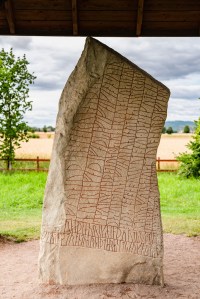
Wondering what I’m going on about? Runes. Let me give you a brief (very brief!) introduction to this early Germanic writing system.
The Elder Futhark (or Fuþark, /ˈfuːðɑːrk/), also known as the Older Futhark, Old Futhark, or Germanic Futhark, is the oldest form of the runic alphabets. It was a writing system used by Germanic peoples for Northwest Germanic dialects in the Migration Period. Inscriptions are found on artifacts including jewelry, amulets, plateware, tools, and weapons, as well as runestones, from the 2nd to the 8th centuries…. knowledge of how to read the Elder Futhark was forgotten until 1865, when it was deciphered by Norwegian scholar Sophus Bugge.
Why would I have this stuck in my head? No idea. My mother studied it once upon a time, and of course, the runes of Middle Earth owe a lot to the old runic languages.
Here’s Gandalf’s mark, Certh rune no. 19:

And here’s the letter F in Elder Futhark: ᚠ
As for what it means? What can I say, the mind works in odd ways.
This wisp of a dream got me thinking about language, and how a characteristic of civilization that we think of as both ubiquitous and permanent, like an alphabet, can just… disappear.
What’s really interesting to me about this, aside from the historical progression of written language, is that what that language represents hasn’t changed all that much.
Writing systems transform, but the stories, the ideas we’re trying to communicate and pass on with that language, those haven’t changed much at all.
I mean, sure, a not insignificant part of language has always been about keeping track of death and taxes, but those aren’t the only things that are inevitable.
No matter the language, stories remind us that we are not alone, help us give structure to the problems we face, and provide an outlet for our experiences.
We’re still interested in heroes and villains, quests and homecomings, pain and joy, and the idea that no matter what challenges we face, there is always hope.
Always.
“Remember, language is fun! It is also magical, so use it well and use it wisely!”
* * *


Leave a Reply!