Feeds:
Posts
Comments

Archive for the ‘Science!’ Category

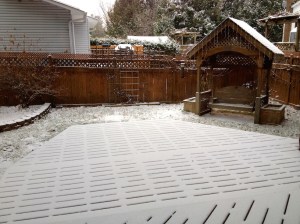
FirstSnow

This is the first real snowfall of the season and it’s still coming down. Yesterday I could pretend that winter was a thing that happened to other people but, alas, no longer!

I say alas but I’m actually coming around on the subject of winter. I ran across an article at Fast Company featuring Kari Leibowitz, a Stanford Ph.D. student who asked a fundamental question: Why don’t people in far northern Norway, a place where the sun doesn’t rise above the horizon between late November and late January, have more seasonal depression? So she went up there and asked.

The answer might surprise you. I know it surprised me, and got me thinking about winter from a different perspective.

“Why would we?”

They see winter as an opportunity, not just to take part in the snowy sports I generally don’t do, but to enjoy the indoor and outdoor beauty of the season. It’s strikingly pretty in the land of practically eternal sunset, but they also focus on what I think of as all the good bits of cold weather. Warm fires, hot chocolate, a good book, good company, cozy blankets. In fact:

Norwegians also have a word, koselig, that means a sense of coziness. It’s like the best parts of Christmas, without all the stress. People light candles, light fires, drink warm beverages, and sit under fuzzy blankets.

That sounds pretty good to me. So sure, winter is coming. Welcome!*
—–
* My Canadian overlords are happy to report that my brainwashing appears to be complete;)

Read Full Post »

Between regular life and my super exciting NaNoWriMo experiment, my schedule has been a bit busy of late. (Hence the relative quiet here.) So I thought I’d start your week off right, with some free fiction.

Today’s selection is a new collection of shorts produced by none other than Microsoft, which is venturing into the fiction futurism business. What’s it all about?

Future Visions: Original Science Fiction Stories Inspired by Microsoft is an anthology of short stories written by some of today’s greatest science fiction authors. These visionary stories explore prediction science, quantum computing, real-time translation, machine learning, and much more. The contributing authors were inspired by inside access to leading-edge work, including in-person visits to Microsoft’s research labs, to craft new works that predict the near-future of technology and examine its complex relationship to our core humanity.

How will the technologies the company is exploring affect our world? They’ve brought together a pretty great group of authors and artists to speculate on that very topic. Contributors include Elizabeth Bear, Greg Bear, David Brin, Nancy Kress, Ann Leckie, Jack McDevitt, Seanan McGuire, Robert J. Sawyer, Blue Delliquanti and Michele Rosenthal, and Joey Camacho.

This link takes you to a Microsoft news page with jumps to Amazon and other download sites where you can get the e-book file for free free free.

Enjoy!

Read Full Post »

I don’t know about you but certain events pull me out of myself, away from the everyday minutia that anchor most of us to our little corners of the planet and remind me that we’re really just tiny dots on a spinning lump circling an isolated (if lively) corner of the Milky Way.

Eclipses are like that for me.

And lo, a total lunar eclipse is happening on Sunday night. Also, supermoon! That’s right, it won’t be just any eclipse, but one in which the moon’s orbit brings it about as close to the Earth as it comes, around 220,000 miles at perigee (rather than its more typical distance of 240,000 miles). And as this article in Slate describes it:

During this total lunar eclipse, the moon will appear about 14 percent larger and 30 percent brighter than Earthlings are used to seeing it… The last supermoon eclipse was in 1982, and it won’t happen again until 2033.

So, fellow Earthlings, get thee outside around 10:47pm EST Sunday evening and enjoy the dramatic sight of a harvest supermoon tinged red with Earth-shadow. Or, you know, watch it live-streamed on the Slooh Community Observatory network or see NASA TV’s coverage of the event from 8:00pm on. Your choice, just don’t forget the popcorn:)

Read Full Post »

Wait, what?

Yep, that’s the takeaway from a recent Bloomberg article about humans with (very, very) rare genetic mutations:

These Superhumans Are Real and Their DNA Could Be Worth Billions

Perhaps unsurprisingly, the focus of the article is on drug companies exploiting such mutations to develop new blockbuster products, but let’s just take a second to look at the bottom line:

Rare mutations > affect a tiny percent of the human population = superpowers.
/enough said

Yes, it’s Unbreakable all over again, only this time for real. If there’s a way to convert such mutations into useful (rather than simply profitable) innovations, great. Without (hopefully) the evil mastermind willing to sacrifice innocent lives in the search for outliers.

Are there challenges to life as a “superhero”? Of course, the most obvious being the dramatic downsides for those with dangerous mutations like insensitivity to pain, but I have to say: I find this hopeful.

Why? Because it’s a reminder that there is no one “normal” and that the continuum of human evolution isn’t done with us yet, not by a long shot.

That the range of human experience is deep and varied, and that there is room in our world for everyone.

And that the impossible can, under extraordinary circumstances, become possible.

Read Full Post »

Oh, I love this*: the folks at the most excellent Science News have assembled a scrapbook of sorts for the Curiosity rover. It tracks the rover’s path from August 2012 to the present, and includes a date/sol-based timeline, rover tweets, photos, maps and commentary. Fun and educational. And fun!

* Partly for the same reason we love R2D2, no doubt; Curiosity is both awesome and adorable. Also, adventures in space!

Read Full Post »

Gerardus Mercator was born today in 1512. Yes, that Mercator, as in maps, as in one of cartographic history’s groundbreaking creations, the Mercator Atlas. The Mercator projection* displayed latitude and longitude as a grid, which (while causing all sorts of difficulties with pole-proximate object scales that persist to this day**) allowed sailors to plot their courses in straight lines. Sounds like a simple thing? Try calculating where you are, and where you need to go, while tossing up and down on the deck of a ship in the middle of the Atlantic Ocean, using hand-held scientific instruments and a flattened, rum-stained ellipse with sea monsters at the edges, then see how you feel;)

In honor of Mercator’s 503rd birthday, I want to point my fellow writers to an article on the right ways (and wrong ways) to build a cartographic history for your fantasy land:
10 Rules For Making Better Fantasy Maps

I particularly like suggestion #3 for urban fantasists; when it comes to understanding city form, it’s hard to go wrong with Kevin Lynch at your side.

Map: a useful distortion of reality.

* For more on Mercator’s process and the social context in which he produced his maps, see this excerpt from Mark Monmonier’s Rhumb Lines and Map Wars, via the University of Chicago Press.

** Check out this interactive puzzle map for a fun demonstration of size distortions.

Read Full Post »

Considering a weekend getaway? Check out travel posters for these new destinations, courtesy of NASA’s Jet Propulsion Laboratory and the Kepler Space Telescope.

NASA made travel posters for real exoplanets, and they’re superb
keplertravel

I love the WPA-style presentation and terrific design sense. Want high-resolution versions to call your own? Check out the linked images in the engadget article or go to the NASA PlanetQuest Exoplanet Travel Series and click away.

Kepler-16b, here I come! (Now, where did I put my spacesuit?)

… the ways by which men arrive at knowledge of the celestial things are hardly less wonderful than the nature of these things themselves.

— Johannes Kepler


Read Full Post »

Erik Wernquist’s lovely short film “Wanderers” is making the rounds online, and deservedly so. The piece uses dramatic visualizations of our solar system and is narrated with audio excerpts from Carl Sagan’s book Pale Blue Dot. If you have four minutes and a yen for optimistic futurism, let this film help you imagine humanity’s future on the open road, “out there.” And it’s always good to hear Carl Sagan.

Read Full Post »

via io9, a call for creative new ways to get the heck off this rock:
The White House Office of Science and Technology Policy is planning ahead — way ahead. The agency wants you to email ideas for how “the Administration, the private sector, philanthropists, the research community and storytellers” can develop “massless” space exploration and a robust civilization beyond Earth.
Tell me that this challenge isn’t exactly in our wheelhouse, people. Hard sci-fi writers, mechanical and other engineers, and practical dreamers of all stripes, your skills are needed!

Read Full Post »

via Slate.com:
Using Science Fiction to Create a Better Tomorrow: A Future Tense Event Recap

Oh, this looks fun. A recent event hosted by Slate’s Future Tense and Issues in Science and Technology in D.C. focused on ways that imagination in general, and science fiction in particular, can help inspire a better future. Sure, dystopias are all the rage and who doesn’t love a good apocalypse, but people have always enjoyed teasing themselves with frightening things. The key word is “teasing”… that doesn’t mean we actually want to live there.

(Srsly, do you really want a horde of raving zombies standing between you and your pumpkin spice latte every morning? Neither do I. I want to live in a future where disease is manageable, hunger is obsolete, and creativity and innovation rule the day in the best ways. I also want a flying car. Because where are all the flying cars?!)

Check out the October 2nd event, complete with video of speakers like Neal Stephenson, Ted Chiang, Elizabeth Bear, representatives from NASA, DARPA, SyFy and many others, here: Can We Imagine Our Way to a Better Future?

From the tales we tell about robots and drones, to the narratives on the cutting edge of neuroscience, to society’s view of its most intractable problems, we need to begin telling a new set of stories about ourselves and the future.

Related links:
— Neal Stephenson’s article at the World Policy Institute, on the importance of renewing our society’s ability to “get big things done”: Innovation Starvation.
— The anthology Hieroglyph: Stories and Visions for a Better Future.
— For more links to short stories (including pieces from Hieroglyph) and related discussions on this topic, see the final section of the Slate article.

Read Full Post »

« Newer Posts - Older Posts »