Feeds:
Posts
Comments

Archive for the ‘Science!’ Category

Now that Suni Williams and Butch Wilmore are back on the planet after an unexpectedly long stint at the office (in space! because they’re astronauts!), we’re left with some important questions.

Like, what changes when you’re in space, physically speaking? How challenging is it when you come back to earth? How long does it take to adjust? And what exactly happens in their “comprehensive reconditioning process”?

For the answers to all this and more, check out How astronauts like Suni Williams and Butch Wilmore adjust when back on Earth.

“I was like, laying in bed. I had to go to the bathroom and I just started pushing off my back thinking, ‘I’m going to float to the bathroom.’ And the light was out and I’m pushing up and I roll out of bed,” he says.

Hehe:)

Here’s another take on the process, from former NASA astronaut Jack Fischer: Astronaut explains what a long space mission did to his body. He answers critical questions like “Can you have a beer right away if you wanted to?”

Inquiring minds want to know! (Short answer? Yes!)

There are certain upsides, physical…

The impacts of being in space, especially for long periods of time, on the body are still being studied. During a study conducted on astronaut twins Mark and Scott Kelly, researchers found that while Scott was on the ISS, he temporarily became two inches taller.

— NPR

…and mental…

“I went around the planet every 90 minutes. I saw everyone that was, is and will be on planet Earth.”

— Leland Melvin, Astronaut, NFL Player, Children’s Book Author 

Here’s to perspective!

* * *

Read Full Post »

Tonight, a little astronomy-related drama!

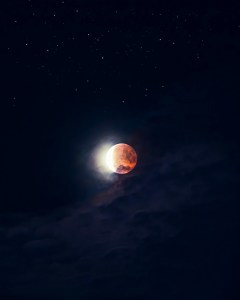
North America will have a blood worm moon this week. Here’s how you can see it

Late Thursday night or Friday early morning, North Americans with clear skies can look up to see a full moon with a beautiful reddish hue. 

What to know about March’s full “Blood Worm Moon,” a total lunar eclipse

March’s full moon, known as the Worm Moon, will pass into Earth’s shadow on the night of March 13, or early on March 14, depending on the time zone, according to NASA. This eclipse will be visible from Earth’s Western Hemisphere.

While the peak of the eclipse will happen in the middle of the night (my time, at least), we should be able to see the event begin as the red(dish) moon rises around 7pm. 

Why red? The color can vary based on the Moon’s path and the Earth’s atmosphere. The shade is measured on the Danjon Scale, which is a thing I hadn’t heard of but absolutely needed to know!

Danjon Scale of Lunar Eclipse Brightness

Earth’s atmosphere contains varying amounts of water (clouds, mist, precipitation) and solid particles (dust, organic debris, volcanic ash). This material filters and attenuates the sunlight before it’s refracted into the umbra. For instance, large or frequent volcanic eruptions dumping huge quantities of ash into the atmosphere are often followed by very dark, red eclipses for several years. Extensive cloud cover along Earth’s limb also tends to darken the eclipse by blocking sunlight. 

And for fun: Capri Sun Releases a Glow-in-the-Dark Moon Punch

Not fun but interesting: This week’s ‘blood moon’ eclipse mirrors one Christopher Columbus used to scare indigenous people in 1504

Enjoy. I’m hoping for an L3 on the Danjon scale!

* * *

Read Full Post »

Measles Is One Of The Most Contagious Diseases On Earth

Measles infection can result in severe and sometimes permanent complications including pneumonia, lung damage, brain damage, and death.

But unlike some infectious diseases, measles has a safe, effective vaccine that can protect us from infection.

We, the general public, can control measles outbreaks.

… [this bit’s for the grandparental units out there; stay healthy, folks!]

The first live measles virus vaccines—which are more effective—were available in 1969.

So anyone born between 1957–1968 may not have sufficient antibodies to avoid infection. Consult your doctor about immunization.

Many of our parents, grandparents, and other waybacks lived through a lot of difficult things: two world wars, the Great Depression, Spanish Influenza, polio, smallpox, or life before basic standards of health and safety, for example. (Coincidentally, today is also the anniversary of the declaration of the Covid pandemic. Because history may not repeat itself, but it does rhyme.)

If you’re fortunate enough to still have relatives who lived through those times, consider asking them what it was like, and who they lost.

You might hear some interesting stories.

* * *

Read Full Post »

You may remember in 2023 when I mentioned a five-planet parade in the skies, or in 2024 when six planets aligned

Fun sky news: this week we are in line for a parade of all seven planets!

When and how to view February planet alignment

Skywatchers will get a cosmic treat this week with a celestial gathering of planets.

A planetary alignment, or a “planet parade,” according to the internet, will grace our night sky just after dusk, according to SkyatNightMagazine. You can expect to see seven planets align Friday when Mercury joins Mars, Jupiter, Uranus, Neptune, Venus and Saturn.

Mercury, Venus, Jupiter, and Mars will be visible to the naked eye, but Saturn will be harder to spot low on the horizon, and you’ll need a telescope for Uranus and Neptune. Still, “every other world in our solar system will be visible among the stars at the same time — if you know where to look.”

“You really only have a few minutes after sunset to catch them before they drop below the horizon. After that, you’ll still be able to see Venus, Jupiter, and Mars clearly for a much longer time,” Dr Bloomer added.

I don’t have a telescope, and we often can’t see this kind of event because of city lights. 

Still cool!

* * *

Photo by Luke Stackpoole on Unsplash

Read Full Post »

Here’s a question: what if we flipped the whole “search for alien life” on its head and asked How Far Away Could We Detect… Ourselves?

A fledgling space-travelling civilization similar to ours may be out there somewhere in the Milky Way. Maybe they have their own fledgling SETI program, complete with radiotelescope arrays scanning the sky for the telltale signs of another technological civilization.

If there is, and if they do, from how far away could they detect our technosignatures? New research is asking that question.

Answer? Very far away!

Better check my work for typos again, because you never know who might see this! 😉

* * *

Photo by Maxim Hopman on Unsplash

Read Full Post »

Today is Pluto Day!

Lowell Observatory holds I Heart Pluto Festival

On Feb. 18, 1930, the young astronomer Clyde Tombaugh discovered Pluto, considered for decades a planet and “demoted” to dwarf planet status in 2008.

A few weeks later, an 11-year old girl named Venetia Burney suggested the name Pluto because of its connection to the god of the cold dark underworld.

This in-depth discussion of Pluto covers all sorts of interesting facts, including details of its discovery, how the New Horizons spacecraft gave us a much more detailed picture, and more. (Did you know that Pluto is half the size of the Moon but has five moons of its own? And someone who weighs 180 pounds on Earth would weigh 11 pounds on Pluto.)

What Makes Pluto So Intriguing | TIME

It takes Pluto slightly over 248 Earth years to orbit the sun, which means that on March 23, 2178, one Plutonian year will have elapsed since the dwarf planet was first spotted, on Feb. 18, 1930.

Here’s a cool animation showing our increasingly detailed understanding of Pluto:

And here’s an interactive image of Pluto 3D Model – NASA Solar System Exploration.

You’ll always be a planet to me, Pluto!

* * *

NASA/Johns Hopkins University Applied Physics Laboratory/Southwest Research Institute

Read Full Post »

Some days you realize that yes, we really are living in the future. Point in case:

Oxford Scientists Say They’ve Achieved Quantum Teleportation

Researchers at the University of Oxford say they’ve achieved quantum teleportation — stitching together separate quantum computers to run an algorithm collaboratively, across a distance, in a “breakthrough” they say could lead to powerful quantum supercomputers.

Still lots to do on the road to practicality, of course, but how cool is that?

* * *

Photo by Dynamic Wang on Unsplash

Read Full Post »

Ever wondered what it’s really like to be an astronaut? Do you wish you could ask someone all those burning space questions you’ve got in the back of your mind (and who doesn’t)?

Tomorrow is your lucky day!

Astronauts Are Streaming Live on Twitch—and You Can Talk to Them

This Wednesday evening, you’ll be able to join two astronauts—one of whom is in space right now—on a live stream from space and ask them questions about what it’s like to live and work on the ISS.

You can ask your very own question if you remember to tune in on Wednesday, February 12, at 11:45 a.m. EST (8:45 a.m. PST) on NASA’s Twitch channel.

I’m posting this now to give you time to prepare your best questions and to stock up on snacks like freeze dried ice cream, the weirdly addictive treat I’ve loved since childhood.

For fun, here’s an article on space food, even more on space food, and a sample menu from the International Space Station:

Why do typos matter? Ask the “cried apples”! Also, I am hungry now.

Apparently I’m interested in space food😉 No matter what space stuff you’re into, you’ve got a chance to ask about it tomorrow!

* * *

Not an astronaut, but fun all the same. Photo by Iván Díaz on Unsplash

Read Full Post »

What’s the Difference Between Asteroids, Comets and Meteors? We Asked a NASA Scientist

So, what’s the difference between asteroids, comets, and meteors? Well, asteroids are rocky, comets are icy, and meteors are much smaller and are the shooting stars that you see up in the sky.

* * *

Photo by Ken Cheung on Unsplash

Read Full Post »

What do Saturn, Venus, Neptune, Uranus, Jupiter and Mars all have in common? They’re all currently in alignment, at least from our Earthly perspective.

6 planets aligning in night sky will get even better in February

Venus, Saturn and Neptune will be bunched together low in the southwestern sky, while Mars, Jupiter and Uranus will glow higher in the southern sky.

One trick for finding the planets is to look for how they shine. Stars appear to twinkle while planets do not, making it easier to pick out planets in a star-studded sky.

Weather and light pollution permitting, four of these planets will be visible to the naked eye. Pretty cool!

* * *

Photo by Zelch Csaba on Pexels.com

Read Full Post »

« Newer Posts - Older Posts »