Feeds:
Posts
Comments

Posts Tagged ‘science’

It’s been just over two years since the Perseverance rover began its quest on Mars. What’s it been up to? A lot, but this article has a summary and link to the whole of its adventure (so far) distilled into a time-lapse video.

Follow Perseverance on Its Mars Journey With This Two-Year Timelapse – Universe Today

The rover has now traveled almost 15 km (9 miles). In addition to studying numerous rocks, it has also collected and stowed away 18 sample containers of rocks, regolith, and even the Martian atmosphere, to be gathered later and brought to Earth in a future Mars Sample Return mission.

For more cool stuff like a Mars photo booth, check out NASA’s Perseverance’s Highlights and Dr. Sunanda Sharma’s talk about Perseverance- Two Years on Mars.

* * *

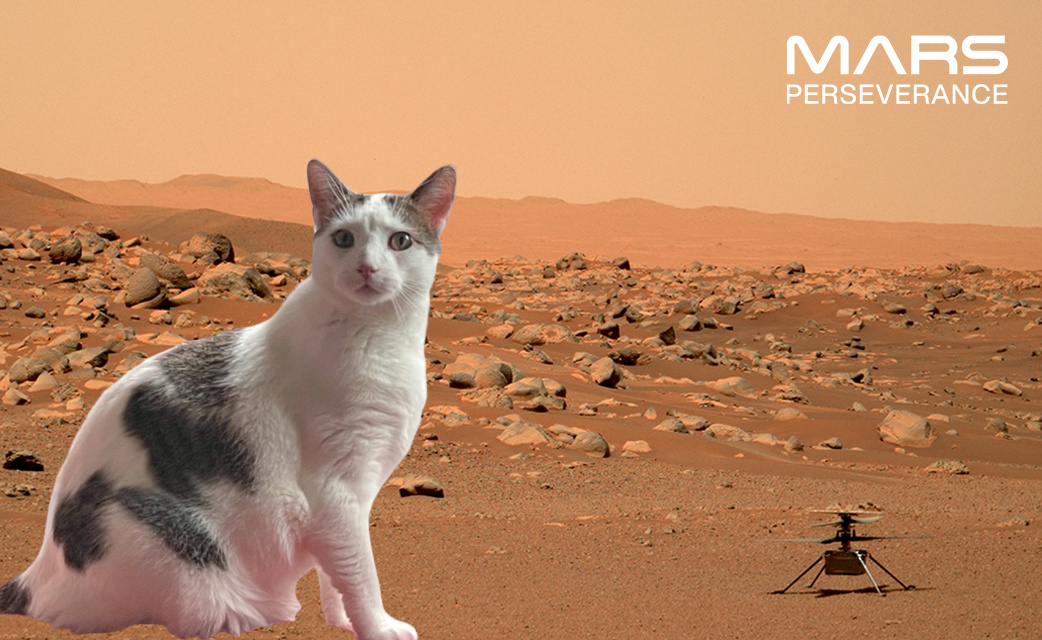
Chewie on Mars: “What do you mean, this isn’t a new chew toy?”

Read Full Post »

If you are going shopping this weekend, you might find this information useful. If nothing else, it will give you something to consider as the checkout lines to either side of you whoosh on by.

Bill Hammack the engineerguy.com

* * *

Photo by Mario Purisic on Unsplash

Read Full Post »

Inquiring minds want to know!

* * *

Photo by Laurent Grattepanche on Unsplash

Read Full Post »

Let’s give one last shoutout to our visitor from outer space. C/2022 E3 (ZTF), the universe’s charismatic invitation to look up and wonder about our past and our future, is at its closest point to Earth today. That means it will be at its brightest. If the world and weather are on your side, you might be able to see it with the naked eye. Look to the north after sunset. Is it fuzzy? Is it green? It might just be a comet!

Green comet C-2022 E3 (ZTF) will be closest to Earth today | Space

During the comet’s perigee, it will come to within a distance of around 26 million miles (42 million kilometers) from our planet, which is equivalent to about 28% of the distance between Earth and the sun. If you’ve been waiting to get a look at C/2022 E3 (ZTF) before it speeds away, now is your best chance. You can also watch the comet live online on Feb. 1 in a free webcast at 11 p.m. EST (0400 GMT) from the Virtual Telescope Project.

If the weather isn’t cooperating where you are or you have a hard time finding it or you just can’t see yourself outside in the cold, there will be a live webcast tonight. Pour a cup of hot cocoa and wave as The Green Comet flies by!

* * *

Photo by Junseong Lee on Unsplash

Read Full Post »

My mother, ever curious, wanted to know what all the “green comet” fuss is about. Here’s a quick guide to C/2022 E3 (ZTF), a visitor last welcomed to these parts by Neanderthals.

A lot has changed since then!

* * *

See a rare green comet closest to the sun on Jan. 12 in livestream | Space

NASA’s Jet Propulsion Labs (NASA JPL) gives the period of this comet as 50,000 years. This means the last time the orbit of C/2022 E3 (ZTF) brought it so close to the Earth, our planet was in the midst of the last glacial period or “ice age” and early Homo sapiens and Neanderthals still shared the planet.

Pretty pictures: A dazzling green comet has stargazers thrilled in amazing photos | Space.

How to Watch the Green Comet During the New Moon – The New York Times

Comets are clumps of dust and frozen gases, sometimes described by astronomers as “dirty snowballs.”… 

“They’re alive,” Laurence O’Rourke, an astronomer with the European Space Agency, said. “When they’re far from the sun, they’re sleeping, and when they get close to the sun, they wake up.”

[Nothing to worry about then. It’s fine!]

To catch the comet, look north.

On Jan. 21, the night of the new moon and thus the darkest skies, the comet will be close to Draco — the dragon-shaped constellation that runs between the Big Dipper and the Little Dipper.

Over the following nights, the comet will creep along the dragon’s tail. And on Jan. 30, the comet will reside directly between the Big Dipper’s “cup” and Polaris, the North Star. If you’re accustomed to finding the North Star by following the two stars on the end of the Big Dipper’s cup, then you should be able to spot the comet. Simply scan that imaginary line until you see a faint smudge.

For anyone living above the 35th parallel — imagine a curving East-West line running from North Carolina through the Texas Panhandle out to Southern California — the comet will be visible all night starting Jan. 22.

So C/2022 E3 (ZTF) is going to be visible for a while, but you might need binoculars. What did the Neanderthals think of it and its dramatic green halo, I wonder? 

* * *

Photo by Huper by Joshua Earle on Unsplash

Read Full Post »

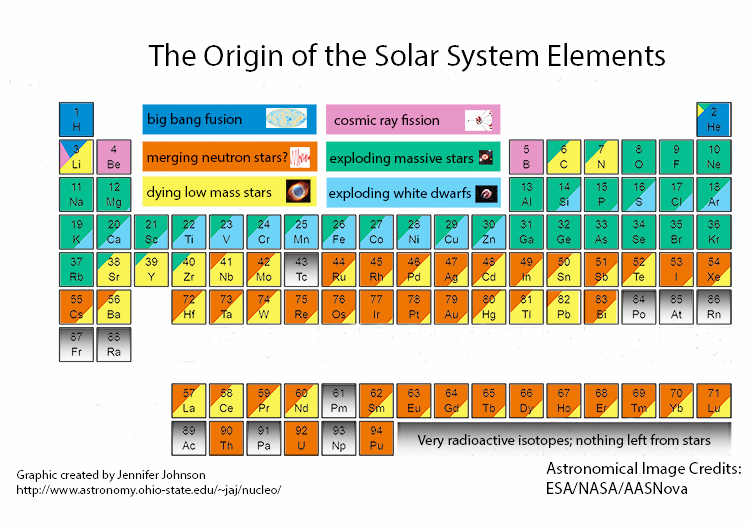
A recent NASA Astronomy Picture of the Day featured an excellent version of the Periodic Table highlighting not just elements, but also those elements’ origins.

The hydrogen in your body, present in every molecule of water, came from the Big Bang. There are no other appreciable sources of hydrogen in the universe. The carbon in your body was made by nuclear fusion in the interior of stars, as was the oxygen. Much of the iron in your body was made during supernovas of stars that occurred long ago and far away. The gold in your jewelry was likely made from neutron stars during collisions that may have been visible as short-duration gamma-ray bursts or gravitational wave events…

— Astronomy Picture of the Day
Origin of the Elements in the Solar System by Jennifer Johnson is licensed under a Creative Commons Attribution-ShareAlike 4.0 International License.

And the fact that the author and I share a name? An astronomical coincidence.

* * *

Photo by Franco Antonio Giovanella on Unsplash

Read Full Post »

For those of us in the Northern Hemisphere, today marks the shortest day of the year.

December Solstice

The December solstice is the moment the Sun is directly above the Tropic of Capricorn in the Southern Hemisphere. This is the southernmost latitude it reaches during the year. After the solstice, it begins moving north again.

Today is also technically the start of winter, although the fifteen inches of snow in our front yard this past week would beg to differ.

Between that and predictions of another big storm in the offing, it’s no wonder Santa is so determined to make his annual road trip.

* * *

Photo by Tatiana Colhoun on Unsplash

Read Full Post »

Today has been all about dealing with tech issues. Along those lines:

Watch an egg fall from near space...

A former NASA engineer and now-YouTuber has created a viral sensation with a video documenting efforts to send an egg to near space to test if it cracks up on landing.

Because sure, why not?

* * *

Photo by 青 晨 on Unsplash

Read Full Post »

Explore the wondrous interconnectivity of life with this interactive graphic:

OneZoom Tree of Life Explorer

An interactive map of the evolutionary links between all living things known to science. Discover your favourites, see which species are under threat, and be amazed by the diversity of life on earth.

How small the selection we have today, and how precious.

* * *

Photo by Johannes Plenio on Pexels.com

Read Full Post »

The Artemis moon mission is now underway, which means fun updates like this video flyby of the Moon.

… NASA’s Orion spacecraft performs a close approach of the lunar surface on its way to a distant retrograde orbit, a highly stable orbit thousands of miles beyond the Moon. During the Artemis I flight test, launched on Nov. 16, Orion will travel 280,000 miles (450,000 km) from Earth and 40,000 miles (64,000 km) beyond the far side of the Moon, carrying science and technology payloads to expand our understanding of lunar science, technology developments, and deep space radiation.

— Artemis I Close Flyby of the Moon – YouTube

Check out Orion’s location with the Artemis Real-time Orbit Website: NASA: Artemis I.

* * *

Photo by Hebert Santos

Read Full Post »

« Newer Posts - Older Posts »