I don’t know about you but I am more than ready for Spring.
Most of my family is south of the border, and they keep talking about things like 60℉ weather and unfrozen soil and flowers. Crazy talk!
We still have a patch of snow out front but today might be the day it finally disappears. So as one last goodbye to winter, let’s visit the world’s largest ice carousel, in Lappajärvi, Finland.
For all the nitty gritty details, check out this in-depth video:
Go for 30,000 tons of spinning ice, stay for the custom cutting rigs, mad scientist stuff, and awesome accents. It took days, and is an impressive testament to the lengths people will go to in order to escape the winter doldrums;)
Planning to try this next year? Safety first, of course, but here’s a how to.
I feel for his family and for those he led. His loss will reverberate throughout the community. And yes, I also feel some personal sorrow. His restaurant is lovely, and going there always felt a bit like coming home.
* * *
I met Chef Chartrand once or twice in person, but mostly I knew him through his food, and through the warmth and care that showed in his restaurant.
L’Orée du Bois is located in a converted century-old farmhouse, and the dining areas are cozy rooms with exposed wood and windows that overlook the garden, the smoke house, the patio, and the forest.
They added a timbered patio we haven’t been able to try yet, and lined the path through the forest beyond the herb garden with benches, lights, and a fire pit.
It might be odd to say because I’m an American English speaker with roots far from here, but everything about this French Canadian restaurant suits me. I’ll be honest, it was one of the things that convinced me that I could make this new country a home. That I would fit here.
Because to me, that Québécois restaurant at the wooded edge of Gatineau Park, anchoring this southerly edge of our neighboring province, is perfect.
* * *
L’Orée du Bois is the place we go when we want to celebrate, or take visitors out for a dinner that is both special and comfortable.
The food is inventive, delicious, often surprising and frequently local. It is the type of establishment where wine pairings are spot on, the staff are thoughtful and friendly, maple pops up on the menu with reassuring regularity, and typical haute cuisine rules about avoiding ingredient or menu substitutions are meant to be broken.
My kind of place.
Many of the ingredients are sourced from local producers. Admire a hand thrown butter dish? Enjoy the mushroom medley or the red deer medallion or the fiddleheads? Chances are good that it was made or farmed or harvested nearby. I didn’t know Chef Chartrand, but it was clear he cared about his community.
* * *
When my mother came to visit, we took her there. Chef Chartrand came out to the dining room to speak with us, making sure that everything was good and that we were happy, then stayed to chat a bit under a framed chef’s hat signed by Justin Trudeau and his family. My mother is hard of hearing, and restaurants can be awkward places to talk. The chef was kind and thoughtful and helped make her evening special.
The last time we took my father (he has been several times) we were given a tour of the kitchen, the wine cellar, and sent home with a selection of handmade chocolates.
L’Orée is where Mr. Man took me the first time we visited Ottawa, even before we started talking seriously about moving here. It’s where we went after we bought our house. When I became a Canadian citizen. And the day we married, we took pictures in the herb garden out front while waiting for our table.
Thinking we should expand our horizons, we tried other restaurants, but always came back. The alternatives were always… something. Too crowded, too cold, too bright, too self-important, too self-consciously avant-garde. Too much something, and not enough L’Orée du Bois.
We always went back.
* * *
As the pandemic took hold and lockdowns began to stretch from weeks into months, we worried that the restaurant might not make it. When they opened for takeout, we went as often as we could. Celebrating the holidays without family this year, we ordered bag after bag of take-out to get us through the season.
Smiling staff handed out hot mulled wine as we waited for our pickup. It’s that kind of place.
* * *
Information on Chef Chartrand is limited but the announcement mentioned that a staff member tested positive for Covid-19. Just days later, Chartrand was gone.
Jean-Claude Chartrand, the celebrated chef and co-owner of L’Orée du Bois, has died, just days after a worker at his much-loved West Quebec restaurant tested positive for COVID-19.
After almost a week and an estimated $60 billion in lost trade, the Ever Given has finally been freed from its unplanned docking site in the Suez Canal. What’s next for this disruptive container ship? Imagine it anywhere in the world with this nifty new map adaptation.*
For today, I give you this highly-personalized, certainly particular list of #ThingsIKnowForSure:
Creativity is what’s important, not how or why or when you do it.
I eat less when I can taste more.
My garden deserves better.
Summer is a montage of awkwardly-placed mosquito bites. Still worth it.
The world needs a better brand of catnip.
Sometimes figuring things out is a matter of a good book and a long afternoon. If that doesn’t work, try a walk. Or a stiff drink.
That thing you don’t want to do is probably exactly what you should do (sorry!)
Sometimes a day just needs a thunderstorm.
Tonic and lemonade are good together. Also gin.
Some days there are just too many choices.
Touch ID hates me.
Sometimes you actually do need that ancient laptop you stashed in the closet.
A good book makes any day better.
I’m pretty much done letting other people define what’s “good” 🙂
Star Wars is the best movie ever (#1, now renamed #4 like a child whose parents changed their mind when she was ten years old. Who does that?)
Lord of the Rings is the best book ever. Even though I don’t read it every year (anymore), the effect it had on my life means that it will remain The Best Book Ever for always and ever and ever.
Kittens are hard to catch.
* * *
Can’t go wrong with a kitten, right? Photo by Henda Watani on Pexels.com
(Being me, I couldn’t resist a Hobbit reference, but this post is about migratory birds in general. No Goblins allowed!)
* * *
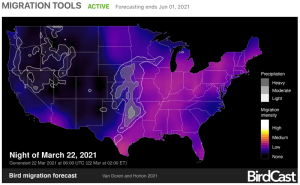
We’ve still got two feet of snow on the lawn but the signs of Spring are everywhere. Melting ice, the smell of skunk in the night, and Canadian teenagers in shorts and T-shirts (it is above freezing, after all). And soon, the birds will be back. Last evening I heard a flock of Canada geese heading for the river, and they aren’t the only avian adventurers heading our way.
If you are interested in the when and where of bird migrations, you’re in luck. From now through the end of May you can track migration forecasts, get location-based alerts, and learn more about what’s happening in Birdlandia.
And as for those eagles, and other birds of prey? Check out this story about a suffragist and bird lover who established Pennsylvania’s Hawk Mountain Sanctuary in 1934. It’s an incredible place, and is why I am lucky enough to know what it’s like to watch from the edge of a stone outcropping while hawks ride the thermals mere feet away.
The abundance of raptors at North Lookout owes a great deal to topography and wind currents, both of which funnel birds toward the ridgeline. But it owes even more to an extraordinary activist named Rosalie Edge, a wealthy Manhattan suffragist who founded Hawk Mountain Sanctuary in 1934. Hawk Mountain, believed to be the world’s first refuge for birds of prey, is a testament to Edge’s passion for birds—and to her enthusiasm for challenging the conservation establishment. Bold and impossible to ignore, she was described by a close colleague as “the only honest, unselfish, indomitable hellcat in the history of conservation.”
(adapted from The New York Times Large Type Cookbook)
Notes from my father: Here’s the best story I have about this recipe; this happened at Hawk Mountain. We were there to see the raptor migrations in October. We were camping at a nearby state park and it was freezing, in fact it snowed. We were cooking chakchouka for 4 in a big pan over a Coleman stove. Right near the end of the cooking we picked up the pan to serve everyone and it tipped and spilled a large part of dinner into the dirt. You two were off running around in the woods somewhere, so we both looked at each other and then at dinner in the dirt, looked back at each other, then brushed the dirt off and put it all back in the pan. It was actually still pretty good. You know in statistics “robustness” means that you can violate the rules a lot and the results still hold, so you could say that this is a very robust recipe.
3 links Italian sweet sausage, cut into 1-inch pieces
2 Tbs. olive oil
2 onions, finely chopped
2 cloves garlic, minced
1 green pepper, diced
1 tomato, diced
2 potatoes, diced
1 cup water
Salt and pepper
3 eggs, lightly beaten
Sauté sausage pieces in a large skillet until browned.
Add olive oil, onions and garlic and cook 3 minutes.
Add green pepper, tomato and potatoes and cook 2 minutes longer.
Add water and allow mixture to simmer, uncovered until potato is tender. Season with salt and pepper.
Stir in eggs and continue to cook, stirring, until eggs are done, about 2 minutes. Garnish as desired.
“Please bear in mind that Somaliland has no Postal Service”
Think about that.
Forget complaints about the cost of stamps rising by however many cents, or the extra day it took for your first class letter to reach Hawai’i. There are places on Earth with no postal service at all.
Want to mail a letter? Too bad. Want to send in your rent or mail tax forms or vote? Sorry. And if you want to do something crazy like send in a patent application or submit to Fantasy & Science Fiction, you are out of luck.
“Talent is equally distributed, opportunity is not.”
Even beyond the immediate usefulness, I find the concept of a system that ties us all together inspiring. Sure, the internet is obviously taking up a lot of that space (in ways both good and bad) but I also believe that there is also real value in its physical equivalent.
I mean, Owl Post is great and all, but consider the Muggles.
My little brother just got his first shot. I can’t tell you how happy I am that he and his wife are one step closer to full protection.
As discussed in many venues in recent months,* the path to the Covid-19 vaccines has been convoluted. And not only does our health and safety rest on the shoulders of scientists who spent most of their careers in under-rewarded obscurity** but the history of vaccines is even more complicated than it may at first seem.
* * *
The past year has been a nightmare, but I am incredibly grateful that we haven’t had to deal with a disease like, say, smallpox. Wildly contagious with a fatality rate of about thirty percent, for most of human history this disease was unstoppable. It spread within communities and also, devastatingly, between locations (like 17th century Europe and North America).
Thanks to a concerted international effort and global vaccination campaign, by 1980 smallpox was eventually eradicated. Thank you, science! And now we’re tackling our own pandemic with the power of vaccination. How did we get here?
* * *
The history of vaccination usually starts something like this:
One of the first methods for controlling smallpox was variolation, a process named after the virus that causes smallpox (variola virus)… The basis for vaccination began in 1796 when the English doctor Edward Jenner noticed that milkmaids who had gotten cowpox were protected from smallpox. Jenner also knew about variolation and guessed that exposure to cowpox could be used to protect against smallpox.
What caught my eye about this bit in particular was “variolation.” Who, I wondered, was behind the initial work? I’m always interested in the beginnings of things. Who worked out how to eat a poisonous plant like cassava, for example? In this case, where did the idea of inoculation come from? What of the giants on whose shoulders we stand?
Practitioners in Asia worked out the method, and by the 1700s it had spread to Africa, India and the Ottoman Empire. Next stop, North America, by way of the slave trade.*** Here’s a version of that story in graphic form:
At the same time, a smallpox epidemic devastated England. An English Lady (yep, capital L), Lady Mary Wortley Montagu, brought information about inoculation back with her from the Ottoman Empire, where female medical professionals practiced a variation of the technique:
Unfortunately, “European doctors were aware of what the Ottomans and others were doing but they refused to believe it worked. At the time, “Europe was pretty isolated and it was fairly xenophobic”…”
Lady Mary’s efforts came up against (stop me if you’ve heard this one) prejudice, xenophobia, and the perverse financial incentives of the medical profession.
“I am patriot enough to take the pains to bring this useful invention into fashion in England.” But in the next breath, she expressed contempt for British doctors, who she believed were too preoccupied with making money: “I should not fail to write to some of our doctors very particularly about it, if I knew any one of them that I thought had virtue enough to destroy such a considerable branch of their revenue, for the good of mankind.”
— Lady Mary Wortley Montagu
Even so, she had a positive impact, not least on one particular individual:
…the technique she’d borrowed from Ottoman women did take hold in England. Many thousands were inoculated, including a young boy named Edward Jenner. He went on to develop the first vaccine, also against smallpox.
So here’s to the unsung heroes who took the first steps into the unknown, the practitioners lost to history, and those who passed their knowledge down in the hopes that we would use it to build something better, like the slave who shared what he knew and the aristocrat who used her status for good.
“One takeaway for everyone, whether it be scientists or nonscientists, is that we’re not nearly as smart as we think we are,” he says. “We have much we can learn from others.”
** That really should change, and I hope the Nobel Prize Committee agrees with me. Katalin Karikó, Ugur Sahin and Ozlem Tureci in particular come to mind.
*** No, I’m not happy about this either, but I am very grateful that Onesimus was willing to share.
There are a lot of ways to write, and a lot of types of writing. Fiction alone comes in novels, of course, but also novellas, novelettes, short stories, screenplays, etc. I happen to have a soft spot for the drabble.
A drabble is a piece of fiction that is exactly 100 words long, excluding title. Explore the history of it at that link if you like, but for me the important part is the constraint.
One hundred words, no more, no less.
It’s an easy number of words to produce, of course, but there’s something I find so satisfying about trying to build a story within the confines of such a concrete target. The limits inspire creativity, make finishing feel not only possible but inevitable, and provide a sandbox to play in, if you will.
It’s also a terrific way to dip your toes in the rapids of fiction. My first two publications were drabbles (thanks, Luna Station Quarterly!):
I was sixteen when I found the receipt. My receipt.
“What the hell, Dad?”
The paper was old and faded, one tattered corner poking from a manila folder marked “Family Records.” There were maybe ten lines on the page, with a stamp at the top that read “Beta: Final Sale.”
Dad shrugged, like it was no big deal.
“Are you pissed that you’re a bot, or that you didn’t cost more?”
It’s been a good Saturday morning, even with all the usual laundry and smoothie and house stuff on the menu. I’m getting things done but still had the feeling at the back of my mind that I should be doing more, making better use of my time by… something. My mind was a maelstrom of possibility, alive with whatever idea caught my attention in that moment.
Would I be a better me, I wondered, if I were more focused?
It’s a version of what’s called “time anxiety,” the feeling that there’s never enough time, or that you aren’t making the most of the time you have.
“Am I creating the greatest amount of value with my life that I can? Will I feel, when it comes my time to die, that I spent too much of my time frivolously?”
This clock is definitely judging me. Photo by Krivec Ales on Pexels.com
* * *
But between “Getting started with Arduino” and finding the date for the announcement of the Nebula Award finalists (March 15th fyi), I came across a Nancy Kress short story that spoke directly to the moment.
It’s a great story, full of concrete science with well-structured ideas that still have heart. It’s also something of a cautionary tale, but I often like those because they are like signposts from the future, showing us what to be aware of, and what not to do. (Such stories are also safe, because you leave the bad things behind when you finish the story. I like that part too.)
If I had to summarize the core theme of this story in just a few words? Nature abhors a cheat code.*
So you know what? I’m going to take a breath, step back, and enjoy the weekend. Learn, read, build, bake, clean, think, and otherwise do. Here’s to making the most best of the day.
* * *
A human being should be able to change a diaper, plan an invasion, butcher a hog, conn a ship, design a building, write a sonnet, balance accounts, build a wall, set a bone, comfort the dying, take orders, give orders, cooperate, act alone, solve equations, analyze a new problem, pitch manure, program a computer, cook a tasty meal, fight efficiently, die gallantly. Specialization is for insects.
— Robert A. Heinlein, Time Enough for Love
* * *
* Technically, it might be more precise to say that “no cheat code goes unpunished” or “be careful what you wish for,” but I liked the image of Nature in the background shaking her head as she pressed the “fine, you asked for it” button;)
Today was crazy in many ways, but! We finally got to spend a little time with a close friend we haven’t seen in ages (outside, safe and socially distanced, of course) and that was great.
Stay strong, people, we’re so close now. Better days are coming!













You must be logged in to post a comment.