Feeds:
Posts
Comments

Posts Tagged ‘creativity’

What draws a reader into a book? What breaks their connection with the material world and plugs the brain into an alternative dimension? Sure, cover design, a known author and positive publicity blurbs all have something to do with it, but as speculative fictioneer William Gibson argues in The Atlantic, the first sentence is what invites you in.

The First Sentence Is a Handshake – The Atlantic

For William Gibson, author of The Peripheral, a kind of invitation is extended—and readers will or won’t feel what he calls “the click.” But it’s not just about connecting with an audience. In a conversation for this series, Gibson explained how first sentences invite the writer, too: they contain a blueprint for the book that will be written.

I don’t write the way Gibson does, laboring over the first line until it is worthy of the effort the rest of the book will take, but I do go back to it and rewrite. Ahem. A lot.

The article is full of interesting thoughts from the man who coined the term “cyberspace.” For more on Gibson’s method, his views on the proper balance between mystery and clarity, and a discussion of his newest book, The Peripheral, check out the full article at The Atlantic.

Read Full Post »

After my post last week about Isaac Asimov’s ideas on, well, ideas, a friend sent me a great link on creativity. It’s over at Kim Manley Ort’s blog and is a nice introduction to Twyla Tharp’s 2006 book, The Creative Habit: Learn It and Use It for Life.

As one of America’s preeminent choreographers with more than half a century of creative experience, Tharp has a handle on how to channel the muse. The post introduces Tharp’s thoughts on creativity, how to call it, how to harness it and where to ride it when you do. Not all of her lessons may apply to you but most of it can be translated from person to person, and discipline to discipline. The fact that her chosen form of communication is dance does not mean that her advice is necessarily less relevant for those of us who write.

I found her thoughts insightful; I hope you do too.

* * *

Read Full Post »

Mary Robinette Kowal, that font of wisdom and Regency fashion tips, has a nice column on bad writing advice.

There’s a bunch of aphorisms about writing that started as good, pithy advice in part of someone’s lecture. Then they got pulled out of context and then misapplied.

Mary breaks down the standards that every beginning writer hears and talks about what they really mean, and when they are useful (spoiler: not always!). Write what you know, show don’t tell, raise the stakes, and kill your darlings, all so often repeated as gospel.

If you’ve ever tried to merge the advice to “write what you know” with the burning desire to write about Martian ballerinas and the prospectors who love them, well, fellow speculators, this is for you.

/totally going off to write a story about Martian ballet… right after I finish my novel!

Read Full Post »


Like many of you I’m doing NaNoWriMo and as such I am more than usually interested in questions of creativity and how to help it along. The following is from an essay in MIT’s Technology Review by Isaac Asimov, in which he asks that most fundamental of questions, “How Do People Get New Ideas?

… what is needed is not only people with a good background in a particular field, but also people capable of making a connection between item 1 and item 2 which might not ordinarily seem connected… Making the cross-connection requires a certain daring.

And so to you I say (with a nod to Theodore Roosevelt), dare greatly!

Read Full Post »

I haven’t posted anything about National Novel Writing Month this year because I hadn’t quite decided whether or not to do it. I’m busy, I said. I’ve already proven I can churn out 50,000 words in thirty days, I said. I can do it when I’m happy. I can do it when I’m busy. I can do it when I’m sick. (I am, in fact, something of a freaking Dr. Seuss when it comes to NaNoWriMo.) Do I really need to prove that I can do it again? Would my time be better spent finding a new way to expand my writing experience?

Well, no. That’s what I decided. And when I committed to finding a new way to make the most of my 50,000 words this November, I had a mini breakthrough. Work on one thing, I told myself. Well, ok, work on 50,000 words and one other thing. That’s it. Practice high levels of word production while learning how to do better at *X* and see how that goes.

Turns out it’s going pretty well.

I’m traveling, and finding time to get my word count in has been a challenge. That’s ok. In fact, that’s a great part of this lesson. It is in fact possible to cram in that last 350 words in the ten minutes before dinner. Doing it while also remembering to focus on maximizing the conflict between your characters?

Priceless:)

Happy National Novel Writing Month, all!


Until one is committed, there is hesitancy, the chance to draw back, always ineffectiveness. Concerning all acts of initiative (and creation), there is one elementary truth that ignorance of which kills countless ideas and splendid plans: that the moment one definitely commits oneself, then Providence moves too… Whatever you can do, or dream you can do, begin it. Boldness has genius, power, and magic in it. Begin it now.

― William Hutchison Murray

Read Full Post »

via io9, a call for creative new ways to get the heck off this rock:
The White House Office of Science and Technology Policy is planning ahead — way ahead. The agency wants you to email ideas for how “the Administration, the private sector, philanthropists, the research community and storytellers” can develop “massless” space exploration and a robust civilization beyond Earth.
Tell me that this challenge isn’t exactly in our wheelhouse, people. Hard sci-fi writers, mechanical and other engineers, and practical dreamers of all stripes, your skills are needed!

Read Full Post »

If you’ve ever wondered how master writer James Ellroy puts together a dark, twisting crime novel, or plots stories as deliciously complex as L.A. Confidential, wonder no more.

“I’m a romantic, I love the big challenge and I’m gonna give it to you.”

This Fast Company article by Joe Berkowitz discusses Ellroy’s style (right now), his process (research, let it simmer, then go big, really big), and finally, bring it all together in a tight-packed ending. Enjoy!

Read Full Post »

The excellent Elizabeth Bear has a good post on how to get past “rave rejections.” You know the ones, where they tell you how great the story is but sorry, can’t use it.

Her advice? Focus on Voice and Narrative. While these suggestions are hardly new she does frame them in concise, useful language that cuts through the extensive “how to” checklists so often found in writing advice. Here she is on how to grow a voice:

Write a lot. Work at identifying and expunging cliches and lazy word choice from your prose. Find sharp verbs and strong, observed details. Read things out loud and if you don’t like how they sound, change them. Embrace whimsy and quirkiness, but only inasmuch as it is natural to you: otherwise you run the risk of becoming twee. Play with pastiche. If you have a natural wit, let it shine through. Be playful.

On narrative drive and creating characters readers care about:

A character who loves something, or who holds fast to an ideal, is humanized and becomes approachable. A character who takes action lures us unto caring about what she cares about.

We love people who fight.

It’s a great post, short, approachable, with a “manageable bite-sized helpful chunk” of useful information. Also, bonus points for using a funny video of David Bowie to make her case.

Read Full Post »

So I’m chatting with my mother and somehow the topic of her graduate work comes up. Next thing I know we’re discussing linguistics, theories of form, elegance as a measure of validity, and how it’s possible to learn a language in a weekend (if you’re awesome, like my mom).

Not that I needed it with her, but it was a great reminder that everyone is interesting, everyone is complex and multi-layered and experienced in some way. Given the press of time and the tyranny of labels, it can be too easy to let this drift to the background. Mother, neighbor, mail carrier, teacher, gas station attendant. They are these things, yes. And much more.

Liking a person has less to do with it than you might think. The man who throws a huge stack of newspaper advertising against my front door every week, where it lands with a loud bang? His limp tells me he may not just be doing it to be annoying.

Everyone has a story. It’s important not to forget it, especially if you are a writer.

Pay attention. It’s all about paying attention. Attention is vitality. It connects you with others. It makes you eager. Stay eager.”
― Susan Sontag

Read Full Post »

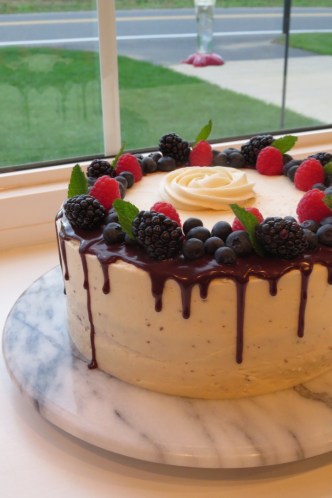
Every year I make a cake for my birthday. This year I decided it was time to try tiered layers, plus butterflies, fondant flowers, pearls and gold dust (those last all technically edible but we know better; save your taste buds for the good stuff). What you see here are two 9″ layers supporting two 6″ layers, all in chocolate with a ridiculously decadent Grand Marnier frosting. Delicious!

Cake2014

/not a lie:) Also, what better fuel for writing than cake?

Read Full Post »

« Newer Posts - Older Posts »