Feeds:
Posts
Comments

Posts Tagged ‘environment’

Perhaps you remember me mentioning the submission call for this year’s Grist climate collection. Folks submitted (1200 of them!), editors did their editing thing, and now we have a brand new collection of free climate stories for 2025!

Here’s the full collection, including twelve new stories with the goal of looking “beyond the current moment to picture what could be.”

Imagine 2200 climate fiction contest: The 2025 collection – Grist

Welcome to the 2025 Imagine 2200: Climate Fiction for Future Ancestors collection. For four years, this contest has celebrated stories that invite us to imagine the future we want — futures in which climate solutions flourish and we all thrive. These stories have never pretended the path will be easy — some of the most compelling Imagine stories showcase the struggle as well as the successes — but they all offer the promise that through the transformative power of radical imagining, we can envision a better world and work toward making it our reality.

Yes, please!

* * *

Photo by Vitolda Klein on Unsplash

Read Full Post »

I don’t write screenplays, but perhaps you do? If so, consider this new grant from The Black List, the NRDC’s (Natural Resources Defense Council) Rewrite the Future program, The Redford Center, The CAA Foundation, and NBCUniversal.

That’s a lot of organizations getting behind climate storytelling. If you want in, here’s how!

2025 NRDC Climate Storytelling Fellowship | The Black List

We need it all–the bleak and the inspirational, the fantasies, dramas, comedies, and rom-coms. It is the power and privilege of writers to show us how climate change is transforming our world, and to help us find a path to salvation. This program aims to support well told stories with climate themes that entertain viewers and allow them to engage with the range of emotions caused by the climate crisis. 

Application deadline is December 05, 2024.

Even if you aren’t into screenplays or don’t want to navigate The Black List sign up/apply for a fee waiver process, you may want to check out the list of Writer’s Resources at the bottom of the description page.

Examples include the Sustainability Onscreen Tipsheet and The Last Laugh: Comedy in the Age of Climate Change.

Because whatever else happens, the future needs laughter.

* * *

Photo by Teja J on Pexels.com

Read Full Post »

Today’s question of the day: 

BBC World Service – The Climate Question, Can Science Fiction help us fight climate change?

The acclaimed US sci-fi author Kim Stanley Robinson is also a star in the world of climate activism because his work often features climate change – on Earth and beyond. Robinson has been a guest speaker at the COP climate summit, and novels such as The Ministry For The Future and The Mars Trilogy are admired by everyone from Barack Obama to former UN climate chief Christiana Figueres. 

Now, the answer to this question seems fairly self-evident to me. I see innovation as a conversation, in a way, between what is and what we can imagine will be. And fiction is excellent at helping us imagine new and better worlds.

Other examples of sci-fi ideas made real:

Ten Inventions Inspired by Science Fiction | Smithsonian

6 scientific innovations inspired by science fiction

10 ‘Star Trek’ Technologies That Actually Came True | HowStuffWorks

Look around you. What are our technological and social capabilities? What are our needs? And what do you think we’ll invent next?

* * *

Photo by Cody Dagg on Unsplash

Read Full Post »

Last year Mr Man and I drove north from Los Angeles. Our goal was San Francisco and points in between, but before we could get there we had to escape LA. Our hotel room faced south and had a view of the pool and a sliver of Hollywood Boulevard, but nothing that resembled nature. We plotted a course out of the city that took us north through the canyons and picked up a rental car. 

Heading into the hills, we drove through a landscape that, while studded with the bright flowers of a superbloom, revealed a checkerboard of green growth and canyons sliced into smaller and smaller segments. Hollywood, Beverly Hills, the 101 and the 405 frame the natural world in a rigid network of pavement.

How, I wondered, do animals without wings survive here? The answer is with difficulty.

There is, however, some good news on that front!

World’s largest wildlife bridge will help animals cross California highway – The Washington Post

The 10-lane freeway that slices through this part of Southern California is one of the busiest in the country, ushering more than 300,000 cars across the greater Los Angeles area every day.

For drivers, it’s a nightmare: This stretch of Highway 101 is known as the “highway from hell,” the infamous host of the nation’s worst commutes.

But if the 101 is bothersome for bipeds, it is downright disastrous for the wildlife that also calls the region home. The 101 cuts like a chain saw through a vibrant natural ecosystem of coastal sage scrub and oak trees interspersed with suburban neighborhoods, disrupting the movement of animals and threatening their survival.

Now a massive infrastructure project is underway to suture together the vast tracts of fragmented wildlife habitat that have been separated by the highway for decades. Construction on a key phase of the Wallis Annenberg Wildlife Crossing — a $100 million structure funded by a mix of public and private money — began last month and is expected to open in early 2026.

One thing the article doesn’t get into is the fact that wildlife crossings, while not cheap to build, actually save money and lives. 

Earth Day Success Story: Wildlife Crossings Keep Animals and People Safe – Newsweek

“They are a cost-effective way of addressing the problem from the human side,” she said, pointing out the human toll from collision deaths, injuries and damage to vehicles. “We’ve got structures in the western states where they pay for themselves in less than five years.”

Like, A Lot of money, and A Lot of lives, both animal and human. It’s also not just a problem in highly urbanized landscapes like LA.

Animal crossings over and under highways can save big dollars — not just lives — says new study

WSDOT published a report of its own earlier this year on the benefits of wildlife crossings for road safety. Aside from matters of life and death, WSDOT estimated the average vehicle-deer collision resulted in economic costs of $9,175. Hitting an elk ballooned the average cost per collision to $24,242 and a moose even more, $42,652 per collision.

The good news is that California isn’t the only one getting in on this party. They’re actually a little late to the game. Canada pioneered wildlife overpasses two decades ago, and the idea has spread around the world.

The story of Canada’s pioneering adventures in overpasses for non-humans: As Banff’s famed wildlife overpasses turn 20, the world looks to Canada for conservation inspiration.

Fancy study with many long paragraphs and detailed mitigation case studies but here’s the really interesting bit: It can actually cost less to build a crossing than to do nothing. As an example, it’s estimated that the annual cost of animal collisions at $232 million (in 2021 dollars, which is like a million bajillion now).

And finally, here’s a page with a handy chart summarizing the average “Direct monetary costs of ungulate-vehicle collisions” (as a Pennsylvanian/Canadian I know such collisions are a big deal, but it’s even more dramatic to see the difference between the cost of hitting a deer ($6,617 and a moose $30,760 (in 2007 dollars, no less)!)

In conclusion, I love the idea of animal crossings for a number of reasons. Not only does it save animals and ecosystems while costing less in the long term, it also safeguards people. I love solutions that are smart, sensible, and just make sense.

Win win!

* * *

Photo by Tor Stryger on Unsplash

Read Full Post »

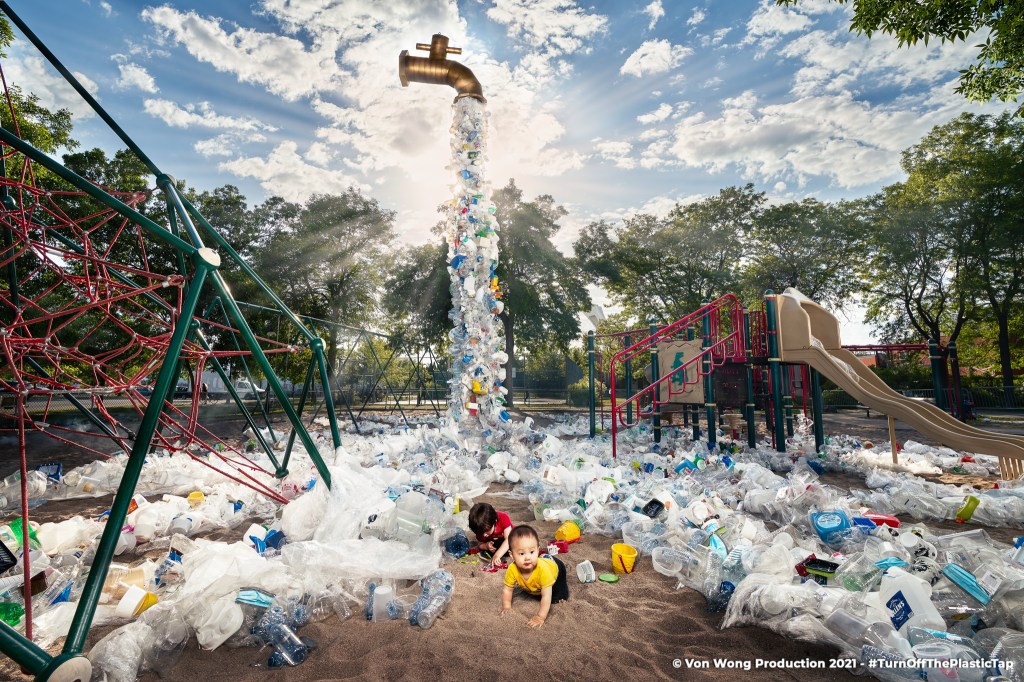
You know how sometimes you see a thing and it sets off little creative sparkles in your brain parts? Well, that’s what happened when I spotted this striking piece of art:

©Von Wong Production 2021 – http://www.TurnOffThePlasticTap.com

Giant “Faucet” Spewing Single-Use Plastic Urges Us To Reconsider Our Plastic Use

When I saw this my first thought (after “Ok, that’s insanely cool”) was “How can I do that? 

Lucky me (and you, if you’re so inclined), the artist has not only created this installation* but turned it into an interactive opportunity. Just as I was visualizing the steps needed to trim a tap like that and build a fountain of plastics, I spotted this:

If you are an artist or creative that would like to participate, join us in creating a remix of the Giant Plastic Tap

— This three story tall giant art installation is leaking plastics into different environments – Von Wong Blog 

Don’t mind if I do! If you want to join the fun, all files needed to remix your very own giant plastic tap are available here:

Remix the Giant Plastic Tap – Photoshop Challenge! – Dropbox Paper

Check out this post for more details on usage.

* * *

I’m practicing new photo processing techniques and thought this was a good place to start. Lots to learn (ugh, lighting and color balance! I was in a hurry, but still) and this challenge is a great way to do it.

Tap image ©Von Wong Production 2021 – http://www.TurnOffThePlasticTap.com, Photos by Jordan RowlandJeff Finley on Unsplash
Tap images ©Von Wong Production 2021 – http://www.TurnOffThePlasticTap.com, Photo by Danielle MacInnes on Unsplash

* Von Wong’s mind-bending original project was sponsored by the Embassy of Canada in France. Because Canadians are awesome. Every single one!

Read Full Post »

Oh, this is fun. If you have a little map, environment and/or geography geek streak, check out this interactive:

River Runner by Sam Learner

* * *

“Do unto those downstream as you would have those upstream do unto you.”

― Wendell Berry

When a raindrop falls, where does it go? If it falls on my hometown, it flows 390km to the Atlantic Ocean.

If it falls on the Denver Broncos’ Mile High 50-yard line, just east of the Continental Divide, the path to the Gulf of Mexico is 3862km!

Click a starting point and the site will calculate a route and then do a visual fly-over. I wish it covered places outside the US but it’s still a fun and impressive window into data from the always excellent USGS.*

* Ah, the USGS, font of so much maptitude! Wait, is that a volcano webcam? Stop browsing, woman, you have work to do! But remind me to tell you my volcano story someday:)

* * *

river running through a forested glade
Photo by Dave Hoefler on Unsplash

Read Full Post »