It’s snowing! It’s pretty! All is right with the world.
The past few weeks of above-freezing temperatures and no snow have been, for lack of a better word, weird. It reminds me of the time I spent in Arizona, and my first warm Christmas. Seventy degrees on Christmas? In the Northern Hemisphere? Weird. I thought I’d be happy to get away from the cold and snow but I guess childhood imprinting isn’t so easy to escape.
I’ve also been thinking about the desert for a story I’m working on. Remembering the dry expanse stretching to the horizon, tenacious scrub clinging to the sides of dry riverbeds and the clarity of the air at dawn. Thinking about the challenges of crossing such a place in an era before the things Americans tend to take for granted, like functional highways, a network of gas stations and cars that didn’t blow a tire every 50 miles. And I stumbled across this fascinating article in the Smithsonian’s Air & Space magazine, about a network of alien markings giant concrete arrows crisscrossing the continent.
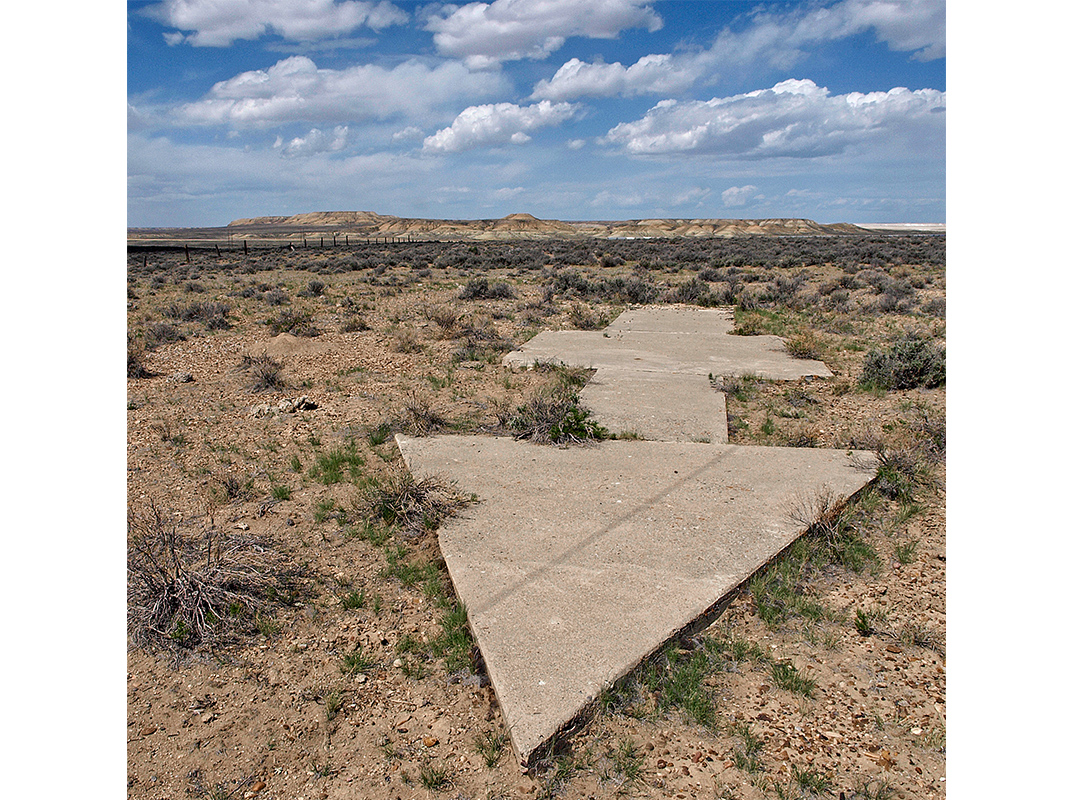
Before satellites, real-time GPS or other modern navigation systems, pilots had to be able to see where they were going. They couldn’t fly at night or in bad weather, and figuring out where they were was a complicated affair involving tools like a compass, maps (on paper!) and a bit of guesswork.
Some towns painted their names in oversized block letters on rooftops to help pilots get their bearings. And sometimes—like when navigational delays slowed down transcontinental air mail delivery* after 1920**—the government saw the need for a more comprehensive solution to the problem and stepped in. In this case they built a system of 70-foot-long concrete arrows pointing the way:
The government built a path of 70-foot-long concrete arrows every few miles from coast to coast, each painted yellow and topped with a 51-foot steel tower that had a rotating beacon. Using the path, an airmail pilot needed only half the time to deliver a letter from New York to San Francisco.
Eventually technology caught up with our demands and the markers were abandoned. Where are these markers now? An intrepid couple named Brian and Charlotte Smith wanted to know the answer and embarked on A Quest (because let’s face it, it’s hard to get anything significant done without A Quest).
They go on road trips to investigate these remnants of a bygone era, and now you can too. With the help of drone lessons from their nine-year old grandson, they’ve assembled photos and a database of marker locations.
The core idea of this story resonates with me. It’s the same childhood fascination I had for the Pony Express or the challenges of nineteenth-century explorers. For me, it’s hard to read a piece like this and not conjure up a daring young Lady Adventurer winging her way across an untamed landscape on a new world, with nothing but a few isolated markers to keep her on track.***
Marvelous!
—–
* FYI, I love the USPS and public libraries and Eisenhower’s Interstate Highway System. These and other basic infrastructure**** projects help make us a better connected, better educated country and have impacted everything from social mobility to what we eat for dinner.
** Before 1920, if you wanted to send a letter to your cool aunt in San Francisco, for example, it went via methods like stagecoach or boat or train. Slooooooow. Or you could send a telegram and tell the whole world your business… like Twitter, actually.
*** A lot like Beryl Markham, actually.
**** (A footnote within a footnote. Does that make it a toenote?) I just want to include the definition of infrastructure and ask lawmakers responsible for assigning project funds, how is this optional?
Infrastructure: The basic physical and organizational structures and facilities (e.g., buildings, roads, and power supplies) needed for the operation of a society or enterprise.
Read Full Post »



You must be logged in to post a comment.