Feeds:
Posts
Comments

Posts Tagged ‘J.R.R. Tolkien’

“To become the shadow to defeat the shadow only extends the shadow’s reach and its reign. In one of the great ironies of our international moment, it appears that many of the people who’ve read “The Lord of the Rings” the most understand it the least. They perceive an emergency – a world in crisis – and grasp for the ring.

But Tolkien’s message is profoundly different. You must demonstrate courage to defend against evil, but to defeat it, you cannot rely on your own strength. It is to the “light and high beauty” that we must turn, even when we cannot see a way through.”

— David French

* * *

Read Full Post »

Why Tolkien thought “sub-creation” was the secret to great fantasy and science fiction

There is something about great fantasy that emboldens the spirit and gives fire to the fight. It is found not only in the words and plot but in its atemporality. It tells us that there is something universal to the human condition that ought to be celebrated. It is something as true for Anglo-Saxons in their snowy mead halls as it is for office drones changing their login passwords.

It says that no matter what monsters we face, we shall overcome and live on. We shall not be defeated.

That’s a pretty good secret.

* * *

Read Full Post »

You know how some days you wake up at 5:30 and lie there in the early morning sun wondering what brought your mind up from sleep? That was me this morning. And as I lay there, the answer bubbled up from my dreams, slow and obscure but clear: Elder Futhark.

Weird, I thought, but I’m sure I’ll get over it.

Nope. For the past few hours every time my mind is unoccupied for more than a moment, what pops into my mind? Elder Futhark.

Wondering what I’m going on about? Runes. Let me give you a brief (very brief!) introduction to this early Germanic writing system.

Elder Futhark

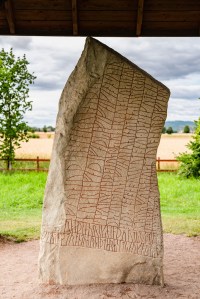
The Elder Futhark (or Fuþark, /ˈfuːðɑːrk/), also known as the Older Futhark, Old Futhark, or Germanic Futhark, is the oldest form of the runic alphabets. It was a writing system used by Germanic peoples for Northwest Germanic dialects in the Migration Period. Inscriptions are found on artifacts including jewelry, amulets, plateware, tools, and weapons, as well as runestones, from the 2nd to the 8th centuries…. knowledge of how to read the Elder Futhark was forgotten until 1865, when it was deciphered by Norwegian scholar Sophus Bugge.

Why would I have this stuck in my head? No idea. My mother studied it once upon a time, and of course, the runes of Middle Earth owe a lot to the old runic languages.

Here’s Gandalf’s mark, Certh rune no. 19:

And here’s the letter F in Elder Futhark:

As for what it means? What can I say, the mind works in odd ways.

This wisp of a dream got me thinking about language, and how a characteristic of civilization that we think of as both ubiquitous and permanent, like an alphabet, can just… disappear.

What’s really interesting to me about this, aside from the historical progression of written language, is that what that language represents hasn’t changed all that much. 

Writing systems transform, but the stories, the ideas we’re trying to communicate and pass on with that language, those haven’t changed much at all.

I mean, sure, a not insignificant part of language has always been about keeping track of death and taxes, but those aren’t the only things that are inevitable.

No matter the language, stories remind us that we are not alone, help us give structure to the problems we face, and provide an outlet for our experiences. 

We’re still interested in heroes and villains, quests and homecomings, pain and joy, and the idea that no matter what challenges we face, there is always hope.

Always.

“Remember, language is fun! It is also magical, so use it well and use it wisely!”

— The Tolkien Society

* * *

Read Full Post »
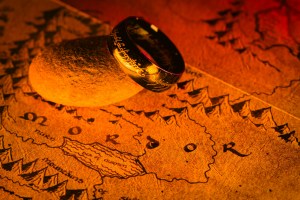
There is nothing like looking, if you want to find something. You certainly usually find something, if you look, but it is not always quite the something you were after.

— Thorin Oakenshield

* * *

Read Full Post »

This article is for the Tolkien fans among us. Hello all you beautiful hobbits elves dwarves wizards ents

 people!

Middle-Earth isn’t a place. It’s a time in (English) history

Although Middle-Earth is most definitely a fictional place, this does not mean it is completely unrelated to reality…. This interpretation argues that the various regions of Middle-Earth visited in The Lord of the Rings were inspired by, and intended to represent, specific moments in English history.

* * *

Photo by Simon Forster on Unsplash

Read Full Post »

On this day, eons ago, the brave Frodo Baggins and Samwise Gamgee fulfilled their quest to destroy the One Ring in the fires of Mount Doom. And so it was decreed that March 25th would ever after be known as Tolkien Reading Day!

What does that mean?

Today is Tolkien Reading Day! – The Tolkien Society

And as an extra bonus, J.R.R. Tolkien’s Estate Releases Treasure Trove Of Drawings And Maps.

See those maps and more here: Maps – The Tolkien Estate.

* * *

“There, peeping among the cloud-wrack above a dark tor high up in the mountains, Sam saw a white star twinkle for a while. The beauty of it smote his heart, as he looked up out of the forsaken land, and hope returned to him. For like a shaft, clear and cold, the thought pierced him that in the end the Shadow was only a small and passing thing: there was light and high beauty for ever beyond its reach.” 

― J.R.R. Tolkien, The Return of the King

* * *

Photo by Martin Jernberg on Unsplash

Read Full Post »

I vote for this as one of the feel-good stories of the year. Because what’s happier than real-life hobbits?

‘What is this if not magic?’ The Italian man living as a hobbit

“I decided that I wanted to live my hobbit life to the fullest… I wanted people to enter my mind, my fantasy. Many make fun of us. Some think I am trying to escape from reality. Far from it. I am living my dream, my adventure.”

— Nicolas Gentile, hobbit

* * *

Good for you, Italian hobbit man, good for you.

Photo by Andres Iga on Unsplash

Read Full Post »

I sit beside the fire and think 
Of all that I have seen
Of meadow flowers and butterflies
In summers that have been

Of yellow leaves and gossamer
In autumns that there were
With morning mist and silver sun
And wind upon my hair

I sit beside the fire and think
Of how the world will be
When winter comes without a spring 
That I shall ever see

For still there are so many things
That I have never seen
In every wood in every spring
There is a different green

I sit beside the fire and think
Of people long ago
And people that will see a world
That I shall never know

But all the while I sit and think
Of times there were before
I listen for returning feet 
And voices at the door

― J.R.R. Tolkien

* * *

Photo by Murilo Silva on Unsplash

Read Full Post »

On the off-chance that you find yourself reading a book (like Tolkien) and are stumped by some of the more archaic measurements, this list may be of some use:

  • furlong: 22 yards
  • league: 2.4 to 4.6 miles
  • fathom: 6 feet
  • coomb: (from combe) a deep, narrow valley
  • ell: 45 inches 

Bonus marginally-related factoid, for Jim Butcher fans:

  • rill: a very small brook or a personified force of nature from an alternate world

* * *

Photo by Nathan Anderson on Unsplash

Read Full Post »

I always wanted to be able to draw. In high school, I had a friend who was a wizard with a pen. It was a form of magic, really, the translation of life to page. I could just about manage a creditable human eye and that’s it. The eye’s match was beyond me; the second one was never quite the same. I spent a good bit of my time in French class trying to improve (apologies to my French teacher) but eventually gave up and turned my hand to personalized on-demand poetry for my classmates. (It’s amazing what you can do with a hard deadline.)

I was better at the poetry. But I still wanted to draw, at least a little.

Thank you, computer graphics!

I’m not a wizard, but I was able to fill at least some of that gap with Illustrator, Photoshop and the like. And of course I write, another way to translate life to the page.

* * *

In art and life, find a way to do the things that call to you. The path may not be the one you expected, but it can take you to your destination just the same.

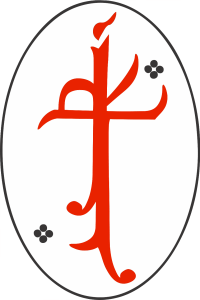
My personalized monogram in the style of Tolkien’s glyph.

Read Full Post »

Older Posts »