Feeds:
Posts
Comments

Posts Tagged ‘Orion’

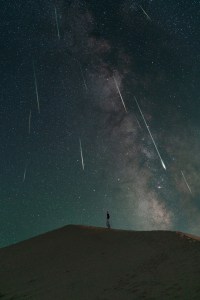
Who’s up for a meteor shower? Orion, that’s who, and this week the Orionid shower is at its peak!

The Orionid meteor shower 2026: How to watch | The Planetary Society

The 2026 Orionid meteor shower peaks on the night between October 21 and October 22. The Orionids can produce bright, fast meteors that make for a spectacular show with the constellation Orion in the background.

Here’s an interactive map and more info to help you get oriented: Orionids Meteor Shower 2026. And this week’s a great time to check it out because the moon, while waxing, has a way to go before it’s full. And darker skies mean brighter stars.

I’m posting this today because while the Orionids will peak in a day or two, they’re already happening. Day and night. Right above us! So even if you can’t get outside or there are clouds on those particular nights or you’re just wishing for a touch of cheer, these shooting stars will continue through November 7th.

And perhaps you, too, find that a little magical.

* * *
Read Full Post »

Want to see a rare astronomical event tonight? (And really, why wouldn’t you?)

The extremely rare Betelgeuse occultation by asteroid (319) Leona

For a very short time, we will see the legendary Orion constellation without its famous, orange shoulder, as it will be in the distant future, once Betelgeuse will have exploded as a supernova and faded to black.

Hey, I like Orion! What’s this all about?

Watch an asteroid eclipse the puzzling red giant star Betelgeuse tonight live online

At at 8:17 p.m. EST Monday (Dec. 11) (0117 GMT, Dec. 12), an asteroid will pass in front of the curious red star Betelgeuse, eclipsing it from our vantage point here on Earth and blocking it from view for up to 15 seconds in an event known as an occultation. The asteroid is known as 319 Leona, a main belt object that orbits the sun between Mars and Jupiter. Shaped roughly like an egg, 319 Leona measures some 50 by 34 miles (80 x 55 kilometers) in size.

Here’s a link to live coverage of the event.

So Orion’s loss is temporary, and will also help scientists better understand both the asteroid’s shape and the star’s characteristics. No Tim Burton movie required!

* * *

via Microsoft Image Creator: graphic illustration stamp of a star over mountains in winter, with a passing asteroid

Read Full Post »