Stitching together more than 600 overlapping snapshots, the panorama serves as the largest photomosaic ever assembled from Hubble Space Telescope observations. Across its 2.5 billion pixels are a vast and vibrant assortment of 200 million stars, a mere fraction of Andromeda’s entire population. Taken in its entirety, the panorama is not only a technological or photographic achievement, it’s also a critical glimpse into the Andromeda galaxy itself.
I have a folder of interesting articles, quotes, and ideas. When the cicadas are buzzing and the temperature is too hot to think of anything particularly timely, I search that folder for stories that might interest you.
Today, this treasure trove of ideas wants you to know about a critical space station issue: water.
When you’re on a camping trip, you might have to pack your own food and maybe something to filter or treat water that you find. But imagine your campsite is in space, where there’s no water, and packing jugs of water would take up room when every inch of cargo space counts. That’s a key challenge engineers faced when designing the International Space Station.
Real life Dune! Ok, not really, but kind of! And this is exactly the sort of technology that can benefit the Earth-bound among us too.
This guide is intended to be a comprehensive look at the tech that Star Trek suggested to drive humanity forward ad astra per aspera. The emphasis is on innovations that don’t violate physics according to present consensus understanding. Go ahead and explore boldly… Just don’t waste too much time on idle speculation: there’s a whole lot to do if we’re going to get to Trek, and it’s going to take all of us.
If you’ve ever wondered what’s down in the ocean deeps, the funnest version of the answer is that we mostly don’t know!
Here’s an interesting article featuring graphic illustrations by Angela Hsieh, showing what we know about the ocean, its depths, the differences between the Sunlit, Midnight, and other zones, and the many (many) things we have yet to discover about the oceans that surround us.
Whoops, I forgot to mention a recent solar system milestone. Two days ago, the Earth (that’s you and that’s me!) reached aphelion, or the point in our orbit at which we’re the farthest distance away from the Sun. That puts us at approximately (give or take the distance we’ve traveled in the past two days) about 3 million miles farther away from the sun than we are at perihelion.
This happens every year in early July, which might sound backward. If we’re farthest from the sun, shouldn’t it be cooler?
The answer lies in the fact that the Earth gets closer to and farther away from the Sun, but it’s also tilted.
Our planet spins at an angle — about 23.5 degrees — which means different parts of the globe receive more (or less) sunlight depending on the time of year. In July, the Northern Hemisphere is tilted toward the sun, bringing longer days and higher sun angles that lead to more direct sunlight — all of which produce summer-like heat.
Since Kepler’s laws of motion dictate that celestial bodies orbit more slowly when farther from the sun, we are now moving at our slowest pace in orbit, slightly less than 18 miles per second (29 kilometers per second) compared to just over 19 at perihelion.
Given that, today might be a good time to relax, and enjoy the ride.
If you don’t track space news or astronomy news or science news, you may not have seen the announcement about the debut of the Vera C. Rubin Observatory’s recent drop of galactically cool imagery.
Even if you have seen the announcements, you may not know the story behind the observatory, its world-beating telescope, or the woman it’s named after. Here’s a quick orientation and of course, a look at some of that amazing imagery.
The Legacy Survey of Space and Time camera is expected to capture more information about the universe than all optical telescopes throughout history combined.
What is the observatory observing from its perch on Cerro Pachón in Chile? All the things!
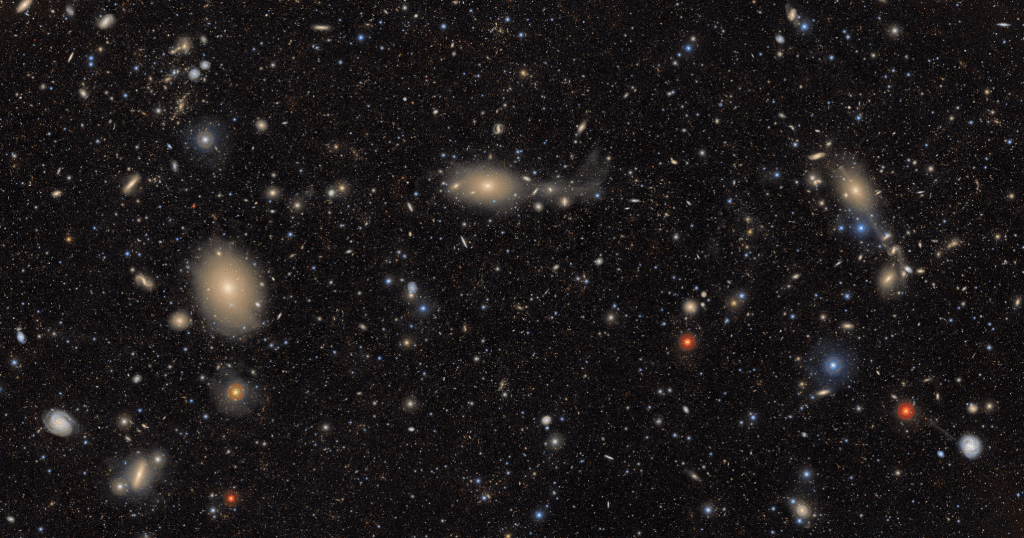
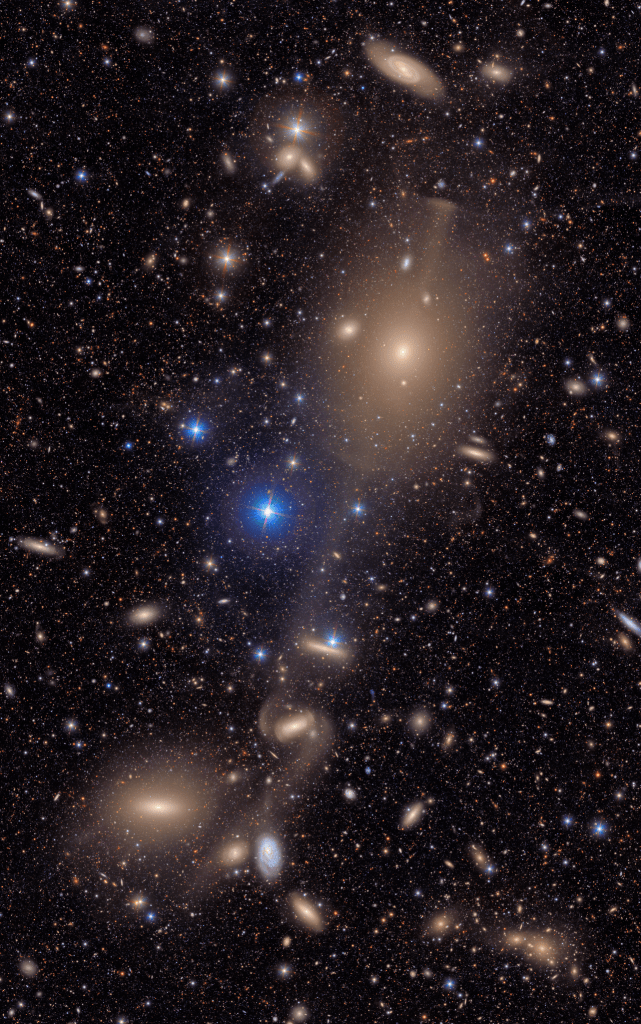
In just over 10 hours of test observations, NSF–DOE Rubin Observatory has already captured millions of galaxies and Milky Way stars and thousands of asteroids. The imagery is a small preview of Rubin Observatory’s upcoming 10-year scientific mission to explore and understand some of the Universe’s biggest mysteries.
It should detect killer asteroids in striking distance of Earth and map the Milky Way. It will also answer crucial questions about dark matter, the mysterious substance that makes up most of our universe.
Exactly who was Vera C. Rubin? Just a girl who dreamed of space, ignored the haters, and grew up to be a world-class scientist.
Vera Rubin is best known for presenting the first sound evidence of dark matter—an elusive substance that makes up more than 80 percent of our universe, yet doesn’t interact with light or other electromagnetic radiation, making it impossible to glimpse directly through a telescope. Her central scientific accomplishment involved discovering a mismatch between the predicted angular motion of galaxies and the observed motion of galaxies. Rubin’s calculations offered a solution to this so-called “galaxy rotation problem” by suggesting that galaxies must contain at least 10 times as much mass as can be accounted for by the visible stars. This invisible mass constituted evidence for what astronomers had earlier proposed to be dark matter.
Rubin became a cosmological giant against the odds, illuminating a path for future female astronomers.
(And, I’d like to add, becoming a role model for kids of all shapes and sizes!) Want even more in-depth info about telescope and its capabilities?
In this exclusive interview, Professor Mario Jurić reveals how the Vera Rubin Observatory accidentally discovered 2,000 asteroids in just 10 hours while testing its capabilities on the distant Virgo Cluster—transforming humanity’s asteroid discovery rate from 20,000 per year globally to potentially over one million annually with a single telescope.
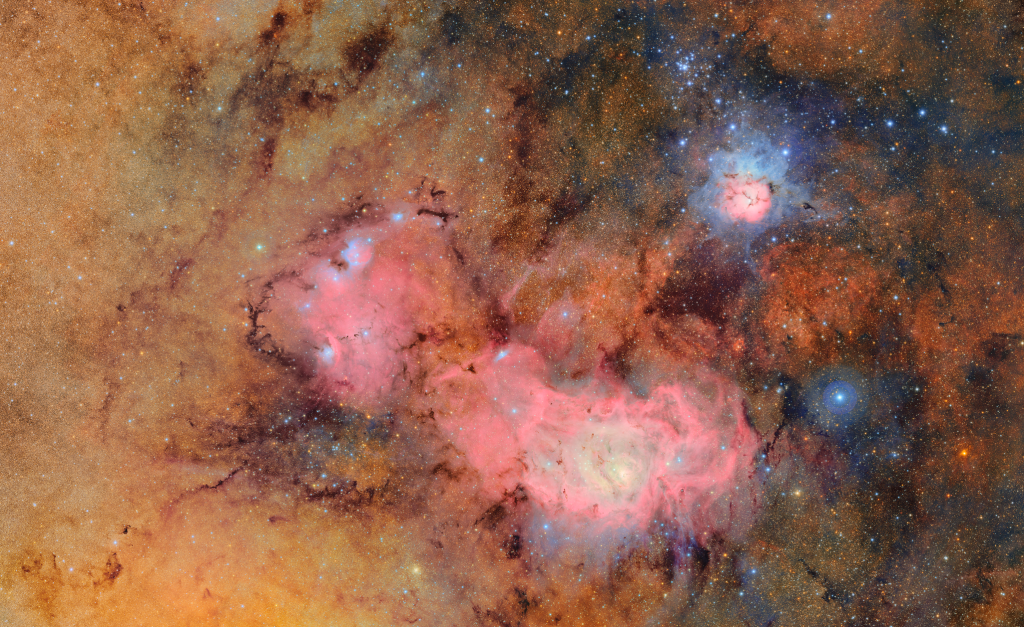
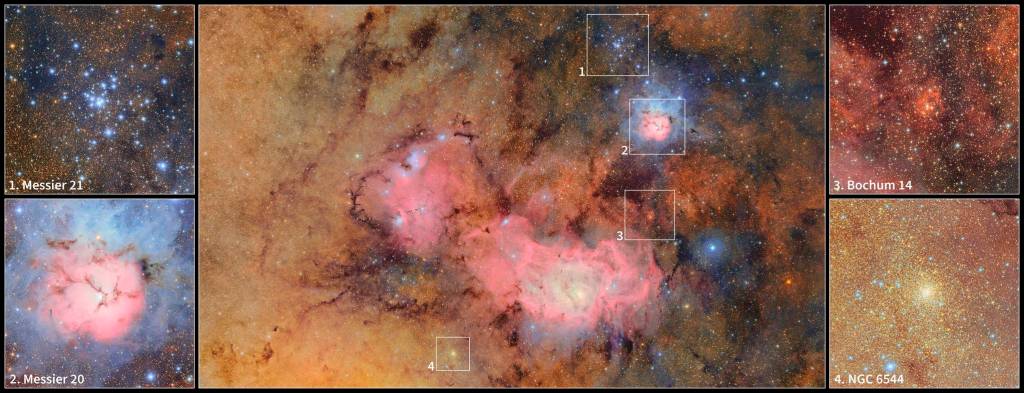
Short and very cool video of the Trifid and Lagoon nebulae, compiling more than seven hours of observing time: Trifid and Lagoon Nebulas (Video-ES).
Space Surveyors is a fun, interactive game where YOU move the Rubin telescope around the sky. How many stars, galaxies, supernovae, comets, and asteroids can you catch in one minute, before the sun rises?
While players aren’t moving the *real* telescope around, it’s still fun to play. (I discovered 22 objects before the clouds rolled in and the sun came up. Bet you can do better:)
Adventure! Discovery! Secrets of the universe! This, kids, is why math is important.*
* I mean, sure, also to figure out if you have enough money to pay rent and still buy ice cream, but also this!
First let me make clear that what I’m about to share is 100% not safe for work. Or delicate ears. I mean, yeah, there’s a lot of swearing. That said, the subject matter is one of those topics that almost requires strong language.
This series of videos pairs climate scientists with comedians who translate for us regular folks.
Watch Emmy Award-winning comedian David Cross and Professor Michael Oppenheimer pretty much fix the climate crisis between them, in the first US pilot of the hit “Climate Science Translated” series. What’s the gist? Most Americans (74%) actually want more climate action from government. What no one wants is sky-high insurance bills, a home destroyed by extreme weather, or to pass on a ruined planet to their kids.
The films use humor (and profuse swearing) to translate the urgency of the problem, and bring it back down to Earth.
Sadly, it looks like the Ispace lander Resilience did not make a successful landing on the moon yesterday. (If it did land, it’s harboring enough resentment about the process that it’s refusing to pick up the phone.)
Ispace has gone out of its way to make clear that it’s not giving up. The motto underpinning today’s mission was “never quit the lunar quest.” And by all accounts, the company has every intention of sticking with these moon missions until they succeed.
Let this be a lesson to all you aspiring creatives out there. Never quit! (And maybe name the next lander Persistence?)
The Resilience lander is currently orbiting the moon as it prepares to land within Mare Frigoris (“Sea of Cold”) in the northern hemisphere. The landing is scheduled for Thursday at 3:17 p.m. EDT (1917 GMT; or 4:17 a.m. Japan Standard Time on Friday, June 6)… If Resilience lands successfully, it is expected to operate for up to two weeks (one lunar day) on the moon’s surface before succumbing to the deep cold of lunar night.
That’s right, a private company is attempting a moon landing today. Is the privatization of space a good thing? A bad thing? It’s certainly an interesting progression of humanity’s extra-planetary exploration, always fascinating material for science fiction writers.
And we can watch!
(“the deep cold of lunar night”: is that a great phrase or what?)
Quick update: the landing time changed a bit due to orbital mechanics or something fancy like that, but more importantly, controllers are waiting to find out if it landed safely and can establish contact. Updates via CNN…




You must be logged in to post a comment.