Feeds:
Posts
Comments

Posts Tagged ‘science’

As we’re right around the full (super!) moon this weekend (and I’m knee-deep in tech and tax stuff, super fun), here’s a composite image of the moon with amazing detail.

An Enormous Photo of the Moon Zooms in on the Cratered Lunar Topography in Incredible Detail

The self-taught Kurdish astrophotographer amassed 81,000 images, which he stitched into a 708-gigabyte composite revealing the intricacies of the lunar topography in stunningly high resolution.

Scroll down through the images to be impressed by the work of this self-taught astrophotographer.

* * *

What the moon looked like to Galileo in 1610, Public domain, via Wikimedia Commons

Read Full Post »

Today is all about cake baking and other kitchen stuff. We needed a few ingredients like apples and eggs, which required a trip to the store, which in turn led to that age-old question: Why is our checkout line so slooooow? What is queuing theory anyway? And, inevitably, how would this affect procedure at a transdimensional transit hub?

* * *

Photo by Nk Ni on Unsplash

Read Full Post »

If my brain had been working yesterday I would have mentioned the fact that many of us have an unusual opportunity to see the Aurora Borealis right now. 

“The word Aurora was first used by Galileo and comes from Latin and is the name of the goddess of dawn.” — NOAA

This light show in space is typically reserved for latitudes close to the Earth’s poles, but we happen to be experiencing a G3 solar storm right now. This happens when solar storms drive coronal mass ejections, solar flares, solar particle events and solar winds at us. And by us, I mean Earth.

First, some pretty pictures from as far south as Florida:

PHOTOS: Exceptional solar storm sparks stunning auroras across Canada – The Weather Network

But wait, why does solar energy sometimes turn the sky into an Impressionist painting?

Understanding aurora colors; the science behind the display | MPR News

Our sun is the main reason for an aurora display. Particles energized by the sun race toward Earth, colliding with our upper atmosphere. Earth’s magnetic field divert this energy towards the north and south poles. As these energized particles enter Earth’s atmosphere, they excite gas atoms and molecules. The colors observed depend on which gas atoms they interact with.

Aurora colors explained, National Weather Service

And hang on, it comes in black?!

Aurora Colors Explained – Southern and Northern Lights

In addition to colorful light bands, sometimes an aurora has black bands that block starlight. The dark regions likely come from electric fields in the upper atmosphere that block electrons from interacting with gases.

I won’t be hurt if you want to stop here and go search for more pictures, but if you’d like to know more about the how and why, read on!

Aurora Dashboard (Experimental) | NOAA – NWS Space Weather Prediction Center

When and where can you see the northern and southern lights also known as the aurora? This page provides a prediction of the aurora’s visibility tonight and tomorrow night in the charts below. The animations further down show what the aurora’s been up to over the last 24 hours and estimates what the next 30 minutes will be like. The aurora’s colorful green, red, and purple light shifts gently and often changes shape like softly blowing curtains.

Aurora – 30 Minute Forecast | NOAA – NWS Space Weather Prediction Center

This is a short-term forecast of the location and intensity of the aurora.

Even more in-depth sciency stuff!

Aurora Tutorial | NOAA – NWS Space Weather Prediction Center

The figure below shows the magnetosphere and the locations where electrons are accelerated (in red). The red region on the right of the figure is where the electrons that produce night-time aurora are accelerated and the source of the processes that generate geomagnetic storms.

Pretty colors are pretty, of course, but why should we care about space weather?

Education and Outreach | NOAA – NWS Space Weather Prediction Center

Space weather is a global issue. Unlike terrestrial weather events, like a hurricane, space weather has the potential to impact not only the United States, but wider geographic regions. These complex events can have significant economic consequences and have the potential to negatively affect numerous sectors, including communications, satellite and airline operations, manned space flights, navigation and surveying systems, as well as the electric power grid.

Aaaand in case you haven’t had enough about auroras in particular and space weather in general, NOAA has a fun dashboard for you! 

Space Weather Enthusiasts Dashboard | NOAA – NWS Space Weather Prediction Center

The goddess of dawn

shivers with rainbow delight.

The sun blows his kiss.

* * *

Photo by Ibrahim Boran on Unsplash

Read Full Post »

This lovely story from Eleanor R. Wood on Flash Fiction Online is just what I needed to brighten my day.

I hope it cheers you too.

Fibonacci

One sample of DNA.

One chance to prove herself and silence her peers.

And if you’d like to know more about some of the science behind the story, check out these links.

Nautilus

What’s special about the shape of a Nautilus shell? Find out.

* * *

Photo by Content Pixie on Unsplash

Read Full Post »

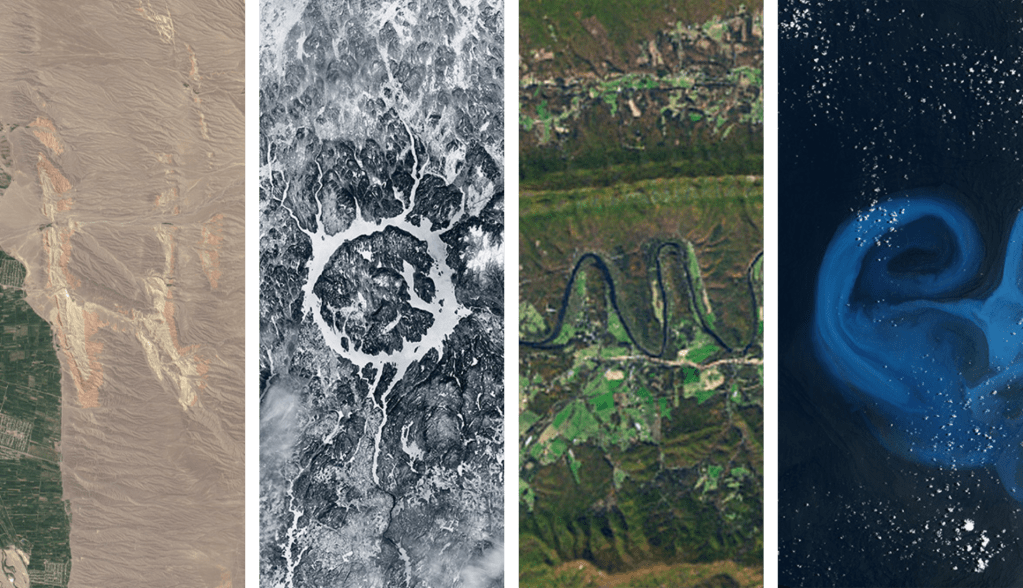
Your Name in Landsat 🛰️

Type in your name to see it spelled out in Landsat imagery of Earth!

Does what it says on the tin. Excellent!

* * *

Read Full Post »

The moon shines bright tonight, my friends. 

  • We have a full moon.
  • We have a harvest supermoon.
  • And if you (like me) are in North America, South America, Africa or Europe, we have a partial lunar eclipse.
  • We even have a bonus sort of moon related item at the end!

First, the what, when, where of tonight’s eclipse.

What to know about Tuesday’s lunar eclipse and harvest supermoon – NPR

The best times to view the event will depend on your location, but the lunar eclipse will peak at 10:44 p.m. ET, according to NASA. All of North and South America will have a chance to see the partial lunar eclipse and harvest supermoon depending on the weather. Europe and Africa will also have an opportunity to see the eclipse.

The Next Full Moon is a Partial Lunar Eclipse; a Supermoon; the Corn Moon; and the Harvest Moon – NASA

As the full Moon closest to the autumnal equinox, this is the Harvest Moon. The first known written use of this name in the English language (per the Oxford English Dictionary) was in 1706. During the fall harvest season farmers sometimes need to work late into the night by moonlight. On average moonrise is about 50 minutes later each night. Around the Harvest Moon this time is shorter, about 25 minutes for the latitude of Washington, DC, and only 10 to 20 minutes farther north in Canada and Europe.

(Note from the future: NASA has a great Astronomy Photograph of the Day showing a time lapse of the eclipse.)

Here is some general info on eclipses and a fun video from NASA.

* * *

And as for that more-or-less moon related bonus item? It’s a tasty one.

Mr Man and I went for a lovely if hot hike down by the river, and decided that the best way to cap it off would be with ice cream. We found ourselves at Chris’s Ice Cream Ottawa.

This fun little shop had a number of interesting and creative flavors, including blood orange, chili chocolate, strawberry crunch, and… hang on, what’s this?

Moon mist.

Ysh.cabana, CC BY 4.0, via Wikimedia Commons

Interesting. Never heard of it. (That’s because we’re not Out East and I have apparently not been shopping in the right ice cream stores.)

Wait, it’s a combination of bubble gum, grape, and banana?! 

Here’s a quick intro to this regional delight: Written in the stars: The legendary tale of Atlantic Canada ice cream favourite Moon Mist.

I did not think I would like it. I did not think the flavors would work. In fact, they did more than work, as all three flavors combined into a new, better flavor.

I don’t quite know how to describe this “improbable” combination except as a structural shift. Imagine three individual flavors, normally experienced as if they were sequential, or side by side. When eaten together, however, the flavors stack together to create a singular new experience.

Readers, I loved it.

* * *

Photo by Shot by Cerqueira on Unsplash

Read Full Post »

How did we get the landscape that we have today? I’m talking the big stuff, geology, not horticulture. Plate tectonics. We all know what Earth looks like now, but how did we get here?

This animation starts with the world we recognize, then rolls back time to show how the planet’s macrostructure has changed. Fun, right?

Witness 1.8 billion years of tectonic plates dance across Earth’s surface in a new animation

Mapping our planet through its long history creates a beautiful continental dance — mesmerising in itself and a work of natural art.

It’s a beautiful dance.

* * *

Photo by Drew Colins on Unsplash

Read Full Post »

If you’re the sort of person who enjoys looking up, you might like this list of September skywatching tips from NASA.

What’s on the roster? Another supermoon, a partial lunar eclipse, Saturn doing its ring thing, and something called International Observe the Moon Night, plus more more more.

Check out the article or watch the video here:

Have fun!

* * *

Photo by Jordan Steranka on Unsplash

Read Full Post »

It’s Tuesday (ugh) and it’s practically a Monday thanks to the holiday weekend and I’ve been thinking about Nature thanks to our recent museum visit, so let’s get a little weird, shall we?

Welcome to the University of Glasgow’s Wellcome Centre for Integrative Parasitology!

What’s this, you may ask? A serious science center (excuse me, centre) with a public engagement arm so dedicated and creative that they turned parasites into a comic book? And when the first issue became a surprise hit, went on to produce a five-part series about some of the world’s most impactful parasites?

Yes, that is exactly what I’m saying.

You’re wellcome.*

* Heh, see what I did there. Yeaahhh, because it’s that kind of day:)

* * *

Photo by João Pedro Schmitz on Unsplash

Read Full Post »

Here’s an interesting puzzle: How Do You Send a Warning 1,000 Years into the Future? – Now I Know

Think back to what the Earth was like a thousand years ago — the year 1,015. Almost everything would be foreign to modern eyes and ears — even the language would be incomprehensible. For all intents and purposes, humanity from a millennium ago may as well be an alien species (culturally, at least) with similar DNA, which simply happens to have lived on the same planet we do now.

How do we communicate with people so far removed from our own language, culture, and assumptions? It’s a great question, whether you’re thinking about the safest approach to nuclear waste disposal or contacting aliens.

In order to keep the people of the future safe from the radioactive goop created today, we need a way to tell them to watch out. And more likely than not, very few aspects of today’s society will be around to do that. Even a sign warning travelers of potential dangers would be insufficient — who among us could translate runes from the Middle Ages?

(My mom, that’s who, but point taken.)

What particularly interests me about these proposed solutions (an Atomic Priesthood dedicated to perpetuating knowledge through myth? color-changing cats?!) is that they seem to have skipped over the most obvious approach. How to conjure the fear of death, to warn people away, and to alert the future not to what is there, but what will happen if it is disturbed?*

This is a plague panel from the early 17th century. If you saw this on a house, would you go in or turn and run the other way?

Deutsches Historisches Museum Berlin, Public domain, via Wikimedia Commons

In the end, the U.S. Department of Energy plan opted to go with warning signs in multiple languages illustrated with images of people in pain. Still, I wondered, what’s wrong with the classics?

Another odd writer thought, brought to you by an odd writer.

* Also, the real problem seems to be the gap between exposure and untimely demise. If you break into a tomb and die immediately, that sends a pretty strong message. And no one has to tell people not to build on an active lava flow, but a peaceful-looking mountain with fertile soil close to the bustling port of Naples and the dynamic town of Pompeii (circa 78 AD)? What’s not to like?

* * *

Photo by chris robert on Unsplash

Read Full Post »

« Newer Posts - Older Posts »