“To live is not to breathe but to act.”
— Jean-Jacques Rousseau
* * *

Posted in Other, tagged #365Ways, #365Ways2025, action, inspiration, life, philosophy, quotes, Thoughts on June 29, 2025| Leave a Comment »
“To live is not to breathe but to act.”
— Jean-Jacques Rousseau
* * *
Posted in Other, tagged #365Ways, #365Ways2025, happiness, quote, Thoughts on June 28, 2025| Leave a Comment »
We took a little time out this afternoon to deliver encouragement to some hardworking friends. And delicious 0% blueberry beer from Broadhead Brewery, perfect for a hot summer’s day.
Recommend!
“Happiness is not made by what we own. It is what we share.”
— Jonathan Sacks
* * *

Posted in Science!, tagged #365Ways, #365Ways2025, astronomy, discrovery, female scientists, inspiration, science, space, Thoughts, universe on June 27, 2025| Leave a Comment »
If you don’t track space news or astronomy news or science news, you may not have seen the announcement about the debut of the Vera C. Rubin Observatory’s recent drop of galactically cool imagery.
Even if you have seen the announcements, you may not know the story behind the observatory, its world-beating telescope, or the woman it’s named after. Here’s a quick orientation and of course, a look at some of that amazing imagery.
World’s largest telescope debuts
The Legacy Survey of Space and Time camera is expected to capture more information about the universe than all optical telescopes throughout history combined.
What is the observatory observing from its perch on Cerro Pachón in Chile? All the things!
Ever-changing Universe Revealed in First Imagery From NSF–DOE Vera C. Rubin Observatory
In just over 10 hours of test observations, NSF–DOE Rubin Observatory has already captured millions of galaxies and Milky Way stars and thousands of asteroids. The imagery is a small preview of Rubin Observatory’s upcoming 10-year scientific mission to explore and understand some of the Universe’s biggest mysteries.
Here are just some of the first images: Rubin Observatory.
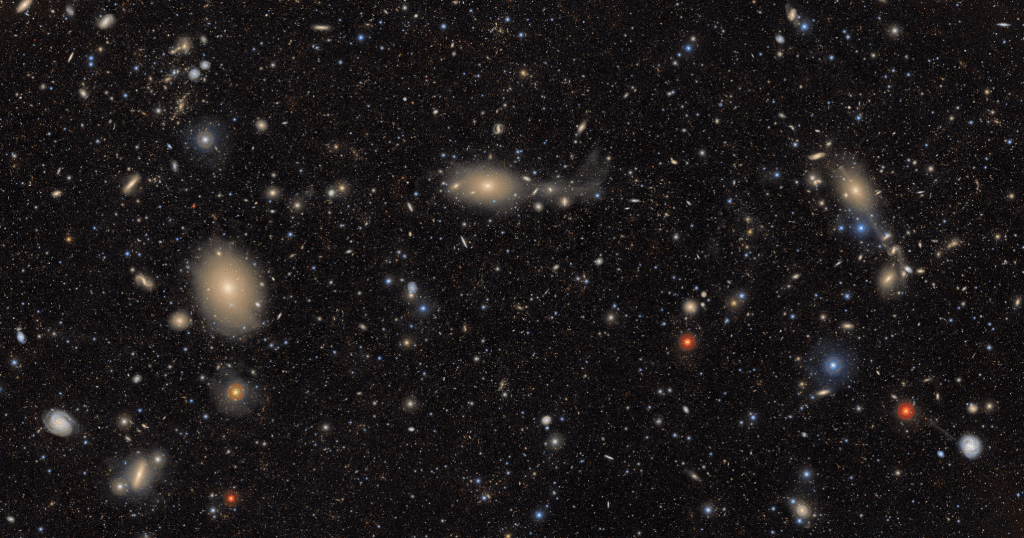
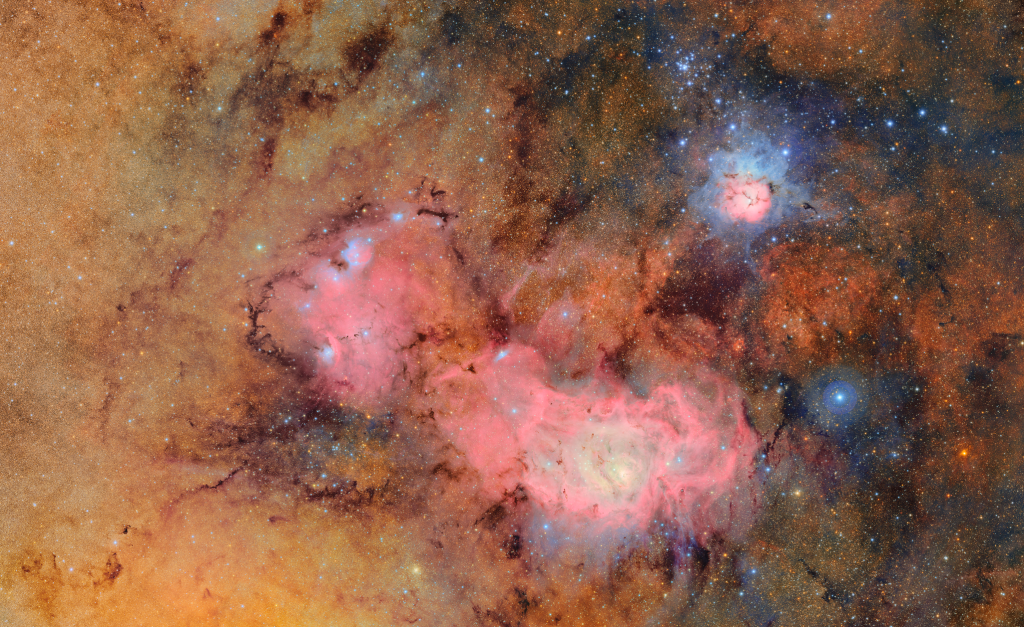
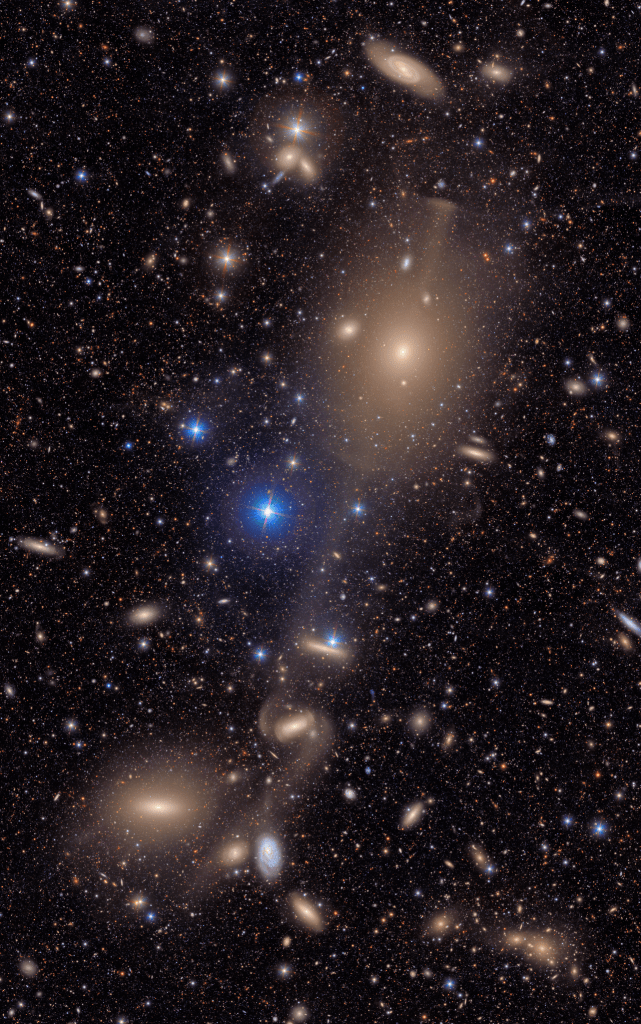

Vera Rubin: First celestial image from revolutionary telescope
It should detect killer asteroids in striking distance of Earth and map the Milky Way. It will also answer crucial questions about dark matter, the mysterious substance that makes up most of our universe.
Exactly who was Vera C. Rubin? Just a girl who dreamed of space, ignored the haters, and grew up to be a world-class scientist.
The Woman Behind the World’s Biggest Camera
But who is the observatory’s namesake astronomer?
Vera Rubin is best known for presenting the first sound evidence of dark matter—an elusive substance that makes up more than 80 percent of our universe, yet doesn’t interact with light or other electromagnetic radiation, making it impossible to glimpse directly through a telescope. Her central scientific accomplishment involved discovering a mismatch between the predicted angular motion of galaxies and the observed motion of galaxies. Rubin’s calculations offered a solution to this so-called “galaxy rotation problem” by suggesting that galaxies must contain at least 10 times as much mass as can be accounted for by the visible stars. This invisible mass constituted evidence for what astronomers had earlier proposed to be dark matter.
Rubin became a cosmological giant against the odds, illuminating a path for future female astronomers.
(And, I’d like to add, becoming a role model for kids of all shapes and sizes!) Want even more in-depth info about telescope and its capabilities?
First Data from Vera Rubin Observatory Rewrites Astronomy (Starting Now) – YouTube
In this exclusive interview, Professor Mario Jurić reveals how the Vera Rubin Observatory accidentally discovered 2,000 asteroids in just 10 hours while testing its capabilities on the distant Virgo Cluster—transforming humanity’s asteroid discovery rate from 20,000 per year globally to potentially over one million annually with a single telescope.
Short and very cool video of the Trifid and Lagoon nebulae, compiling more than seven hours of observing time: Trifid and Lagoon Nebulas (Video-ES).
And sure, why not, a space game!
Space Surveyors is a fun, interactive game where YOU move the Rubin telescope around the sky. How many stars, galaxies, supernovae, comets, and asteroids can you catch in one minute, before the sun rises?
While players aren’t moving the *real* telescope around, it’s still fun to play. (I discovered 22 objects before the clouds rolled in and the sun came up. Bet you can do better:)
Adventure! Discovery! Secrets of the universe! This, kids, is why math is important.*
* I mean, sure, also to figure out if you have enough money to pay rent and still buy ice cream, but also this!
* * *
Posted in Other, tagged #365Ways, #365Ways2025, quoteandaprettypicture, Thoughts on June 26, 2025| Leave a Comment »
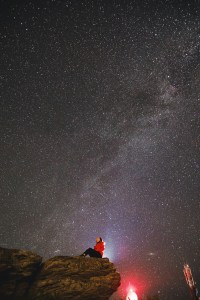
“Those who dwell among the beauties and mysteries of the earth are never alone or weary of life.”
— Rachel Carson
* * *

Posted in Other, tagged #365Ways, #365Ways2025, #InquiringMinds, politics, primers, Thoughts, voting on June 25, 2025| Leave a Comment »
A random explainer for curious minds: In case you’re wondering about voting in the New York City mayor’s primary, or what people advocating for ranked choice voting are going on about, here’s an interactive demo. With ice cream!
(Here’s a more complicated explainer, but the ice cream works for me!)
Ranked choice voting: Get the scoop on how it works
Get a taste of RCV by ranking your five favorite ice cream flavors and then follow along as the votes get counted and we find out which flavor tops the cone.
* * *
Posted in Other, tagged #365Ways, #365Ways2025, 1, 2, 3, 4, 5, 6, 7, AI, health, infant mortality, mortality mortality, public health, Thoughts, vaccines on June 24, 2025| Leave a Comment »
I recently subscribed to We’re Here, a “nice little email for people from Earth” that originated from Hank and John Green’s Nerdfighteria. One issue last month included a thought piece I found interesting: The Tragedy of Prevention.
The thesis? “A tricky thing about modern society is that no one has any idea when they don’t die.”
That line stuck with me, and I’ve been toying with it for the past month. How, I wondered, could we be made more aware of those moments in particular, and our good luck in general?
The tragedy of prevention goes like this: The most effective way to save lives (prevention) is the least noticeable, which leads us to undervaluing it in our individual choices, in what we celebrate, and in public policy. That undervaluing of prevention leads to a great deal of needless death and suffering…
If every person who had their life saved by a vaccine, or an airbag, or a clean air regulation felt the same as a firefighter carrying an unconscious person out of a burning building, I think we’d feel a lot better about humanity, and maybe that would help us move forward more effectively.
Surely, I thought, there must be a website out there that will tell me all the times I coulda woulda shoulda died? When a search turned up nothing useful (and a whole lot that wasn’t, and wasn’t something I wanted to wade through), I decided to put AI to good use. This was my hypothetical:
Q: I am a 50-year old white man living in the US. You are a doctor specializing in historical causes of mortality, including vaccine-preventable diseases and other health-care preventable causes of mortality. Tell me all the moments in my life where I would have died if this were the year 1898.
I picked 1898 because it had all the lessons of the 19th century but none of the World Wars of the 20th. It’s also just after the Gilded Age, a time currently being showcased as a time of All Good Things, at least for robber barons those in power.
What was the answer?
ChatGPT: This is a fascinating and sobering thought experiment. Assuming you’re a 50-year-old white man in the U.S. in 2025, you would have been born in 1975. Let’s now imagine that you lived your exact same life—same exposures, environment, risks, and medical events—but in 1898. Here are the major moments where you very likely would have died, or your survival would have been highly unlikely, given the state of medicine, vaccines, and public health at that time.
The answer started with fun diseases like diphtheria, measles and scarlet fever and moved on from there. It summarized a lot, but even this abbreviated trek through a hypothetical life over a century ago made me think: How lucky are we?
If you’re curious, here’s the full answer,* complete with terrifying scenarios like no antibiotics, insulin or public sanitation, life expectancies under 50, and pretty much every disease ever from The Oregon Trail:
* Fair warning, I haven’t fact checked all of these specific numbers, but the overall point is both relevant and on target.
1. Infancy and Childhood (0–5 years)
🚼 Risk of Infant Death from Infectious Diseases
- Diphtheria, Pertussis (Whooping Cough), Measles, Scarlet Fever, and Smallpox were all common causes of childhood death.
- You would not have been vaccinated, as the only routinely available vaccine in 1898 was for smallpox.
- Infant mortality rate in 1898 was around 150 per 1,000 live births, meaning a 15% chance of dying before age 1.
📍Moment of Likely Death #1: Age 0–5 — Measles, Whooping Cough, or Diphtheria.
If you got any of these common childhood infections—as most kids did—you would face a high chance of dying from pneumonia, encephalitis, or airway obstruction.2. Appendicitis, Accidents, or Infections (Any Age)
⚠️ Lack of Antibiotics and Surgery
- Appendicitis, if you ever had it, would have been a death sentence due to lack of surgical techniques and no antibiotics.
- Strep throat, infected cuts, dental abscesses, or pneumonia could have killed you due to the absence of penicillin (discovered 1928, not widely used until the 1940s).
📍Moment of Likely Death #2: Any bacterial infection that in your modern life was easily treated with antibiotics—especially in your teens or 20s.
3. Injuries and Trauma
🩸 Modern Trauma Care Didn’t Exist
- Car accidents didn’t exist yet, but horseback riding accidents, industrial injuries, and farm equipment injuries were common.
- No blood banks, IV fluids, or sterile technique meant internal injuries or bleeding often led to death.
📍Moment of Likely Death #3: Any serious physical injury. Even a broken leg with complications like infection or blood loss could have been fatal.
4. Adulthood Illnesses
❤️ Heart Attacks, Strokes, and Chronic Disease
- In 1898, there were no treatments for hypertension, high cholesterol, or heart disease. If you had any of these risk factors, your risk of death in your 40s or 50s was vastly higher.
- Diabetes was also nearly untreatable. Insulin wasn’t discovered until 1921. You would likely die within a year of diagnosis.
📍Moment of Likely Death #4: Undiagnosed or untreated chronic illness. If you’ve ever taken blood pressure meds, cholesterol meds, or insulin—you would have died without them.
5. Infectious Disease in Adulthood
🦠 Tuberculosis, Influenza, and Pneumonia
- TB was called “consumption” and was a leading cause of death.
- The “old man’s friend” (pneumonia) often claimed people in midlife or earlier.
- Influenza pandemics occurred repeatedly—including in 1918.
📍Moment of Likely Death #5: Any bout with flu or pneumonia. Without antivirals, antibiotics, or supportive hospital care, this could easily have been fatal.
6. Surgical Interventions
🛠️ No Modern Anesthesia or Sterile Technique
- If you’ve ever had a hernia repair, tonsillectomy, gallbladder surgery, or even dental work—your risk of dying from infection or surgical shock would have been significant.
- Hospitals were places people went to die; wealthy people often avoided them.
📍Moment of Likely Death #6: Any surgery. Even minor operations were high-risk.
7. Cancer
🔬 No Diagnostics, No Chemotherapy, No Radiation
- Cancer was often only diagnosed very late—usually through symptoms like bleeding or swelling.
- Surgical removal was often impossible or fatal due to poor technique and infection.
📍Moment of Likely Death #7: If you ever had or will have cancer, you’d likely die quickly and in pain.
Survival Odds in 1898
- Life expectancy for white men in 1898 was about 46 years.
- As a 50-year-old in 2025, you’re already past the average life expectancy of your 1898 counterpart.
- Public sanitation, antibiotics, vaccines, and modern surgery have already saved your life many times over—even if you’ve never had a dramatic medical crisis.
Bonus: Things You Would Not Die From in 1898
- Car crashes (few cars existed).
- Obesity-related diabetes (far less common).
- Opioid overdose (though morphine addiction was real, it was not yet a mass crisis).
- Mass shootings or modern warfare (depending on your background and profession).
And that’s the beauty of prevention!
* * *

Posted in Writing, tagged #365Ways, #365Ways2025, creativity, Thoughts, Writers, writing on June 23, 2025| Leave a Comment »
Creativity is inventing, experimenting, growing, taking risks, breaking rules, making mistakes, and having fun.
— Mary Lou Cook
* * *

Posted in Other, tagged #365Ways, #365Ways2025, creativity, life, Thoughts on June 22, 2025| Leave a Comment »
“We’re not born creative or destructive. Each one of us has the ability to create or destroy, to leave the world better than we found it, or worse.”
— Yo-Yo Ma
* * *

Posted in Writing, tagged #365Ways, #365Ways2025, creativity, quoteandaprettypicture, Thoughts, Writers, writing on June 21, 2025| Leave a Comment »
“Imagination is the highest kite one can fly.”
— Lauren Bacall
* * *

Posted in Science!, tagged #365Ways, #365Ways2025, climate change, climate communication, comedy, creativity, humor, science, Thoughts on June 18, 2025| Leave a Comment »
First let me make clear that what I’m about to share is 100% not safe for work. Or delicate ears. I mean, yeah, there’s a lot of swearing. That said, the subject matter is one of those topics that almost requires strong language.
This series of videos pairs climate scientists with comedians who translate for us regular folks.
Again, there’s definitely swearing!
Here’s an article about what they’re doing and why with a link to the main site.
And here’s an example:
David Cross Meets Prof Michael Oppenheimer | NSFW – YouTube
Watch Emmy Award-winning comedian David Cross and Professor Michael Oppenheimer pretty much fix the climate crisis between them, in the first US pilot of the hit “Climate Science Translated” series. What’s the gist? Most Americans (74%) actually want more climate action from government. What no one wants is sky-high insurance bills, a home destroyed by extreme weather, or to pass on a ruined planet to their kids.
The films use humor (and profuse swearing) to translate the urgency of the problem, and bring it back down to Earth.
For more, check out the playlist. They even made PG versions, if that’s your thing!
And yes, climate change is something to cry about. But we can laugh too.
* * *




You must be logged in to post a comment.