Dipping back into my old journal, I find a reminder that world travel isn’t all hot air balloons and fairy chimneys. Fifteen years ago today I was somewhere over Europe, the sand and beauty of Egypt at my back, catching up on my writing after an unexpected interruption…
July 8
Saturday
Over Europe
Egypt was a hot, hazy abyss for words and a huge gap on these pages. Where have I been? Where haven’t I? Luxor, the Nile, within pharaoh’s tombs feeling the weight of centuries above me, Aswan, the Red Sea, and back to Cairo. Right now I’m on British Air flight 155 from Egypt to Heathrow on a bright Saturday morning, trying to make sense of the past week. I thought it was exciting, historic, odiferous, and best when just itself.
Things I liked best about Egypt: the Pyramids, even though I couldn’t go inside; the Cairo souk (best yet, used by actual locals!); cruising up the Nile at sunrise; sitting on the beach at the Red Sea watching dozens of crabs scurry past my feet; and Karnak by night.

Things I didn’t like as much about Egypt: long cab rides to places unknown at noon while sweating like a faucet; not knowing as much as I wanted to about what I was seeing; not understanding the voices of those who mistook me for Egyptian; the constant stream of misinformation from person after person after Sheraton person until that was the only thing I could count on; and finally, getting sick.
Call it Nile Fever, the Mummy’s Curse, whatever, being sick was bad. The worst. The only thing I was thankful for was that it happened on the cruise ship MS World (trés apropos, I thought in my more lucid moments) on a two-night jaunt between Luxor and Aswan. I don’t think I left the boat once. I did go topside several times (I may have even lasted half an hour up there once), to watch the Nile slide beneath me. The river’s green banks sheltered children and shacks and goats, then withered abruptly into the face of the desert beyond. Even that much water has to bow to the power of the Sahara.
Fishermen, boys really, prowled the marshy shallows two to a boat. One boy stood at the prow with a stick over his head, waiting. The other may have had a net, and in my mind I see them both poised, waiting. Their felucca holds steady beneath them as they wait for dinner to come to them. When it does, they explode into motion, beating the water with the stick. I can picture too, the shock wave that stuns the fish just long enough for the second boy to do his work.
The water glowed green in those places, matted with lily-like stems floating over shaded fishing grounds. The room had a raised platform just past the bed where a queasy woman could sit and watch the river from sliding glass doors.

Being sick was bad bad bad, but only for a day. Two, really. I couldn’t eat anything in that time and in three days managed to lose almost ten pounds. Cutting back to one bite of bread and a handful of Pepto-Bismol did what spas all over the world are trying to accomplish, but I wouldn’t recommend it. Illness shaped my last week in Egypt and along with the ruins and the heat, that’s what I’ll remember.
This week’s greatest accomplishment? It’s a tie between seeing the Valley of the Kings in 50-plus degree heat (centigrade!), and making the bus trip from Aswan to El Gouna while ill. Did I mention that the second trip took ten hours in faux-A/C, no WC buses and involved more Pepto-Bismol than the previous two days combined? Now that I think about it, the bus trip definitely gets my vote for toughest challenge overcome in a foreign country to date.
El Gouna is a small resort town built on the shores of the Red Sea. There is no local market, history or culture because everything’s been imported to create a place just for tourists. I didn’t care. I spent the time in a beautiful arched room with real A/C, room service, and a view. From the window I could see the water and watch the tide go out in the early afternoon. The sea floor was shallow there, leaving broad swaths of sea floor exposed for hundreds of feet.
The hotel complex was built on a manufactured island in what used to be a swamp. First they dredged it, then built a pretty little system of buildings connected by bridges and lagoons. The walls are painted pink and yellow and blue, and the grounds are full of green. Every sunset and sunrise the lagoons are fogged to keep the mosquitoes at bay.
More than a swim I wanted to walk on the floor of that Sea as the waters receded, see what Moses and those seven Chinese brothers would have seen as the water vanished before them. So I did. I’d have liked to see the local pod of dolphins, too, but didn’t even have the strength to pretend to dive.
Moses must have worn waders because the muck was impressive. So were the creatures who called it home. I was pleased to find a whole spiral shell just under an inch long, then shocked when it up and walked away from me. Almost all the shells were inhabited and the ground pocked with air holes. I strolled through the slime looking back every so often at the colorful, improbable hotel.
The next day I walked to a neighboring island’s pier and hiked the long boardwalk to the edge of the tidal zone. At the end of this huge pier the Sea changed color, shifting from clear to green as the bottom dove down. Farther out the water wasn’t red at all, but a dark electric blue. The Red Sea Mountains’ jagged edges rose smoky blue in the desert. One last toe into the lapping waters. So ended my journey through Egypt.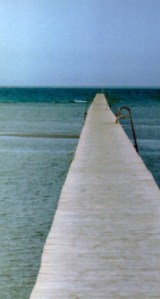




You must be logged in to post a comment.