It’s like this: I have a whole folder titled 365, full of interesting and informative ideas for this blog. I even had an idea for the post I wanted to do today, but lo (for various reasons involving day job bureaucracy for both myself and Mr Man), ’tis not to be. Instead, I give you ChatGPT’s idea of “a quote about joy in the voice of my cat.”
“Joy is found in the simple things, like a warm sunbeam, a cozy napping spot, and a good belly rub. Purr-fect happiness is just a whisker’s length away.”
— Your Cat.
Because this is the sort of information that everyone needs.
For more on cats and whiskers:
* You may also know that “chat” is French for cat. So now we know what’s really behind A.I…. that’s right, animal intelligence.
Let’s give one last shoutout to our visitor from outer space. C/2022 E3 (ZTF), the universe’s charismatic invitation to look up and wonder about our past and our future, is at its closest point to Earth today. That means it will be at its brightest. If the world and weather are on your side, you might be able to see it with the naked eye. Look to the north after sunset. Is it fuzzy? Is it green? It might just be a comet!
During the comet’s perigee, it will come to within a distance of around 26 million miles (42 million kilometers) from our planet, which is equivalent to about 28% of the distance between Earth and the sun. If you’ve been waiting to get a look at C/2022 E3 (ZTF) before it speeds away, now is your best chance. You can also watch the comet live online on Feb. 1 in a free webcast at 11 p.m. EST (0400 GMT) from the Virtual Telescope Project.
If the weather isn’t cooperating where you are or you have a hard time finding it or you just can’t see yourself outside in the cold, there will be a live webcast tonight. Pour a cup of hot cocoa and wave as The Green Comet flies by!
My mother, ever curious, wanted to know what all the “green comet” fuss is about. Here’s a quick guide to C/2022 E3 (ZTF), a visitor last welcomed to these parts by Neanderthals.
NASA’s Jet Propulsion Labs (NASA JPL) gives the period of this comet as 50,000 years. This means the last time the orbit of C/2022 E3 (ZTF) brought it so close to the Earth, our planet was in the midst of the last glacial period or “ice age” and early Homo sapiens and Neanderthals still shared the planet.
Comets are clumps of dust and frozen gases, sometimes described by astronomers as “dirty snowballs.”…
“They’re alive,” Laurence O’Rourke, an astronomer with the European Space Agency, said. “When they’re far from the sun, they’re sleeping, and when they get close to the sun, they wake up.”
[Nothing to worry about then. It’s fine!]
…
To catch the comet, look north.
On Jan. 21, the night of the new moon and thus the darkest skies, the comet will be close to Draco — the dragon-shaped constellation that runs between the Big Dipper and the Little Dipper.
Over the following nights, the comet will creep along the dragon’s tail. And on Jan. 30, the comet will reside directly between the Big Dipper’s “cup” and Polaris, the North Star. If you’re accustomed to finding the North Star by following the two stars on the end of the Big Dipper’s cup, then you should be able to spot the comet. Simply scan that imaginary line until you see a faint smudge.
…
For anyone living above the 35th parallel — imagine a curving East-West line running from North Carolina through the Texas Panhandle out to Southern California — the comet will be visible all night starting Jan. 22.
So C/2022 E3 (ZTF) is going to be visible for a while, but you might need binoculars. What did the Neanderthals think of it and its dramatic green halo, I wonder?
Scientists have been trying to image the intricate plumbing of volcanoes to help understand their dynamics and better predict eruptions… and plan better supervillain lairs.
They didn’t really say that last part. But they should have.
As an example, here’s a handy explainer showing the depths beneath Santorini, a beautiful but geologically unstable Greek island in the Mediterranean. The graphic shows why.
It also tries to give a nod to the volcanically disrupted Minoan culture, late of Santorini, but the Latin placeholder text is less than useful. Here’s a link to help with that: Santorini 1600 BC and the End of Minoan Civilization.
If you have a chance to visit the island, I recommend it. Because nothing says a supervillain lair can’t be pretty.
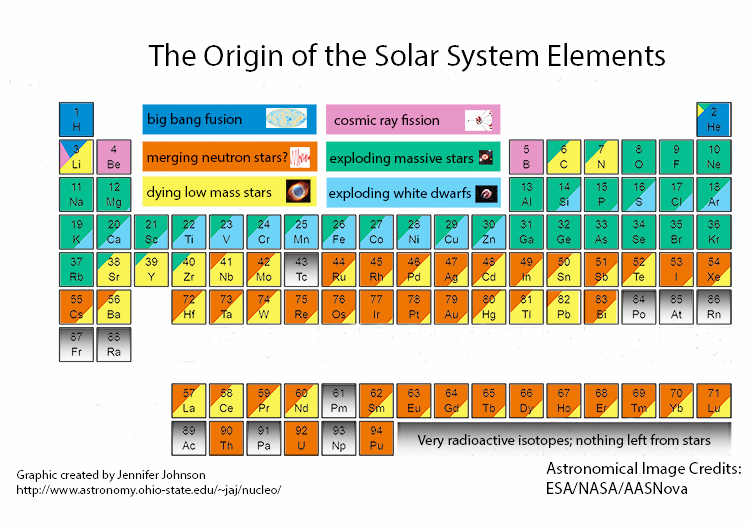
A recent NASA Astronomy Picture of the Day featured an excellent version of the Periodic Table highlighting not just elements, but also those elements’ origins.
The hydrogen in your body, present in every molecule of water, came from the Big Bang. There are no other appreciable sources of hydrogen in the universe. The carbon in your body was made by nuclear fusion in the interior of stars, as was the oxygen. Much of the iron in your body was made during supernovas of stars that occurred long ago and far away. The gold in your jewelry was likely made from neutron stars during collisions that may have been visible as short-duration gamma-ray bursts or gravitational wave events…
The December solstice is the moment the Sun is directly above the Tropic of Capricorn in the Southern Hemisphere. This is the southernmost latitude it reaches during the year. After the solstice, it begins moving north again.
Today is also technically the start of winter, although the fifteen inches of snow in our front yard this past week would beg to differ.
Between that and predictions of another big storm in the offing, it’s no wonder Santa is so determined to make his annual road trip.
This year was a bumper one for our neighborhood rabbits. We had a lot of babies running around during the warmer months, and still have at least a few adults. One has been acting a little extra lately, sprinting by the porch and across the street rather than sauntering as it did this summer. He seems to be trying to minimize the amount of time he and his brown fur spend exposed over snow-covered ground. Sensible, as we still have a few stray cats and other predators in the area.
Which led me to ask, “How does a rabbit know what color it is?”
* * *
The opposite of this. Photo by Andy Brunner on Unsplash
/for those not interested in new technology, the influence of that technology on writing, or our future overlords’ feelings about cat names and other topics, avert your eyes!
You may have seen recent discussions on ChatGPT, the new AI chat bot blazing its way across the internet.
I resisted for a few days and then gave in. Is it as good as they say? In my (admittedly limited experience), yes and no. Here are a few examples.
* * *
I’ve written about AI-assisted writingbefore, but the models are getting markedly better. There are still hiccups like getting stuck mid-list due to an odd love for the word “Catrick” (on the way to “List the top one hundred humorous names for a cat” which, let’s face it, should be AI 101). “Catrick Stewart” yes, “Catrick Eddie Vedder” maybe not so much.
Other jobs it did quite well.
Need a “six-paragraph blog post explaining space elevators”? ChatGPT has you covered:
A space elevator is a hypothetical structure that would allow vehicles to travel from the surface of the Earth to outer space. The concept of a space elevator was first proposed by the Russian scientist Konstantin Tsiolkovsky in 1895, and has been explored in various forms by scientists and engineers over the years.
The basic idea behind a space elevator is to have a cable or tether anchored to the surface of the Earth and extending into space. This tether would be attached to a stationary platform, known as a counterweight, at the outer end. Vehicles, such as spacecraft, would then be able to travel up and down the tether, using electric motors to climb or descend as needed.
The main advantage of a space elevator over traditional rocket-based launch systems is that it would allow for much cheaper and more efficient access to space. Rockets require a large amount of fuel to lift off from the Earth’s surface and overcome the planet’s gravitational pull. A space elevator, on the other hand, would essentially be “riding” the Earth’s rotation to reach space, using a fraction of the energy required by a rocket.
However, there are several challenges to building a space elevator. One major challenge is the material that would be used for the tether. The tether would need to be incredibly strong and lightweight, as it would need to be able to withstand the enormous forces exerted on it by the Earth’s rotation and the weight of vehicles traveling along it. Additionally, the tether would need to be able to withstand the extreme temperatures and radiation found in space.
Another challenge is the cost and feasibility of constructing such a massive structure. The tether would need to extend all the way into space, potentially reaching an altitude of more than 20,000 miles. Building and maintaining such a structure would be a massive undertaking, requiring significant financial and technological resources.
Despite these challenges, the concept of a space elevator continues to be explored and studied by scientists and engineers. Some believe that the development of new materials, such as carbon nanotubes, could make the construction of a space elevator possible in the future. Until then, however, the dream of a space elevator remains just that – a dream.
― ChatGPT
Or perhaps you need “a blog post about interesting events in today’s history with a little humor”?
Today in history, we commemorate some truly fascinating events! For example, did you know that on this day in 1872, the world’s first international football match was played between Scotland and England? It ended in a 0-0 tie, but it was a historic moment for the sport and for Anglo-Scottish relations.
But that’s not all! On this day in 1859, the first professional football game was played in the United States. And in 1922, the tomb of King Tutankhamun was discovered, sparking a renewed interest in ancient Egyptian history and culture.
But it’s not all serious business today. On this day in 1823, the first ever Christmas Eve office party was held in New York City. And in 1965, the first ever Yule Log was broadcast on television, providing a cozy and festive atmosphere for viewers at home.
So as you can see, there’s a lot to celebrate today! Whether you’re a sports fan, a history buff, or just looking to party, there’s something for everyone in today’s historical events. So let’s raise a glass and toast to another year of interesting and memorable moments in history!”?
― ChatGPT
But if you want “a hundred word story about a talking cat”? The results were perhaps less useful:
The talking cat was a curious creature. She would sit by the window for hours, watching the world go by and musing about the strange habits of humans. She had many questions, but no one to answer them. That is, until she met the little girl who lived next door. The girl was just as curious as the cat, and the two of them quickly became fast friends. They would spend their days together, the cat sharing her wisdom and the girl listening with rapt attention. And as the girl grew older, the cat was always there to offer guidance and support. They were an unlikely pair, but they were the best of friends.
― ChatGPT
And it completely choked on a few requests, like “write a poem where the last word in every line is a palindrome” (it ignored the palindrome request and just wrote a poem, same when anagrams were tested) and “What did Robert Heinlein say about signs of social change?”
I’m sorry, I am not able to browse the internet, so I cannot provide information on what Robert Heinlein may have said about signs of social change. As a large language model trained by OpenAI, my knowledge is based on the text that has been input into my training data, which has a cutoff date of 2021. I do not have the ability to browse the internet or access new information.
― ChatGPT
* * *
As you can see, it also makes the production of a lot of text possible in a very short period of time. I have some ideas but finding ways to make it useful for fiction is still a work in progress, I think.
Although it did help me with ideas for dinner.
Mars Dinner Recipe
Ingredients:
2 cups dehydrated mashed potatoes
1 cup dehydrated mixed vegetables (peas, carrots, corn)
1 cup dehydrated beef or chicken
1 tablespoon dehydrated onion
1 tablespoon dehydrated garlic
1 tablespoon olive oil
Salt and pepper to taste
Instructions:
• In a small pot, combine the mashed potatoes, mixed vegetables, beef or chicken, onion, and garlic. Add enough water to cover the ingredients, and stir to combine.
• Place the pot over a portable stove or heat source, and bring the mixture to a boil.
• Reduce the heat to low, and let the mixture simmer for 10-15 minutes, or until the meat and vegetables are fully rehydrated and the potatoes are soft.
• Stir in the olive oil, and season with salt and pepper to taste.
A former NASA engineer and now-YouTuber has created a viral sensation with a video documenting efforts to send an egg to near space to test if it cracks up on landing.









You must be logged in to post a comment.