Today is Earth Day. Happy 4.543 billionth birthday, Earth! Here’s hoping for many more.
Much of my day job is based in current news and events, which means I spend a good part of most days knee-deep in the internet. Yeah, it can be exactly as fun as it sounds. That said, I’m not looking for the bad stuff, or not only the bad stuff.
It’s hard to miss the evidence of change, but the good news is that we’re not just discussing it, we’re beginning to take concrete action.
* * *
You already know that doing big things is hard. Like ”saving the planet.” Human beings are small, and I suspect that at the root, most of us are plagued by the niggling feeling that we are just bit players on an unimaginably vast stage. That at some fundamental level our actions don’t matter much at all in the bigger picture. Not really.
But we’re wrong. And the world is made up of smaller pictures.
It’s the question every hero is asked: The future is uncertain. The path is unknown. What are you going to do about it?
What you can, wherever you can. As a minor example, I spent time today researching ways to turn our absolutely useless lawn space into a pollinator garden.
Of course, a lot of what needs to happen on climate change isn’t just about individual action. Deciding not to eat meat on Tuesdays matters, but standards and infrastructure for energy, transportation, agriculture and construction, to name a few sectors, will need to modernize too.
It means working together on new ideas, new innovations, and new legislation. More and better targets, the kind that make a positive difference in people’s lives.*
Because humans are a social species. There is never just one, and when it comes to saving our home that’s a challenge but also a benefit. Sea shanties swept the globe in a matter of weeks. Why not this?
* * *
It sounds big, and it is, but we do big things all the time, often by accident.** It’s just time to do this particular big thing on purpose. Here’s the mantra I try to stick with: Pick a goal. Break it down. Start today.
We are never just one. None of us are. We are legion. And we got ourselves into this mess. We can get ourselves out.
Starting today.
* * *
* Like clean air and water. And I really enjoy the fact that one day, for example, I’ll be able to put my seat belt on, drive an electric car down well-maintained roads, sit in a non-smoking section at a restaurant, and eat food that won’t kill me. And that my nephews don’t spend their summers swimming in a creek laced with PCBs (like we did). Crazy, I know!
** I mean, who sets out to upend civilization? They just want to see what happens if they burn that dirty rock or invent the light bulb or the assembly line or freaking Facebook. There is no button a curious monkey will not poke. Wouldn’t it be nice if we can make it work for us for a change?
* * *
“Look again at that dot. That’s here. That’s home. That’s us. On it, everyone you love, everyone you know, everyone you ever heard of, every human being who ever was, lived out their lives… The Earth is the only world known so far to harbor life. There is nowhere else, at least in the near future, to which our species could migrate. Visit, yes. Settle, not yet. Like it or not, for the moment the Earth is where we make our stand… To me, it underscores our responsibility to deal more kindly with one another, and to preserve and cherish the pale blue dot, the only home we’ve ever known.”
(Being me, I couldn’t resist a Hobbit reference, but this post is about migratory birds in general. No Goblins allowed!)
* * *
We’ve still got two feet of snow on the lawn but the signs of Spring are everywhere. Melting ice, the smell of skunk in the night, and Canadian teenagers in shorts and T-shirts (it is above freezing, after all). And soon, the birds will be back. Last evening I heard a flock of Canada geese heading for the river, and they aren’t the only avian adventurers heading our way.
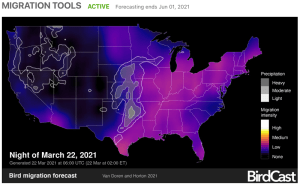
If you are interested in the when and where of bird migrations, you’re in luck. From now through the end of May you can track migration forecasts, get location-based alerts, and learn more about what’s happening in Birdlandia.
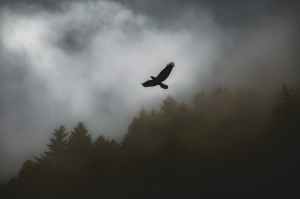
And as for those eagles, and other birds of prey? Check out this story about a suffragist and bird lover who established Pennsylvania’s Hawk Mountain Sanctuary in 1934. It’s an incredible place, and is why I am lucky enough to know what it’s like to watch from the edge of a stone outcropping while hawks ride the thermals mere feet away.
The abundance of raptors at North Lookout owes a great deal to topography and wind currents, both of which funnel birds toward the ridgeline. But it owes even more to an extraordinary activist named Rosalie Edge, a wealthy Manhattan suffragist who founded Hawk Mountain Sanctuary in 1934. Hawk Mountain, believed to be the world’s first refuge for birds of prey, is a testament to Edge’s passion for birds—and to her enthusiasm for challenging the conservation establishment. Bold and impossible to ignore, she was described by a close colleague as “the only honest, unselfish, indomitable hellcat in the history of conservation.”
(adapted from The New York Times Large Type Cookbook)
Notes from my father: Here’s the best story I have about this recipe; this happened at Hawk Mountain. We were there to see the raptor migrations in October. We were camping at a nearby state park and it was freezing, in fact it snowed. We were cooking chakchouka for 4 in a big pan over a Coleman stove. Right near the end of the cooking we picked up the pan to serve everyone and it tipped and spilled a large part of dinner into the dirt. You two were off running around in the woods somewhere, so we both looked at each other and then at dinner in the dirt, looked back at each other, then brushed the dirt off and put it all back in the pan. It was actually still pretty good. You know in statistics “robustness” means that you can violate the rules a lot and the results still hold, so you could say that this is a very robust recipe.
3 links Italian sweet sausage, cut into 1-inch pieces
2 Tbs. olive oil
2 onions, finely chopped
2 cloves garlic, minced
1 green pepper, diced
1 tomato, diced
2 potatoes, diced
1 cup water
Salt and pepper
3 eggs, lightly beaten
Sauté sausage pieces in a large skillet until browned.
Add olive oil, onions and garlic and cook 3 minutes.
Add green pepper, tomato and potatoes and cook 2 minutes longer.
Add water and allow mixture to simmer, uncovered until potato is tender. Season with salt and pepper.
Stir in eggs and continue to cook, stirring, until eggs are done, about 2 minutes. Garnish as desired.
My little brother just got his first shot. I can’t tell you how happy I am that he and his wife are one step closer to full protection.
As discussed in many venues in recent months,* the path to the Covid-19 vaccines has been convoluted. And not only does our health and safety rest on the shoulders of scientists who spent most of their careers in under-rewarded obscurity** but the history of vaccines is even more complicated than it may at first seem.
* * *
The past year has been a nightmare, but I am incredibly grateful that we haven’t had to deal with a disease like, say, smallpox. Wildly contagious with a fatality rate of about thirty percent, for most of human history this disease was unstoppable. It spread within communities and also, devastatingly, between locations (like 17th century Europe and North America).
Thanks to a concerted international effort and global vaccination campaign, by 1980 smallpox was eventually eradicated. Thank you, science! And now we’re tackling our own pandemic with the power of vaccination. How did we get here?
* * *
The history of vaccination usually starts something like this:
One of the first methods for controlling smallpox was variolation, a process named after the virus that causes smallpox (variola virus)… The basis for vaccination began in 1796 when the English doctor Edward Jenner noticed that milkmaids who had gotten cowpox were protected from smallpox. Jenner also knew about variolation and guessed that exposure to cowpox could be used to protect against smallpox.
What caught my eye about this bit in particular was “variolation.” Who, I wondered, was behind the initial work? I’m always interested in the beginnings of things. Who worked out how to eat a poisonous plant like cassava, for example? In this case, where did the idea of inoculation come from? What of the giants on whose shoulders we stand?
Practitioners in Asia worked out the method, and by the 1700s it had spread to Africa, India and the Ottoman Empire. Next stop, North America, by way of the slave trade.*** Here’s a version of that story in graphic form:
At the same time, a smallpox epidemic devastated England. An English Lady (yep, capital L), Lady Mary Wortley Montagu, brought information about inoculation back with her from the Ottoman Empire, where female medical professionals practiced a variation of the technique:
Unfortunately, “European doctors were aware of what the Ottomans and others were doing but they refused to believe it worked. At the time, “Europe was pretty isolated and it was fairly xenophobic”…”
Lady Mary’s efforts came up against (stop me if you’ve heard this one) prejudice, xenophobia, and the perverse financial incentives of the medical profession.
“I am patriot enough to take the pains to bring this useful invention into fashion in England.” But in the next breath, she expressed contempt for British doctors, who she believed were too preoccupied with making money: “I should not fail to write to some of our doctors very particularly about it, if I knew any one of them that I thought had virtue enough to destroy such a considerable branch of their revenue, for the good of mankind.”
— Lady Mary Wortley Montagu
Even so, she had a positive impact, not least on one particular individual:
…the technique she’d borrowed from Ottoman women did take hold in England. Many thousands were inoculated, including a young boy named Edward Jenner. He went on to develop the first vaccine, also against smallpox.
So here’s to the unsung heroes who took the first steps into the unknown, the practitioners lost to history, and those who passed their knowledge down in the hopes that we would use it to build something better, like the slave who shared what he knew and the aristocrat who used her status for good.
“One takeaway for everyone, whether it be scientists or nonscientists, is that we’re not nearly as smart as we think we are,” he says. “We have much we can learn from others.”
** That really should change, and I hope the Nobel Prize Committee agrees with me. Katalin Karikó, Ugur Sahin and Ozlem Tureci in particular come to mind.
*** No, I’m not happy about this either, but I am very grateful that Onesimus was willing to share.
Everyone and their uncle will be talking pi/e today, so I’m just going to leave it at a wish for a happy day, and pie.
It’s cold again today, with gusty winds and a bright clear sky that feels like winter will never leave. Still, Spring is near, I just picked up the first Travis McGee book again and my reader mind is in Florida with lemon and lime trees around every corner. Today I’m thinking of warmth and lemon meringue.
Will I make it? Maybe, but taxes are calling. Either way, it is a delightfully sweet, citrus-scented dream.
Whether you’re in it for the math or the sugar, here’s hoping you have a very Happy Pi Day, folks!
Are you or someone you know currently in possession of superpowers? Are you ready to break out of the box your secret identity has put you in, and fly (or leap, or teleport) free from traditional norms and expectations? Then it is your lucky day!
The Paranormal Challenge is offering a cool quarter of a million dollars US for proof of powers. Supes from all corners of the globe, or universe, are welcome! And the field remains wide open.
Only a handful of the 100 to 150 applicants to the Paranormal Challenge who contact the center each year actually make it to the testing phase…
And that’s not the only such challenge. If you’re ready to come out of the phone booth and face your fans, Wikipedia has a list of current prizes for proof of abilities:
Sure, you’ll be outed on a global scale, tasked with defending the world from the forces of evil,* forced to spend your free time cleaning up other people’s messes while being second-guessed by every Tom, Dick, and Trollie on social media, but just think! You’d never have to wait in line again. And I know you’re in this for the good of humanity and all, but the name and likeness rights alone will set up your family for generations to come.
So come on out! The frontline workers, doctors, nurses, police, and other first responders could use a break.** And my mom makes great capes!
My mother made me and my brother amazing satin bat capes for Halloween one year. I know, Batman doesn’t actually have superpowers. Don’t tell 8-year old me that, though. Photo by Joey Nicotra on Unsplash
* * *
* I mean, you could be evil, I suppose, but that’s only cool in stories. In real life, the trail of broken lives and civilizations has to wear on you after a while. And the insurance premiums! Not that I’m speaking from experience or anything.
If you, like me, watched the Mars landing and thought, “So cool. But something is definitely up with that parachute,” you were not wrong!
Image via the Parachute Up-Look Camera A on Feb. 23, 2021 (Sol 2). NASA/JPL-Caltech
The striking red and white pattern was too distinctive to be meaningless.
I initially speculated that the design was meant to help engineers better understand the forces at work as the lander fell through the atmosphere, but nope. With more thought I might have made some progress, but I put the question aside and focused on other things (like the first audio recording from the Red Planet).
Depending on the shape and location of the red-and-white color patterns circling around the parachute’s center, the segments represent different numbers which can be translated through binary code.
Check out the key below, showing the code in four concentric patterns. It reads: Dare Mighty Things. That’s the Perseverance team motto and is also on the wall at the Jet Propulsion Lab. JPL gets another shout-out in the outer ring, which lists the Lab’s lat/long coordinates on Earth. (That’s going to be awfully confusing for any aliens who find it on Mars:)
Speaking of extraterrestrials, now seems like a grand time to plug my favorite new Syfy show, Resident Alien.
An alien crash lands on Earth and must pass himself off as small-town human doctor Harry Vanderspeigle. Arriving with a secret mission to kill all humans, Harry starts off living a simple life…but things get a bit rocky when he’s roped into solving a local murder and realizes he needs to assimilate into his new world.
It stars the fabulous Wash, I mean Alan Tudyk, plus a cast of other terrific, talented and quirky actors, and is a thing of beauty. The premiere was frakking hilarious.
It’s on my mind because it plays on Wednesday nights, but if you missed it, full episodes are available online for the next year or so.
Because it’s Tuesday, my most stressful day of the week, here’s a “how to defeat stress” breathing video.
This video and many others are included in James Nestor’s collection of expert material on the benefits of hacking your biological systems via invisible forces, a.k.a. air. I enjoyed his Breath book, too.
I spend a lot of time online for non-writing-related work, and on the way to serious business I run across a lot of interesting things. It’s Monday, so here’s a calming fascinating visualization of The Internet and its growth from 1997 to 2021. (Actually, you know what? This isn’t calming at all. I updated the wording but now I’m worried this is going to give small children nightmares. Or maybe me. Still interesting though.)
Look closely enough and you might see sledding pandas and cat videos and recipes and sales and news and art and perhaps even yours truly.
* * *
Parts of the internet are pure entertainment and too many are just awful but others include useful lessons on How to Do Better.
You may remember my motto, A Posse Ad Esse.* I don’t always achieve this goal, but I spend a non-zero amount of time trying to Do Better. Find ways to be more productive, to end the day feeling like I crossed off, if not everything, then the most important things on my list.
That’s been a challenge the past year or, hmm, so. That’s partly why I’m going back to writer’s guides like Swain. It’s also why when I run across articles about grit or new research on how to accomplish more, I take a minute and peruse.
Lately, I’ve found this recent research in Applied Psychology: An International Review helpful. (Ok, fine, I found this article and its summary of those results helpful. I don’t have access to that journal and honestly, reading every interesting scientific study would cut into my cat video time**;)
What did they find? That when working to accomplish something, it’s useful to ask yourself a few specific questions:
What’s my goal?
How would a person who is good at this achieve the goal?
How will I feel if I don’t do this?
What is the first (or next) thing I need to do?
It helps to take a brief break, a couple of times a day, to step back and revisit what you’re trying to do and what needs to happen next. And as “with advertising, repeated exposure was key.” So asking these questions a couple of times a day can help prompt a quick moment of self-reflection that (here’s the useful bit) actually leads to action. I have my Calendar app set to pop up these questions first thing in the morning. So far it’s been helpful.
Let’s try it:
What’s my goal? Write this post.
How would a person who is good at this achieve the goal? Probably stop procrastinating and start writing, so that’s what I’ll do.
How will I feel if I don’t do this? Lame.
What do I need to do next? Open a file and start writing.
And look, here we are! Now I get to cross this off my list and go have lunch. Have fun getting things done today!
* * *
“A majority of life’s errors are caused by forgetting what one is really trying to do.”
— Charlie Munger
* * *
* My Latin is 110% terrible so this may not be exactly right, but it gets the point across.
** I don’t actually watch cat videos much, but it’s nice to know that I could.
I may have a Mars hangover,* so today it’s… drum roll please… Free Fiction Day! Wherein I source high-quality fiction for your perusing pleasure. It’s Friday and I am looking forward to the weekend, so today’s installment is this recent little gem from the good folks over at Daily Science Fiction:
Onboarding Practices for the Ravaging Horde
When ravaging, it is important that you work hard to create a suitably terrifying experience for the peasant farmers of the indolent lands of Gresh. Best practices include clearly establishing client expectations in an orderly and timely manner, particularly for any projects with cyclical processes such as the burning of seasonal crops, the dismaying of children’s birthday parties, or the poisoning of wells.
* Way to go, Perseverance! And yes, we watched The Martian last night. Still fun, and I had the added enjoyment of measuring the distance between where we are now and the movie world. It’s also interesting to consider the fact that (as far as I know) there’s really nothing stopping private citizens from going to Mars themselves. Aside from an ocean of money, which we’ve oh so helpfully given to space-geeks like Elon Musk and Jeff Bezos. Will the first human on Mars plant an Amazon flag? Drive a Tesla rover? Claim (ahem) prime real estate and start building oversized warehouses, then charge the rest of us entrance fees? Disturbing thoughts!







You must be logged in to post a comment.