Feeds:
Posts
Comments

Posts Tagged ‘#365Ways2021’

Saturday mornings always remind me of cartoons and classical music.

We didn’t have a television when I was growing up (or junk food like sugary cereals), which was great for reading and not quite so great for social integration. (This was before there was a smartphone in every pocket, terabytes of entertainment at every turn, and the splintering of society. But I digress.) 

* * *

I did manage to absorb a decent amount of after-school programming and advertising jingles at friends’ houses, and Saturday morning cartoons when we visited our grandparents.

They had a cute little house in Chicago, with a TV room in the back. That’s where I slept when we visited, and I loved it because it meant I could wake up early and start the day with a deliciously sweet diet of cartoons. My brother would join me soon after, and we’d watch until the rest of the house was up. 

* * *

Most Saturdays, though, we’d wake up at home. What those experiences had in common was classical music. Cartoons have used classical scores for decades. My father is a big fan, and likes to start the day with classical music, played loud. Especially on Saturdays. One of the first albums he bought us as kids was Peter and the Wolf.

To this day, I can’t hear that Prokofiev tune without smiling.

I wasn’t the only one indoctrinated by the classical/cartoon connection, of course. Many of you were right there with me. Click through for a fun thread that identifies a number of the more recognizable pieces.

Or perhaps you are looking for a 2+ hour collection of cartoon music? Then this is your lucky day!

* * *

Since I’m thinking of my father and music, here’s a link I think he might enjoy:

I have no idea what most of these shows were (United States Steel Hour?), but I hope that he does, and that some of this music brings a smile to his face, too.

* * *

Happy Saturday!

Photo by Any Lane on Pexels.com

Read Full Post »

It’s been a weird week.

I’d planned something else for today’s post but the website I needed is down. Or just hates me, which is the same thing.

Instead, let’s talk about motivation. And how I don’t have any at the moment. I’m a little stuck when it comes to writing, and while other work is getting done, on that front I’m just… stuck. 

I’m sure I’m not alone, and it can help to remember that.

* * *

I’m reading, way too much. Not possible, you say? Well, honestly, I’d agree you most of the time. I can’t remember a time when I didn’t love to read (thanks, parental units!). It serves me well most of the time, and of course you have to read well in order to write well.

Photo by Jaredd Craig on Unsplash

Input is good but there must be output as well. And right now the balance is a bit off. 

* * *

I am hesitant. That’s a fairly accurate word for it, I think. Asking which direction to go, what steps to take, what story to tell? It’s called the paradox of choice, as in, having too many options makes it harder to make a decision, not easier. This concept is typically applied to decisions about things like breakfast cereals, but it works here too.

So, what to do?

Maybe I’ll limit myself to a certain genre, or length, or story model. Or maybe I’ll make a rule to follow. (I actually like doing that, it does make life much easier. As in, Monday, Wednesday, Friday I work out. No questions, no time spent planning, no wasted brain power trying to wiggle out of it;)

* * *

It helps that today is Friday, that most wondrous of days. Mr. Man will be home soon and there will be laughter and warmth and frosty adult beverages for all. And so long as I keep moving, keep doing, keep trying, I’ll still make progress. Even when things get weird:)

* * *

Photo by Miriam Espacio on Pexels.com

Read Full Post »

You may have noticed that I like funky little websites where people use their creativity to help us use ours. On that topic, I built a spaceship this morning.

This site takes your ship name and builds you a ship. 

shapeWright.

This is an experimental platform for mass customization and procrastination.

They also do other types of models but I wanted a spaceship. This should surprise absolutely no one who knows me.

* * *

Here is my ship, the HMS Happy Day

* * *

Is it weird that it looks like a time-traveling engineer hacked together an AT-AT and the walls of Gondor?

I didn’t think so either:)

Now I’m off to do something more concrete, but my day will be better for that quick mental break. Here’s hoping you can find a little fun in your day too!

Read Full Post »

Somehow this day has completely gotten away from me. I’m still cranking away on day job stuff, so I will leave you with this magic wand. Which I will need to finish off all the items still on my list:)

* * *

One wand, maple. The magic is up to you.

Have fun getting things done!

Read Full Post »

Today, do something amazing.

And the more I learn about creativity, productivity, and motivation, the more I realize that the most important word in that sentence is “today.”

* * *

Photo by Sharon McCutcheon on Pexels.com

Read Full Post »

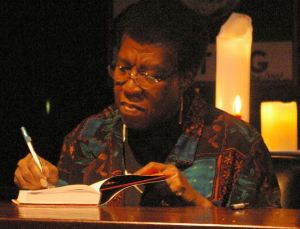
Yesterday it was Black History Month and today it is Women’s History Month. It seems like the perfect day to spotlight American science fiction writer Octavia Butler. 

Nikolas Coukouma, CC BY-SA 2.5 https://creativecommons.org/licenses/by-sa/2.5, via Wikimedia Commons

* * *

Who was she?

Octavia Estelle Butler (June 22, 1947 – February 24, 2006) was an American science fiction author. A multiple recipient of both the Hugo and Nebula awards, she became in 1995 the first science-fiction writer to receive a MacArthur Fellowship.

— Octavia E. Butler – Wikipedia

* * *

What makes her work special?

I think the first Butler book I read was The Parable of the Sower, found in the interesting section of the family’s bookshelves. It had a woman’s name and a black image on the cover. Count me in, I said. And then it got interesting.

This was no whitewashed far future in space, or something like Heinlein’s more recognizable near-ish futures. We begin in a devastated California, raw and gritty and often painful, but with hope and purpose to bind it together into a larger whole. 

This NPR show talks about her work and what made it remarkable:

Octavia Butler: Visionary Fiction‬

She was a deep observer of the human condition, perplexed and inspired by our propensity towards self-destruction. Butler was also fascinated by the cyclical nature of history, and often looked to the past when writing about the future. Along with her warnings is her message of hope — a hope conjured by centuries of survival and persistence. For every society that perished in her books, came a story of rebuilding, of repair.

* * *

Where to start?

She became the first science fiction author to be granted a MacArthur fellowship, and the first Black woman to win Hugo and Nebula awards. Today her influence spans literature, genres and media.

— The Essential Octavia Butler – The New York Times

These links lay out her work and explore her growth as a writer. Explore more to get a better sense of what she wrote and why.

Where to Start with Octavia Butler | The New York Public Library

“‘Devil Girl from Mars’: Why I Write Science Fiction”

In 1998, Butler delivered an address at the Massachusetts Institute of Technology. She describes the thinking behind several of her works of fiction and her motivations for writing. It is essential reading for understanding the social consciousness behind the beloved writer’s oeuvre. 

NYPL

* * *

I won’t lie. Butler’s work is good but can be challenging, not least because of the way it takes a visceral look at who we are and what we can be (both the good and the bad). In many ways, I think of her writing as a more realistic, more historically-informed vision of our future than many of the rah rah space travel versions of sci-fi. Unless we change, that is.

Read Full Post »

Apparently, we are chilling today. 

Do not disturb the Neko Monster!

Mostly, anyway. I’ve accomplished a few things and had planned to plan my next month of writing work, but I’m really just having fun reading.

What else? In keeping with the chilling theme, I may design a few icebergs, because what better art project on a snowy day?

Iceberger

Later, I’ll give Mr. Man a haircut (while appreciating the talents of his regular barber, who does the job roughly 4 million times faster than I do). And then I may do a little design work. Or learn about household economics in early nineteenth-century England. Or shovel some snow. Or find my second-favorite biscuit recipe. Or pack and freeze a 25-pound bag of flour.

Or maybe not. I’ve got a book to finish.

“If you cannot do great things, do small things in a great way.”

— Napoleon Hill

Happy Sunday!

Read Full Post »

This is a somewhat random selection of books I like.

What do they have in common? Awesomeness, that’s what (at least to my mind:). But at their core, they each have a different, clever, well thought-out idea that powers the story engine. And this is just a selection of one person’s likes. There are so many ways to tell a story, and so many ideas from which to start. 

Great. So how do you get to a good idea?

“The best way to have a good idea is to have lots of ideas.”

— Linus Pauling

Excellent, so helpful. It’s good to have goals. But if you’re like me, you might be wondering what exactly that means, and how one goes about it?

So glad you asked! There are lots of ways, of course, from diving in with a crappy first draft (I do like this approach, so helpful for getting past blocks, but it can waste a lot of time), writing prompts, genre-bending or gender-bending existing ideas, to headline news to updated fairy tales to history. And when I’ve seen most professional writers talk about this, getting ideas isn’t really the problem.

It’s getting a good idea. How do we do that?

* * *

Here is a ten-part approach to generating, selecting, and growing ideas from Scott Myers. He recommends generating an idea a day for a month, to get in the habit. Given his background, his suggestions are geared toward screenwriting, but the essential principles are useful across genres.

* * *

Maybe you don’t think of yourself as a writer or creative. That’s fine, but humans are still wired to think in terms of stories. It’s how we understand the world, solve problems, and plan for the future.

Stories the world over are almost always about people with problems,” writes Jonathan Gottschall. They display “a deep pattern of heroes confronting trouble and struggling to overcome.” So a possible formula for a story = character(s) + predicament(s) + attempted extrication(s). This pattern transmits social rules and norms, describing what counts as violations and approved reactions. Stories offer “feelings we don’t have to pay [full cost] for.” They are simulated experiments in people-physics, freeing us from the limits of our own direct experience.

— It Is in Our Nature to Need Stories

What do you see when you look out the window? What stories might you tell about the couple across the street, or the rundown house on the next block, or the accident you just drove past?

It’s that simple, and that hard.

* * *

Photo by Dom J on Pexels.com

Read Full Post »

I have a thing about Beauty and the Beast tales, and I think I’ve just figured out why.

Fairy tales are classics for a reason. They strike deeply-ingrained cultural notes that resonate across many lines. (And like most of history, they’re often pretty hard on women.) But what is it about this particular storyline that appeals to me? I’d never really thought about it, until I found myself reading a not terribly well-done version and wondering why I was still reading. Why this sub-genre appeals to me. Then I figured it out.

It’s because in this story, she saves the day.

* * *

We can argue about the story or the level of efficacy Beauty has (not to mention her name), but the template of the story lends itself to modern updates in a way that many other fairy tales do not.

Now, don’t get me wrong, I have enjoyed other fairy tale retellings, but they don’t always appeal to me in the same way. Is it because there’s no princess in sight? Because there’s room for ethical debates alongside the magic and mystery? Because both main characters are flawed in interesting ways? Probably.

* * *

If you’re too young to remember a time when girls in (at least some) stories did not rescue themselves, count your lucky stars. When I was a kid, that’s pretty much all we had. Princess in a tower, waiting to be rescued? Check. Princess in dragon’s lair, waiting to be rescued? Check! Princess orphaned, alone, and (say it with me now) waiting to be rescued? Yep. And then, of course, there were all those stories where the girl didn’t even make it out alive. Ouch.

My parents tried, but it’s hard to counter the weight of all that history. Slowly, slowly, feminists pushed and creators did better and the world began to shift, but in the meantime, I was a voracious reader with limited formative years.

My attachment to the story may also have had something to do with my own position in the world at the time. The role of misunderstood outsider was one to which I could relate.

I mean, Heinlein’s* Friday was a big deal back in the day. Hard sci-fi starring a kick-ass woman of complex genetic makeup and latte-colored skin? Um, yes please.

* * *

On a related note, I recently learned that my father’s science fiction habit started thanks to recommendations from a sci-fi minded staff member at his university, lo those many years ago. That’s what got our shelves filled with speculation, and I’m better for it. So thank you, interesting unnamed woman who cared enough to share what she knew. (And if that doesn’t sum up most of human history, well, I don’t know what does.)

And that is one reason why I like what I like. Whatever you like, find a way to distill what’s good from it and embrace it. Even if at first it looks a little like a beast.

* * *

* There is deserved debate over Heinlein’s portrayals of women, but his stories helped me see that a different world, a better world, was possible as a kid, and that’s something I’ll always appreciate. It also made me think more about writing, and how to fix what’s broken, and it looks like I’m not the only one. Here’s Jo Walton’s take: The worst book I love: Robert Heinlein’s Friday.

* * *

lion in darkness
Photo by Matthew Kerslake on Unsplash

Read Full Post »

I like Rube Goldberg machines. They are ridiculous and entertaining and look like something I might actually be able to make (even if that’s not always true). They also help me pay attention to the everyday objects and systems around me in new and more interesting ways, always helpful for creativity!

Here’s a fun one for all you cake lovers out there.

I especially love the butter bit. (TBH, though, after all that, I’d want chocolate:)

* * *

And don’t even get me started on some of the lockdown creations people have come up with, like this family of awesome in Toronto. 

Well done!

Read Full Post »

« Newer Posts - Older Posts »