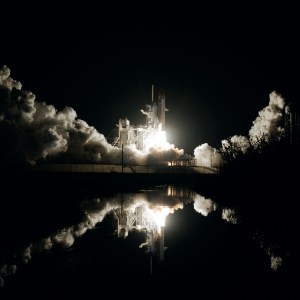
The countdown has begun! Tomorrow is the first April launch date for the Artemis II flight. (If the weather or tech doesn’t cooperate, the mission will be pushed forward, so the next couple of days could be interesting!)
The countdown for NASA’s Artemis II test flight is underway at the agency’s Kennedy Space Center in Florida, with members of the launch team arriving at their consoles inside the Rocco Petrone Launch Control Center. The onsite countdown clock started ticking down at 4:44 p.m. EDT to a targeted launch time of 6:24 p.m. on Wednesday, April 1.
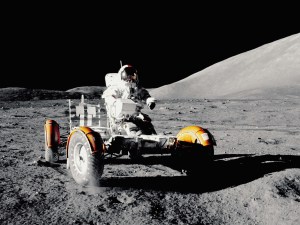
The Americans who blazed the trail to the moon more than half a century ago were white men chosen for their military test pilot experience. This first Artemis crew includes a woman, a person of color and a Canadian, products of a more diversified astronaut corps.
Speaking of the comparison to Apollo, what else is different, how are they similar, is that an excellent graphic showing time and trajectory (yes!) and more:
NASA has announced that Artemis II’s journey around the Moon will be available to track online and via a downloadable app called Artemis Real-time Orbit Website (AROW).
And here’s what it will be like inside Firing Room 1 a.k.a. Mission Control:
…who has the Artemis II astronauts’ backs as they make the 10-day, roughly 685,000-mile journey around the moon, aboard a rocket and spacecraft that haven’t carried humans before? And what does it take to work in the high-stakes, behind-the-scenes roles that keep astronauts safe and the mission on track?
Because astronauts are just the most visible part of what it takes to get a project like this off the ground. Here’s to the engineers, adventurers, and dreamers too!
NASA recently released the Artemis II roster for the next crewed lunar mission. As one article put it, “this is not your grandfather’s moon mission” and that’s a good thing. The crew is 25% female, 25% African American, and even (gasp!) 25% Canadian! (Think you too have what it takes? Here’s a link to get started: Astronaut Selection Program | NASA. Good luck!)
Why go to space? There are a lot of potential answers. Given the complex, diverse and fascinating future of exploration, here’s a collection of stories and essays that address this very question.
Stories by: Madeline Ashby, Steven Barnes, Eileen Gunn, Ramez Naam, Carter Scholz, Karl Schroeder, Vandana Singh
Essays by: Jim Bell, Lawrence Dritsas, Linda T. Elkins-Tanton, Emma Frow, Roland Lehoucq, Andrew D. Maynard, Clark A. Miller, Deji Bryce Olukotun, Steve Ruff, William K. Storey, Sara Imari Walker, G. Pascal Zachary
To supplement my previous post on the progress we’ve made imaging the far side of the Moon, here are a number of snapshots from the Artemis I Orion flyby.
The Artemis moon mission is now underway, which means fun updates like this video flyby of the Moon.
… NASA’s Orion spacecraft performs a close approach of the lunar surface on its way to a distant retrograde orbit, a highly stable orbit thousands of miles beyond the Moon. During the Artemis I flight test, launched on Nov. 16, Orion will travel 280,000 miles (450,000 km) from Earth and 40,000 miles (64,000 km) beyond the far side of the Moon, carrying science and technology payloads to expand our understanding of lunar science, technology developments, and deep space radiation.
Will the Artemis moon mission finally fly? The answer seems to be, “Probably.”* The weather has been challenging but tonight’s forecast looks good. Here’s hoping all goes well tonight!
A successful launch would be a key milestone for NASA’s Artemis program, which aims to put the first woman and first person of color on the lunar surface. The agency has not launched a space vehicle designed to send astronauts to the moon since 1972.
The space agency will host Artemis 1 launch webcast on Aug. 29 to showcase the uncrewed launch on NASA’s first Space Launch System megarocket from Launch Pad 39B at the Kennedy Space Center in Florida.
As of this writing, live updates have begun. Weather forecasts are good but there is an engine issue. Engineers are working the problem but some delays are expected.
The fact that humanity has been going into space, and to the moon, for decades doesn’t mean it’s easy. And that’s ok.
“I don’t need easy. I just need possible.”
— Katie Bone, 16-year old nationally-ranked athlete and Type 1 diabetic





You must be logged in to post a comment.