Tomorrow is an interesting day, astronomically speaking. Let me check my list; it’s a long one (and be warned, exclamation marks ahead!).
Let’s see:
- solar eclipse, check
- meteor shower, check
- planetary conjunction, check!
The Eclipse
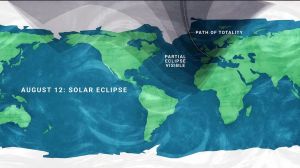
Parts of Western Europe will see a total eclipse, the first visible on mainland Europe in 27 years, but many other places on Earth will have at least a partial version. When and where can you see it? Here’s a look at the timing.
What time is the total solar eclipse on Aug. 12, 2026? | Space
While totality will be visible from parts of Greenland, Iceland and Spain, millions more people across Europe will experience a dramatic partial solar eclipse. Whether you’re chasing the moon’s shadow in Reykjavik or watching the moon take a ‘bite’ out of the sun from London, Paris, or Berlin, timing is everything.
New York City will only see about 9% totality just before 2pm, for example, but if you happen to be in London at 7:13pm, well, 91% totality for you!
You can look up your own location here: Total Solar Eclipse on August 12, 2026. For me, the max eclipse will take place at 13:42:42.
Not in the eclipse path? Live stream it here! LIVE: Total Solar Eclipse – August 12, 2026 – YouTube
One Spanish museum is taking an interesting approach to the eclipse, and how changes in the light impact our perceptions of art.
A light touch-up: Madrid’s Prado Museum digitally reimagines solar eclipse masterpieces | Euronews
The project, entitled “The Prado in the light of the eclipse”, proposes a progressive transformation of the lighting applied to some of the most iconic paintings in the celebrated gallery. Through this shift in light, the video shows how small variations in illumination can radically alter the perception of colours, shapes and the atmosphere of the paintings, revealing details and nuances that everyday light leaves hidden.
That’s already a lot, and we haven’t even talked about meteors or other planets!
The Meteors
Perseid Meteor Shower 2026—When, Where, and How to See It
Good news, meteor shower fans: the 2026 Perseids peak on August 12–13, under a New Moon—the ideal lunar phase for watching shooting stars.
Here’s a viewing map: Perseids Meteor Shower 2026
The Planetary Parade
And just before sunrise on the 12th, the planetary parade:
August 12, 2026 Sky Events: Solar Eclipse, Perseids, Planet Parade
The day starts before the Sun comes up. On the morning of August 12, six planets — Jupiter, Mercury, Mars, Uranus, Saturn, and Neptune — will appear spread across the sky.
Do not expect a tight line of bright dots. This is a wide planetary alignment, stretching from the horizon across a large part of the sky. Mars and Saturn will be the easiest planets to spot with the naked eye. Mercury will sit low above the horizon shortly before sunrise. Jupiter will be bright, but very close to the horizon. Uranus and Neptune will need binoculars or a telescope.
Check the link above for times, but for me this would be just after 6am.
It’s going to be a pretty special day, astronomically speaking. Actually, I should have set up this post in terms of time (location dependent, of course!), like so:
- early morning: planet parade
- early afternoon: solar eclipse
- evening: Perseid meteor shower!
If you have a few moments and clear sky, check it out. There’s a lot going on up there!
* * *


You must be logged in to post a comment.