Many people, myself among them, feel better at the mere sight of a book.”
― Jane Smiley
Me too:)
Posted in Writing, tagged #ThingsILike, artists, books, inspiration, Jane Smiley, quotes, Thoughts, Writers, writing, yay on April 15, 2016| Leave a Comment »
Many people, myself among them, feel better at the mere sight of a book.”
― Jane Smiley
Me too:)
Posted in Food and..., Science!, tagged #BringBackTheBees, #ChooseYourFuture, #LifeisBetterWithBees, bees, chemicals, colony collapse disorder, dessert, environmental sustainability, food, gardening, neonics, pesticides, pollinator health, pollinators, pollution, science, Thoughts on April 13, 2016| 2 Comments »
Today I’m applauding my mother, who wants to build a pollinator garden. What a fantastic idea, and one supported by the Million Pollinator Garden Challenge, Honey Nut Cheerios (for obvious reasons), and many others.
She’s interested in planting a series of native plant species that will flower from early to late growing season and support bees and other pollinators like butterflies and hummingbirds. And it doesn’t have to be a large-scale project to make a difference.
I’ve talked about bees here before but the point deserves emphasis: we need them. Which is why this week I’m lauding the pest control company Ortho for removing neonics, the neonicotinoid-based pesticides linked to wide-scale bee deaths, from their outdoor products. Here’s hoping other companies follow suit soon with this and other bee-friendly strategies, before this Whole Foods nightmare becomes a terrible coffee, chocolate and fruit-free nightmare. Coffee, people!
https://www.instagram.com/p/BEI1JFTqNfU/
Dandelions are pretty (and if you don’t agree there are more targeted ways to get rid of them), weeding is good exercise, and seventy-five percent of US fruits, nuts and vegetables are pollinated by bees. And killing off millions of enthusiastic workers doing their jobs for free seems awfully self-defeating.
https://www.instagram.com/p/BEJDLTsQY-Q/
Why care about pollinators? Personally, I like bees, and I like food. I like to imagine a future filled with more possibilities, not less.
I also care because we’re more dependent on nature than we like to think. Because a future of limited food and little variety is a recipe for human and natural disaster (also? bland!). And because I don’t want to spend my declining years describing the rich red taste of ripe strawberries to children who have no idea what I’m talking about.
Posted in Likes, Writing, tagged #redwoods, artists, inspiration, JK Rowling, Motivation, persistence, quotes, rejection, Thoughts, work, Writers, writing, yay on April 6, 2016| Leave a Comment »
Life is not supposed to be neat. And it’s a comfort. It’s a comfort to all of us who have messed up. And then you find your way back…
— JK Rowling
Posted in Likes, Writing, tagged Bruce Lee, creativity, failure, inspiration, persistence, quotes, Thoughts, work, Writers, writing on March 30, 2016| Leave a Comment »
Don’t fear failure. — Not failure, but low aim, is the crime. In great attempts it is glorious even to fail.
— Bruce Lee
Posted in Funny, tagged funny, home, Spring, Thoughts, winter on March 23, 2016| Leave a Comment »
My father and his partner have been off on a delightful trip to Florida and other parts South, and I just received this postcard (bright red circles added for annoyed emphasis):
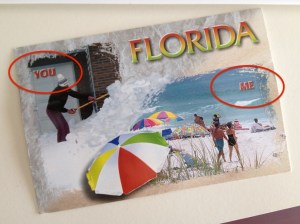
This would be amusing if my front yard did not currently look like this:

Welcome to Spring, Canadian style. I’ll admit, the card’s not funny, it’s hilarious. Because it’s so true!
Now, where’s my shovel?
Posted in Likes, tagged #ThingsILike, creativity, finishing, inspiration, Ireland, Motivation, persistence, problem solving, quotes, Robert Frost, Thoughts on March 18, 2016| Leave a Comment »
I’m banging my head against a data problem so I’ll have to set aside the in-depth and incisive essay on the mating habits of Salarian scientists I had planned (so sad, but maybe next week;).
Instead, today’s thing I like is this image and the sheer effort the landscape represents. It’s also a shout-out to my Irish relatives (currently recovering from St. Patrick’s Day) and to the fact that people have been solving problems for millennia. Look at those walls, that can’t have been easy:)
The best way out is always through.
― Robert Frost
So, persistence for the win. With that in mind, back to work!
Posted in Writing, tagged arts, creativity, Elizabeth Bear, Fiction, finishing, Krista D. Ball, neil gaiman, persistence, quotes, Thoughts, work, Writers, writing, writing advice on March 16, 2016| 4 Comments »
Today I want to spotlight a collection of writing advice. It comes via OWW, the Online Writing Workshop for Science Fiction, Fantasy and Horror. OWW is a fee-based workshop but this advice is available to all.
These short essays discuss topics on writing in general, how to get your work read (if you’re into workshops like OWW, or the free Critters or Codex, for example), and the publishing business overall. I like Nicola Griffith’s piece about avoiding cliches:*
Don’t write “her heart stopped” unless you mean she died. Don’t talk about saucy serving wenches in an inn where the beef stew is thick and hearty and the ale is fresh, nutty, and strong… Why aren’t “serving wenches” ever tired, middle-aged women? Why is the beer rarely yellow, or thin, or cloudy with sediment?
So true.** There’s a reason the average human lives a much longer and healthier life than their ancestors did just a century ago:
In Japan, 72 has become the new 30, as the likelihood of a 72-year-old modern-day person dying is the same as a 30-year-old hunter-gatherer ancestor who lived 1.3 million years ago.
Modern sanitation, medicine and quality infrastructure (for those handy extras like clean drinking water) for the win!
So, keep a weather eye out for dangerous and terrifying pitfalls you have to escape in the nick of time as you navigate the winding path of language clichés:) But keep writing. Remember, all’s well that ends well! (And that’s just about enough of that;)
While we’re on the subject of advice, I’ll supplement the OWW site and my previous posts on writing advice with a link from Brain Pickings. This collection of wisdom is from a variety of writers, genre and otherwise:
#49: Neil Gaiman’s Advice to Aspiring Writers
“You have to finish things — that’s what you learn from, you learn by finishing things.”
Some of this advice may not apply to you; I tend not to relate to Bukowski, for example. But some of it may, and I hope it’s useful.
Since I’m throwing in everything but the kitchen sink today, let me close with this great post from Elizabeth Bear: “everybody’s scared of things that they don’t understand and all the living they don’t do.”
Accept that there will be a lot of failures along the way, and that you can come back from nearly any mistake that doesn’t involve making a left turn in front of an oncoming semi.
Excellent advice.
Write, rewrite, finish. Do it again.
…………
* Some of the examples are also about uncomfortable -isms. Racism and sexism, for instance, are more problematic than simple clichés and should be resolved at a deeper level. Obviously.
** As a side note, if you’re curious about what and how people ate in the Western Middle Ages, SF Canada writer Krista D. Ball has a detailed and useful book on realism in fantasy food: What Kings Ate and Wizards Drank.
Posted in Likes, Writing, tagged #HipsShouldBeUnbreakable, Confucius, encouragement, family, finishing, inspiration, Motivation, perseverance, persistence, quotes, Thoughts on March 9, 2016| Leave a Comment »
For my mother and anyone else facing a challenge today:
It does not matter how slowly you go as long as you do not stop.
― Confucius
Posted in Likes, Writing, tagged #ThingsILike, Andy Weir, Antoine de Saint-Exupéry, awesome, books, creativity, DIY, Fiction, Golden Age, innovation, inspiration, JK Rowling, NASA, Popular Science, quotes, science, science fiction, sff, space, speculative fiction, Thoughts, Tyler Jacks, Weasley clock, Writers, writing on March 4, 2016| Leave a Comment »
A friend with a shared love for Harry Potter sent me a link the other day. Some creative and determined person decided to make a Weasley clock.*
The magical ‘Harry Potter’ location clock exists in DIY form
For those who may have missed this detail from the HP book and/or movie, the Weasley clock is a magical JK Rowling invention that tracks each Weasley family member’s location and displays it on an antique clock face.
Rowling thought it up, and a Muggle made it real. How cool is that?
So with thanks to my friend, today’s installment of #ThingsILike is the real-world power of fiction.
*
“If you just focus on what you know, you’re blinding yourself to new opportunities.”
— Tyler Jacks, MIT
There are a lot of discussions of this topic out there, both contemporary and historical, but it’s a point I like to touch on periodically. A writer imagines a thing and someone else finds a way to make it real.
That’s magic right there.
This applies to specific items like the clock but also to everything from emotional states to broader goals. Want to generate ideas, stir up communal interest, and apply creativity to complex problems like living in space long-term? Tap the power of fiction:
The White House Wants To Use Science Fiction To Settle The Solar System
How to get into space? Excite the minds of young (and not so young) people with stirring tales of adventures in space. This applies to stories from Asimov, Clarke and other Golden Age of Science Fiction authors, but also to more recent blockbusters like Andy Weir’s The Martian.
The latter was particularly good at building future versions of current technologies, and NASA was happy to help Weir build his fictional (for now) world from the Popular Science article on the support NASA gave Ridley Scott as he turned the book into a blockbuster movie:
If you want to understand why it is that NASA loves The Martian and is so gung ho for this movie, you have to realize that this movie more or less presents exactly their future vision, minus all the drama.
*
I’ve cited this quote before but it’s so fitting I’ll use it again:
If you want to build a ship, don’t drum up people to collect wood and don’t assign them tasks and work, but rather teach them to long for the endless immensity of the sea.
— Antoine de Saint-Exupéry
That’s the power of fiction.
———
* There may be other such clocks out there (in fact, I hope there are) but this is the version that caught my attention. Feel free to build more!
Posted in Likes, Writing, tagged #notyet, #ThingsILike, artists, Carol Dweck, creativity, happiness, impostor syndrome, Mary Robinette Kowal, Motivation, pep talk, persistence, progress, Thoughts, work, Writers, writing on February 26, 2016| Leave a Comment »
Today’s entry for #ThingsILike is Impostor Syndrome. Let me be clear, I don’t enjoy feeling like a fraud. What I do like is that I’m not alone when I do. My advisor introduced me to the term in grad school and gave me a gift: he told me that practically everyone at our prestigious and accomplished institution had it. It just wasn’t something people talked about.
Ok, maybe what I really like is the fact that the today’s connectivity means I don’t feel like the only one, be it re: impostor syndrome or sci-fi fandom, POC or what have you. Still, today is as good a time for a pep talk as any. Let’s get to it:)
A lot of people feel like frauds at some point in their lives. The topic came up for me this week because Mary Robinette Kowal has a good piece about it on her site. (If her gaming analogy doesn’t work for you feel free to come up with your own.)
Have you ever felt like a fake, attributed your accomplishments to luck or some external reason, or downplayed your success even though on paper you might look pretty darn impressive? If you’re asking yourself “Who hasn’t?” well, you know about impostor syndrome.
(Quick, here’s a pretty picture to keep your spirits up. That’s you, taking in the view on your way to the top. It only looks like someone else’s behind:)
Impostor syndrome is so common that CalTech has a page on it for its students, and everyone from Forbes to Geek Feminism Wiki to the American Psychological Association wants to help people work through it. (And that’s just from the first Google search page:)
I like Mary’s take on impostor syndrome as a way to tell that you are making progress, working hard, and facing down problems that feel too big to handle. (The key here is “feel.” Feels are fine and all but emotion is interpretation, and not necessarily fact.)
Impostor Syndrome means that you are winning.
I think that’s great.
Speaking of progress and how to make more of it, there’s a great TED talk with relevance here. Rather than seeing challenges as a binary yes or no, can I or can’t I? Carol Dweck argues that it helps to think about targets as yes or not yet. That “yet” is the crucial modifier. The brain is built to learn, you just have to chill out, keep going and give yourself a chance.
Do that, and not yet can become yesterday’s accomplishment. Now I’m off to take my own advice:)


You must be logged in to post a comment.