There is nothing like looking, if you want to find something. You certainly usually find something, if you look, but it is not always quite the something you were after.
Global trade is very much in the news these days. While many of the current moves from the US seem designed to take the country back to a time when every country stood on its own, those times have, arguably, been much exaggerated. There are many historical examples of interconnectivity, from the Egyptians to the Greeks to the Romans to the Silk Road and many more, but I recently saw a very cool map that brought this idea home.
Even before the modern era, the Afro-Eurasian world was deeply interconnected through trade.
I found this map to be a fascinating look into a network of world trade during an era many might assume was very insular. The only thing I wish it included is travel times. How long, for example, would it have taken for cardamom to get from India to Venice to Oslo and into a loaf of braided bread?
Here’s the map from Martin Jan Månsson, part of his website, The Age of Trade:
“Let’s put it this way: if you are a novelist, I think you start out with a 20 word idea, and you work at it and you wind up with a 200,000 word novel. We, picture-book people, or at least I, start out with 200,000 words and I reduce it to 20.”
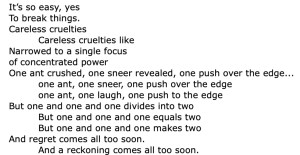
A recent poem, the result of the dumpster fire that is currently the news and a memory of a bully with a magnifying glass on a hot summer day:
It’s so easy, yes
to break things.
Careless cruelties
Narrowed to a single focus
of concentrated power.
One ant crushed, one sneer revealed, one push over the edge…
But one and one and one divides into two
and regret comes all too soon.
I also thought it might be interesting to show my work. Here’s what a typical poem draft looks like for me. The indented lines are the alternatives tested as I wrote my way through.
The 70% rule: If you’re roughly 70% happy with a piece of writing you’ve produced, you should publish it. If you’re 70% satisfied with a product you’ve created, launch it.
Do I believe this, as in, do I think that 70% is “good enough”? Not entirely.
Would I be more productive if I did? Absolutely.
And is most of my reluctance to sign onto this rule based in my little problem with perfectionism? Again, absolutely.
I do very much agree with the general idea:
I’m convinced it’s also the way to cultivate a particular kind of sane, action-focused, peaceful-but-energised approach to life that’s becoming more essential by the day. At the risk of offending any sticklers for traditional mathematics, I’m even tempted to argue that 70% is actually better than 100%, at least in this context.
So I think I’ll try to work my way down toward 70%. Will I get there? Maybe not, but when it comes to clearing away barriers to productivity, every step counts.
Dressing up cats is generally not acceptable (just ask a cat), but there are exceptions to every rule. And because we’re going to get a snowstorm this weekend, allow me to share this adorable snow cat. Honestly, who doesn’t need to see this right now?
A cool cat named Fitz, who lives in Canada, loves to get all bundled up in a nice warm coat and his oversized “bat-eared” hat to go for snowy sled rides that are provided by his human Heidi in the winter.













You must be logged in to post a comment.