Feeds:
Posts
Comments

Posts Tagged ‘predictions’

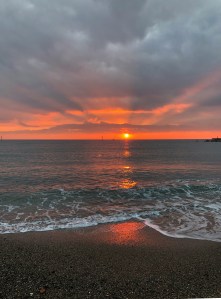
My trip to the mailbox this morning began peacefully enough, a quiet stroll through a slowly brightening day. Then I looked up. The sun hung in a hazy sky, its light filtered by particulates from fires in Quebec, leaving a visible disk that looked like a second moon. The smoke changed the usual morning light from bright yellow to a darker, ruddier hue. Very dramatic.

Today’s forecast? Thunderstorms, which brought to mind the old adage about skies and sailors. “Red sky at night, sailor’s delight. Red sky in morning, sailor’s warning.” It turns out to be based on atmospheric science, and while the logic doesn’t hold up everywhere all the time (and yes, smoke can interfere with its accuracy), it can be useful. 

Red Sky at Night: Is the Sailor’s Saying Really True?

The folklore lines up with two pieces of plain physics: how air moves and how light scatters. Low pressure pulls air together and lifts it, which builds clouds and brings rain. High pressure does the opposite. Air sinks and spreads out, which keeps the sky clear and traps dust and fine particles near the ground. Sailors learned the shorthand long before anyone measured a millibar: low pressure for foul weather, high pressure for fair.

Happily, forewarned is forearmed (to use another old adage). Now I wait, and watch for the coming storm.

A red sun rises.

* * *
Read Full Post »

My mother sent me an article about Octavia Butler, one of a number I’ve seen recently in the wake of the LA fires. Butler was an award-winning sci-fi and fantasy author know for her all-too-realistic versions of the future. Although she died in 2006, a week of devastating fires in LA fit right in with her vision of 2025.

In fact, she was once asked how she was able to predict the problems of the future as accurately as she did, and her answer is a telling lesson for writers but also for people who want to make a difference.

“A Few Rules for Predicting the Future” by Octavia E. Butler – Seven Good Things

“I didn’t make up the problems,” I pointed out. “All I did was look around at the problems we’re neglecting now and give them about 30 years to grow into full-fledged disasters.”

Ouch.

But that’s not all Butler said. I recommend you read the essay in full. It’s not long, but it packs a punch.

“Okay,” the young man challenged. “So what’s the answer?”

“There isn’t one,” I told him.

“No answer? You mean we’re just doomed?” He smiled as though he thought this might be a joke.

“No,” I said. “I mean there’s no single answer that will solve all of our future problems. There’s no magic bullet. Instead there are thousands of answers, at least. You can be one of them if you choose to be.”

I so choose, and I hope you do, too.

* * *

Photo by Luwadlin Bosman on Unsplash

Read Full Post »

For me, the end of a year is a great time to think about the future. 

What did one of science fiction’s most acclaimed writers think about the future back in 1980, what’s changed, and which of his predictions have already come to pass?

* * *

Photo by Ali Pazani on Unsplash

Read Full Post »

Tomorrow I’ll be taking part in a discussion on AI and creativity. Join me, fellow Writers of the Future alum Jason Palmatier, Gene Williams, Glenda Benevides, and host Bonnie D. Graham as we take a positive look at possible futures.

I’m curious to hear what this varied group of creatives predicts.

Listen in live or check out the full show later, links below:

Technology Revolution: “The Future of Human Creativity and AI: Emotion vs Logic? Part 2
Listen & Watch LIVE Wednesday, October 11, 2023, 8 AM Pacific / 11 AM Eastern


2 Ways to LISTEN LIVE: Technology Revolution Radio and VoiceAmerica Business Channel
2 Ways to WATCH LIVE-Stream Video: Linkedin and Facebook
LISTEN Later: On-Demand *** The live audio does not broadcast at this link
WATCH Later: LinkedIn On-Demand and Facebook On-Demand

* * *

Photo by Ameer Basheer on Unsplash

Read Full Post »

Interested in the short and long term future of food? (Of course you are, we all have to eat.) Then you might like this article from Bon Appètit:

Predicting the Future of Food

To take a look at what the future of food might look like, we talked to experts to come up with menu predictions for the future. For the years 2023 and 2024, scientists offered their insights on how food might change. But for 100 years from now—the year 2122—we spoke with people who were unafraid to make some bold claims: science fiction writers. 

Fascinating, sometimes frightening, fun.

* * *

While we’re examining the relevance of science fiction for real-world action, you might also be interested in the next meeting of the Science Fiction/Real Policy Book Club. They’ll be discussing All Systems Red by Martha Wells, a.k.a. Murderbot.

Join Future Tense and Issues in Science and Technology at 6pm ET on Wednesday, June 1 to discuss the novel and its real-world implications.

* * *

Photo by Pawel Czerwinski on Unsplash

Read Full Post »