I like making things. Some days that means building worlds with words, some days it just means building. I find the two modes of creation to be complementary.
One of the more useful things I learned about myself in grad school (aside from the fact that I am capable of a great deal more persistence than previously suspected) is that I like understanding the world through concrete objects. Ideas are good, ideas can be great, but it’s harder for me to make real headway unless I’m also operating in the physical realm. It doesn’t have to be all I do, but it is satisfying to create something with my hands as well as my head. (Yep, Mens et Manus right there.)
In grad school that meant following a lifelong interest and taking up archery (hey there, Legolas!). When my shoulder decided it had had enough, I learned how to knit and ran sidelines in bookbinding and baking. As of a month or two ago, it also means woodturning.
What is woodturning? Simple explanation: one “turns” wood by mounting it on a lathe, spinning it real fast, then shaping said wood with a sharp object.
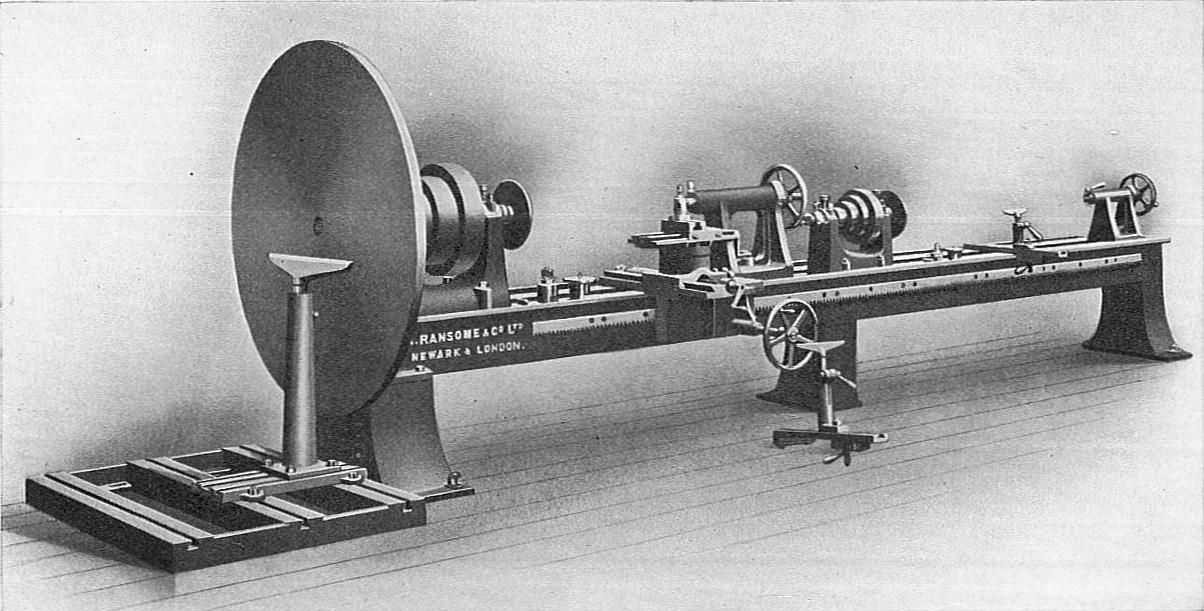
What you can make: many things, so long as they are in some broad sense, round. Think bowls and pepper mills and pens and honey dippers, but also (if you know anything about me at all:) magic wands. What’s not to love?
It’s fun, it’s fast, and it’s exciting (see aforementioned machinery spinning at high speeds!). It’s also strangely relaxing (the word “flow” may have been mentioned). The process is something like pottery, if the potter’s wheel rotated 90 degrees and was used with hardened steel tools and a chance of stitches.
What have I made? A lot of test pieces, a few practice wands not suitable for spell casting, and this little fellow.
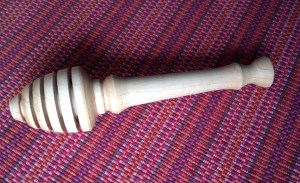
This is my first honey dipper. Hello, little honey dipper!
So, not much yet, but I can tell this is a good outlet for me because I’m constantly fiddling with ideas. I can practically feel the creativity overflowing, and that’s a good thing. Not only am I focused on building tangible objects, but new story ideas are popping up all over the place too.
Win win:) I’m hardly the first to say this, but it’s terrific that creativity doesn’t have to be a zero-sum game.
I’m still very much a woodturning beginner but here are a few things I’ve learned so far:
- An introductory course can be a great way to get started and also teach you how not to end the day bleeding all over your new lathe (bonus!).
- Online resources are also quite useful. Videos are great for seeing what experts are doing with their hands as they say super helpful things like “Then you just pivot the tool and you’re all set!”
- It’s good to step gently into a new and complicated habit, but at some point you’re going to have the take the plunge and buy decent tools.
- You don’t just need a lathe, you’ll also need a grinder to keep your tools sharp. (Tip: apparently fresh-from-the-store tools aren’t actually sharp enough to use. Now they tell me!)
- Based on the shopscape (shopping + landscape = fun new word!), retailers think that most woodturners are men. This may in fact be true, but leads to a problem for any aspiring woodturners smaller than size large. As far as I can tell (Google helped and everything) woodturning smocks do not come in women’s size 4! Pro tip: chef’s jackets work, if you can find one with a closed neck, side pockets and a zipper. I’m happily using a slightly modified version of this one.
For me, making things is a lot like running downhill. Getting to the top can be an effort, but once I get started every step is easier than the last.
So, creative cross-pollination in whatever flavor floats your boat? Recommended! Also, fair warning to those with whom I celebrate gift-giving holidays:
I hope you like wood!
SaveSaveSaveSaveSaveSaveSaveSaveSaveSave
Read Full Post »


You must be logged in to post a comment.