From the Sun’s corona to animal behaviour and human emotions, these rare celestial events continue to provide scientists with valuable insights more than two millennia after they were first observed.
Tomorrow is an interesting day, astronomically speaking. Let me check my list; it’s a long one (and be warned, exclamation marks ahead!).
Let’s see:
solar eclipse, check
meteor shower, check
planetary conjunction, check!
The Eclipse
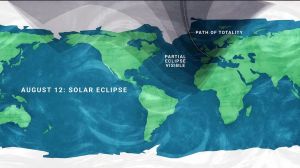
Parts of Western Europe will see a total eclipse, the first visible on mainland Europe in 27 years, but many other places on Earth will have at least a partial version. When and where can you see it? Here’s a look at the timing.
While totality will be visible from parts of Greenland, Iceland and Spain, millions more people across Europe will experience a dramatic partial solar eclipse. Whether you’re chasing the moon’s shadow in Reykjavik or watching the moon take a ‘bite’ out of the sun from London, Paris, or Berlin, timing is everything.
New York City will only see about 9% totality just before 2pm, for example, but if you happen to be in London at 7:13pm, well, 91% totality for you!
The project, entitled “The Prado in the light of the eclipse”, proposes a progressive transformation of the lighting applied to some of the most iconic paintings in the celebrated gallery. Through this shift in light, the video shows how small variations in illumination can radically alter the perception of colours, shapes and the atmosphere of the paintings, revealing details and nuances that everyday light leaves hidden.
That’s already a lot, and we haven’t even talked about meteors or other planets!
The day starts before the Sun comes up. On the morning of August 12, six planets — Jupiter, Mercury, Mars, Uranus, Saturn, and Neptune — will appear spread across the sky.
Do not expect a tight line of bright dots. This is a wide planetary alignment, stretching from the horizon across a large part of the sky. Mars and Saturn will be the easiest planets to spot with the naked eye. Mercury will sit low above the horizon shortly before sunrise. Jupiter will be bright, but very close to the horizon. Uranus and Neptune will need binoculars or a telescope.
Check the link above for times, but for me this would be just after 6am.
It’s going to be a pretty special day, astronomically speaking. Actually, I should have set up this post in terms of time (location dependent, of course!), like so:
early morning: planet parade
early afternoon: solar eclipse
evening: Perseid meteor shower!
If you have a few moments and clear sky, check it out. There’s a lot going on up there!
* * *
A map showing viewing areas of the August 2026 total solar eclipse. NASA/JPL-Caltech
We Earthlings are in the middle of the Leonid meteor shower. It takes place this year from November 6th through the 30th, but will peak overnight tonight. Even better, the moon is only 9% full, so the only competition will be from human light sources.
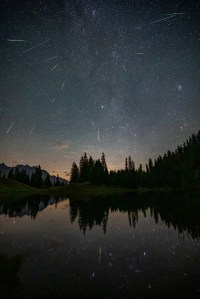
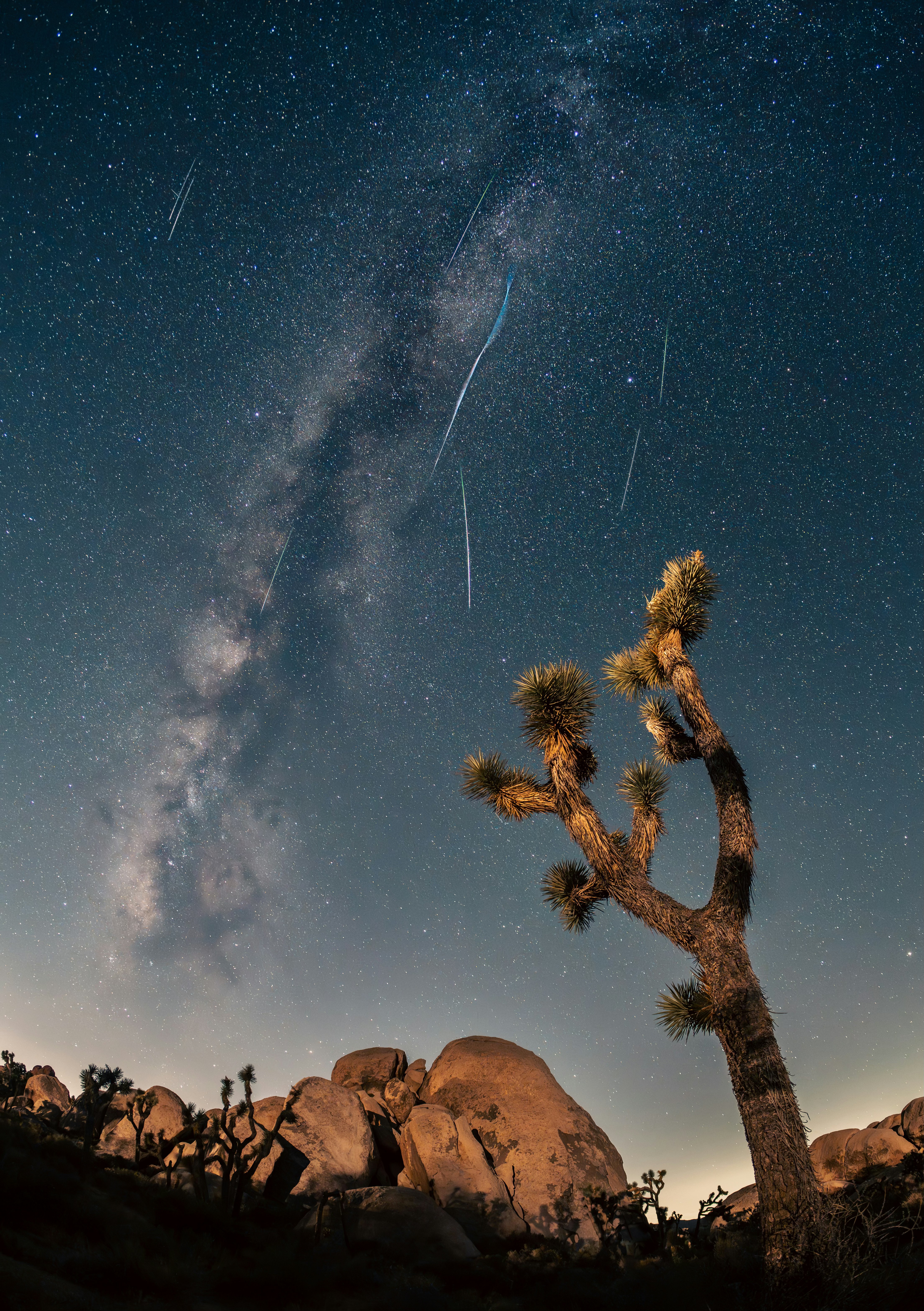
A ritual of summer is gazing up at the night sky in the hopes of seeing meteors, also known as shooting stars, flash across the night sky. While the annual Perseid meteor shower usually gets the most attention, a better bet might be a couple of less-famous meteor showers that will peak on Tuesday night.
It’s summer and that means it’s shooting star time, but what should we do when the astronomical calendar aligns in ways that make it harder to see what is usually one of the best meteor showers of the year?
Don’t give up. Instead, get outside early. Days early.
Peak Perseid will happen August 12th, right around the full moon. All that light will make it hard to see the meteors.
That doesn’t mean there’s nothing else going on overhead, though. If you can, head out tomorrow night and look up.
…the moon will be only about 25% full this week, when two meteor showers known as the Southern Delta Aquariids and the Alpha Capricornids reach their peak on the night of July 29 going into July 30.
And mark your calendars for next year’s Perseids, which should be excellent.
We’re coming up on Easter weekend, which often means sugar-crazed energy spikes, loud family gatherings, and other high-energy experiences. If you happen to be an introvert, or just need a break with a bit of science in it, try going outside at night and doing a little meteor spotting.
“You’re not going to see meteors from downtown Manhattan or Central Park,” Cooke said. “You need to find the darkest sky you can, you need to lay flat on your back and look away from the moon.”
Give yourself 30 to 45 minutes for your eyes to adjust to the dark, Cooke said — and from there, simply enjoy the show.
And if you’re watching the sky this weekend, you may see the Lyrids overlap with another meteor shower, the Eta Aquariids, which is a thing I just learned about. For more on meteors and their schedules, visit the Meteor Shower Calendar from the American Meteor Society.
So lay back, relax, and wave hello to these visitors from outer space.
If you happen to live in a place that will have clear skies tonight (or tomorrow), rejoice! It is time for that highlight of the annual meteor shower cycle, the Geminids.
The Geminids, which are bright and have a yellow hue, are considered one of the best and most reliable annual meteor showers, when at least 120 meteors are usually seen per hour during its peak, NASA says.
The Geminid meteor shower peaks in the middle of December, with the most activity this year expected late Friday and into early Saturday, according to NASA.
Alas, we expect snow and clouds here tonight, but I’m happy knowing that you, dear reader, might have a chance to see one of the most spectacular shows in the solar system.
The Tau Herculids meteor shower may light up the skies over North America on May 30 and 31. Or it may not. There’s a chance we might pass through the thickest part of the comet fragment that is creating the debris, in which case the night skies will be filled with shooting stars.
You can watch the possible tau Herculid meteor shower live online, courtesy of the Virtual Telescope Project. The project’s astrophysicist Gianluca Masi will provide live all-sky cameras from Arizona and Brazil starting at 12 a.m. EDT (0400 GMT) on Tuesday, May 31.
I kind of love that despite all of humanity’s scientific advances, such events can remain a delightful surprise.
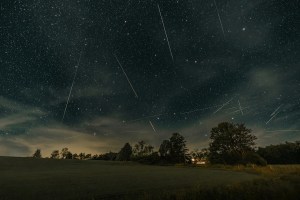
Today’s Astronomy Photo of the Day is a video, two and a half minutes of the Perseid meteor shower as seen from the Indian Astronomical Observatory in Hanle, India.
Watching this takes me back. We would wake up at three in the morning and head to the back yard to watch meteors burn through the atmosphere. I’d anchor myself on Orion, my first and still favorite constellation, then watch the sky for the next magical streak of green.


You must be logged in to post a comment.