From the Sun’s corona to animal behaviour and human emotions, these rare celestial events continue to provide scientists with valuable insights more than two millennia after they were first observed.
Tomorrow is an interesting day, astronomically speaking. Let me check my list; it’s a long one (and be warned, exclamation marks ahead!).
Let’s see:
solar eclipse, check
meteor shower, check
planetary conjunction, check!
The Eclipse
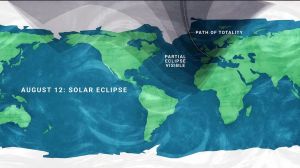
Parts of Western Europe will see a total eclipse, the first visible on mainland Europe in 27 years, but many other places on Earth will have at least a partial version. When and where can you see it? Here’s a look at the timing.
While totality will be visible from parts of Greenland, Iceland and Spain, millions more people across Europe will experience a dramatic partial solar eclipse. Whether you’re chasing the moon’s shadow in Reykjavik or watching the moon take a ‘bite’ out of the sun from London, Paris, or Berlin, timing is everything.
New York City will only see about 9% totality just before 2pm, for example, but if you happen to be in London at 7:13pm, well, 91% totality for you!
The project, entitled “The Prado in the light of the eclipse”, proposes a progressive transformation of the lighting applied to some of the most iconic paintings in the celebrated gallery. Through this shift in light, the video shows how small variations in illumination can radically alter the perception of colours, shapes and the atmosphere of the paintings, revealing details and nuances that everyday light leaves hidden.
That’s already a lot, and we haven’t even talked about meteors or other planets!
The day starts before the Sun comes up. On the morning of August 12, six planets — Jupiter, Mercury, Mars, Uranus, Saturn, and Neptune — will appear spread across the sky.
Do not expect a tight line of bright dots. This is a wide planetary alignment, stretching from the horizon across a large part of the sky. Mars and Saturn will be the easiest planets to spot with the naked eye. Mercury will sit low above the horizon shortly before sunrise. Jupiter will be bright, but very close to the horizon. Uranus and Neptune will need binoculars or a telescope.
Check the link above for times, but for me this would be just after 6am.
It’s going to be a pretty special day, astronomically speaking. Actually, I should have set up this post in terms of time (location dependent, of course!), like so:
early morning: planet parade
early afternoon: solar eclipse
evening: Perseid meteor shower!
If you have a few moments and clear sky, check it out. There’s a lot going on up there!
* * *
A map showing viewing areas of the August 2026 total solar eclipse. NASA/JPL-Caltech
Early this morning, part of a SpaceX rocket was expected to hit the moon. Yes, our Moon! The bad news is that this is a pretty significant bit of littering. The good news is that the strike and subsequent impact crater were at least expected to provide some new observations for lunar science.
Sadly, despite a great deal of professional and amateur peering into the heavens early this morning, no one seems to have spotted the actual event. Yet.
US and South Korean lunar satellites will be positioned to photograph the site after impact but it may take days to receive that information.
With any luck we’ll know more soon. If you have any information leading to the discovery of this rocket part and its impact crater, inquiring minds want to know!
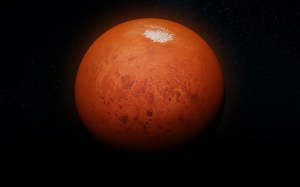
Created from thousands of images, the sequence begins with Mars as a small crescent in the distance. During close approach on May 15, the Red Planet’s cratered surface fills the imager instrument’s field of view. As the spacecraft departs Mars, the changing perspective reveals the planet’s icy south pole.
Want to learn more about the mission? Here’s an article from NASA:
One of the (many) great things about NASA is that the images it produces are public domain. What might a curious and creative person do with such imagery? Why, cut it together as a moon mission movie, of course!
“I have been completely spellbound by the images coming out of NASA’s Artemis II mission,” Boswell wrote on YouTube. “NASA / ESA deserves best cinematography at the Oscars! I dropped everything to put together a tribute to the mission, piecing together the best, highest resolution footage and mission photography with a custom eight-minute score.”
In case you could use a little space-based inspiration today. Thank you, John D. Boswell!
My trip to the mailbox this morning began peacefully enough, a quiet stroll through a slowly brightening day. Then I looked up. The sun hung in a hazy sky, its light filtered by particulates from fires in Quebec, leaving a visible disk that looked like a second moon. The smoke changed the usual morning light from bright yellow to a darker, ruddier hue. Very dramatic.
Today’s forecast? Thunderstorms, which brought to mind the old adage about skies and sailors. “Red sky at night, sailor’s delight. Red sky in morning, sailor’s warning.” It turns out to be based on atmospheric science, and while the logic doesn’t hold up everywhere all the time (and yes, smoke can interfere with its accuracy), it can be useful.
The folklore lines up with two pieces of plain physics: how air moves and how light scatters. Low pressure pulls air together and lifts it, which builds clouds and brings rain. High pressure does the opposite. Air sinks and spreads out, which keeps the sky clear and traps dust and fine particles near the ground. Sailors learned the shorthand long before anyone measured a millibar: low pressure for foul weather, high pressure for fair.
Happily, forewarned is forearmed (to use another old adage). Now I wait, and watch for the coming storm.
We recently spent some time on the road, and drove through some fascinating geology. I had a professor once who was known to wax poetic about highway road cuts, and he wasn’t wrong. Millennia of geological processes are exposed to the light. It got me thinking about geology in general and rocks in particular.
Here’s a general introduction that emphasizes the connection of geology to everything from plate tectonics to the location of our cities:
I’d rather have polished stones from my local highway than diamonds, actually. And for fun, here’s a video on labradorite, a very pretty example of Earth’s stone modification skills:
Thanks for taking us to the Geology Department open house that one time, Dad. I still remember the rock polishing demonstration:)
And if you have a moment next time you’re on the road, watch the road cuts as you go by. Earth’s secrets are out there, waiting for you.
Apologies for being ever so slightly behind the times on this, but we just (as in yesterday!) experienced aphelion. That’s right, on June July* 6th at 1:30pm EDT, the Earth and all of its inhabitants (that’s us!) were 152,087,775 kilometers or 94,502,962 miles away from our favorite life-giving ball of fire.
The Earth orbits the Sun in an elliptical path, which means that there is one point on the path closest to the Sun and one point that is farthest away from the Sun.
(* edited because it’s July now, somehow; catch up, brain! And on a related “really far away from the Sun” note, we just watched Project Hail Mary and thoroughly enjoyed it:)




You must be logged in to post a comment.