Arnie said, “Get your ass to Mars”, but is it really a good idea? We asked the experts about our Martian future.
How likely is it that humanity will be able to live and thrive on Mars? Short answer, no. Longer answer? Still no! Doesn’t mean we can’t dream of new and exciting vistas in our future, though!
The moon will not actually appear dark red like a strawberry, but it may take on a slight orange or reddish tint when it first appears above the horizon. That color shift is caused by light scattering through Earth’s atmosphere, similar to the way some sunsets appear more vivid than others.
The farm down the road has pint baskets overflowing with red berries, and later I’m going to make a red and white dessert for Canada Day.
A storm rolled through today and now strong winds gust through the trees, making me more than usually aware of the weather. Which is why this bit of magic caught my eye.
At first glance, Water World looks more like a painting than satellite imagery. Deep teal and silver clouds swirl slowly across a darkened sky, creating a dreamlike atmosphere. But every formation seen in the film genuinely existed above Earth, recorded in remarkable detail by a weather satellite orbiting roughly 22,000 miles above the equator.
The article goes into more detail on the how and the why, or you could just put the video onscreen and let yourself chill.
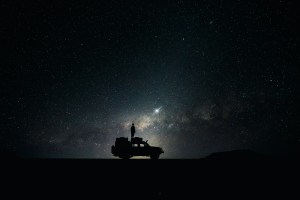
To see Venus and Jupiter together this month, you won’t need binoculars or even a telescope. Just look up after sunset and you’ll find them emerging as the sky grows dark near the western horizon.
Venus and Jupiter – the sky’s 2 brightest planets – are shining together in the west after sunset. They were closest on June 8 and 9. But June overall offers your best opportunity to see them together.
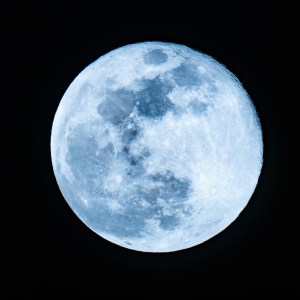
If you missed yesterday’s blue moon, don’t worry, it will still look full tonight too. And as I should also have mentioned, it’s a micromoon (the opposite of a supermoon). The moon is at apogee, or as far from us as it can get. Right now, that’s about 251,000 miles away.
Tomorrow night is the second full moon of May, which makes it a blue moon. They are rare but not very, as they happen every two or three years. The next one won’t happen until December 2028.
People who step outside at the end of the month to catch a glimpse of the rare lunar event should also be able to spot Venus and Jupiter in the western sky about an hour after sunset. Meanwhile, early risers should be able to see Mars and Saturn in the eastern sky about an hour before daybreak.
I wanted to let you know a day ahead of time in case you, like me, like to have these things on your calendar!
Some space veterans seemed to find this scent quite pleasant. “It is hard to describe this smell; it is definitely not the olfactory equivalent of describing the palate sensations of some new food that ‘tastes like chicken.’
Yes, these are the things I find interesting about space. Not the math (with apologies to all my math teachers ever) or the physics (with apologies to all the classes I never took), but the lived experience.
When I’m thinking about a story and need to ground the reader, this sort of information is useful. What would it feel like, what would it taste like?
Recently, Neil deGrasse Tyson visited Stephen Colbert to talk about aliens and his new book Take Me To Your Leader: Perspectives On Your First Alien Encounter. He discussed aliens, why you probably shouldn’t shake hands, and how they might mirror what they see of humanity.
It made me think of the story I wrote on that topic, and how I hope that humanity does more good than not. I’ve re-posted before but I like the story, so here it is again. Click through for the full piece.
And when those parachutes came out, when the mains came out, it was like God himself led us down to the water. And I had a big old grin on my face. It was intense. It went from intense to pure elation.
If you are curious about what it’s like to pilot in space, the difference between a touchscreen controller and stick-and-throttle hand controllers, or the “very intense” 13 minutes and 36 seconds of reentry, read on.
I was!
* * *
NASA/Jim Ross (left to right, Jeremy Hansen, Christina Koch, Victor Glover, Reid Wiseman)
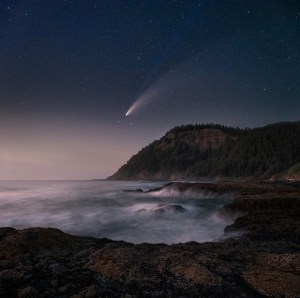
NASA reminded me that we have a new, if transitory, neighbor in the skies overhead. The comet PanSTARRS is making a quick visit and tonight is the closest it will come to the sun.
This is a good weekend for northern hemisphere comet watchers to try to catch PanSTARRS an hour or so before sunrise, as the comet grows brighter approaching its perihelion on April 19. On April 26 the comet makes its closest approach to our fair planet but by then will be difficult to see in the solar glare. Good views of this comet PanSTARRS in late April and early May will be from the southern hemisphere.






You must be logged in to post a comment.