Between work and vaccine side effects and more work, today feels a little tedious. Time is crawling, and it feels like everything is taking a very looooong time.
What better day to remind myself that it could be much much worse? (Seriously, how many movies would I have to watch to fill the time it takes to get to Mars?)
Have you ever thought, “what if I just dug a really really deep hole?”
Well, the USSR actually did. The hole they dug is deeper than the deepest part of the ocean. It’s deeper than Mt. Everest is tall! They began digging it in the 1970s as part of a space race, but down. The United States only got to 600 ft before pulling funding. But the USSR kept going for 20 years. They made it about a third of the way through the Earth’s crust and then STOPPED.
But what if… you just… kept… digging?
If you dug a hole to the center of the Earth, what would you find? What would happen to you? And what does our newest tech tell us is REALLY down below your feet?
If you happen to live in a place that will have clear skies tonight (or tomorrow), rejoice! It is time for that highlight of the annual meteor shower cycle, the Geminids.
The Geminids, which are bright and have a yellow hue, are considered one of the best and most reliable annual meteor showers, when at least 120 meteors are usually seen per hour during its peak, NASA says.
The Geminid meteor shower peaks in the middle of December, with the most activity this year expected late Friday and into early Saturday, according to NASA.
Alas, we expect snow and clouds here tonight, but I’m happy knowing that you, dear reader, might have a chance to see one of the most spectacular shows in the solar system.
I’ll just leave this link here, with gratitude to all the scientists and health care workers who have helped protect me, my family, and my community over the years.
As we’re right around the full (super!) moon this weekend (and I’m knee-deep in tech and tax stuff, super fun), here’s a composite image of the moon with amazing detail.
The self-taught Kurdish astrophotographer amassed 81,000 images, which he stitched into a 708-gigabyte composite revealing the intricacies of the lunar topography in stunningly high resolution.
Scroll down through the images to be impressed by the work of this self-taught astrophotographer.
“It is not plausible that, even with improved typing speeds or an increase in chimpanzee populations, monkey labor will ever be a viable tool for developing non-trivial written works,” the authors muse.
So human writer monkeys can rest easy. In case you were worried!
Behold! Science has caught up to fiction, and the age of Artificial Intelligence, long promised by science fiction in film, literature, and video games, is here! And in this golden age…tech companies expend vast amounts of energy to create search engine assistants trained on partially or fully stolen data, who tell us it’s okay to eat rocks and put glue on pizza, and chatbots who “hallucinate” answers to queries, i.e. confabulate bullshit based on a statistical regression to the textual mean. Our “AI,” as it turns out, is less intelligent than a chicken, even if it has a better vocabulary.
Will the technology continue to change? Certainly, and with rapidity. Will it move more concretely from “applied statistics” to a more humanized “artificial intelligence”? We shall see!
If my brain had been working yesterday I would have mentioned the fact that many of us have an unusual opportunity to see the Aurora Borealis right now.
“The word Aurora was first used by Galileo and comes from Latin and is the name of the goddess of dawn.” — NOAA
This light show in space is typically reserved for latitudes close to the Earth’s poles, but we happen to be experiencing a G3 solar storm right now. This happens when solar storms drive coronal mass ejections, solar flares, solar particle events and solar winds at us. And by us, I mean Earth.
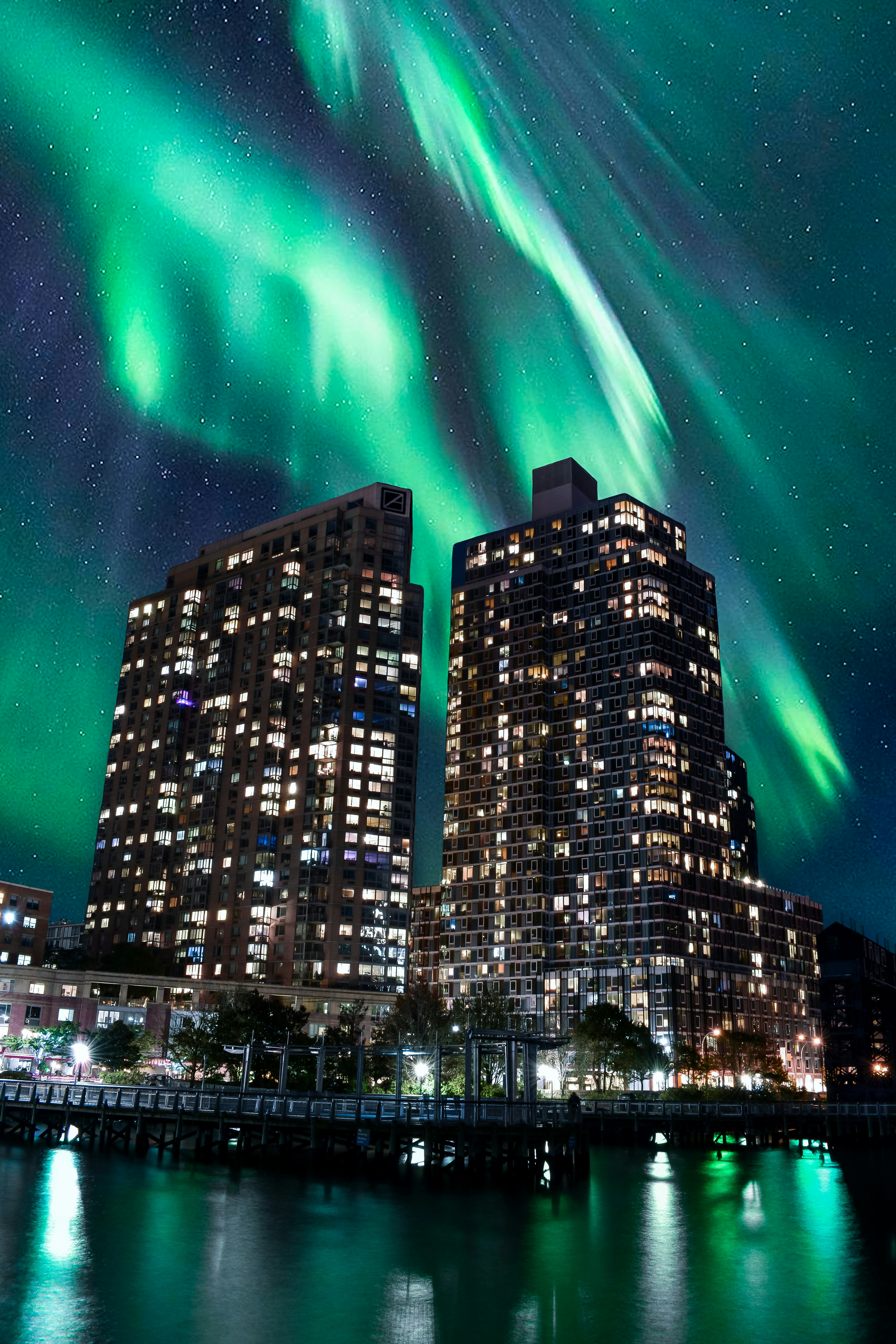
First, some pretty pictures from as far south as Florida:
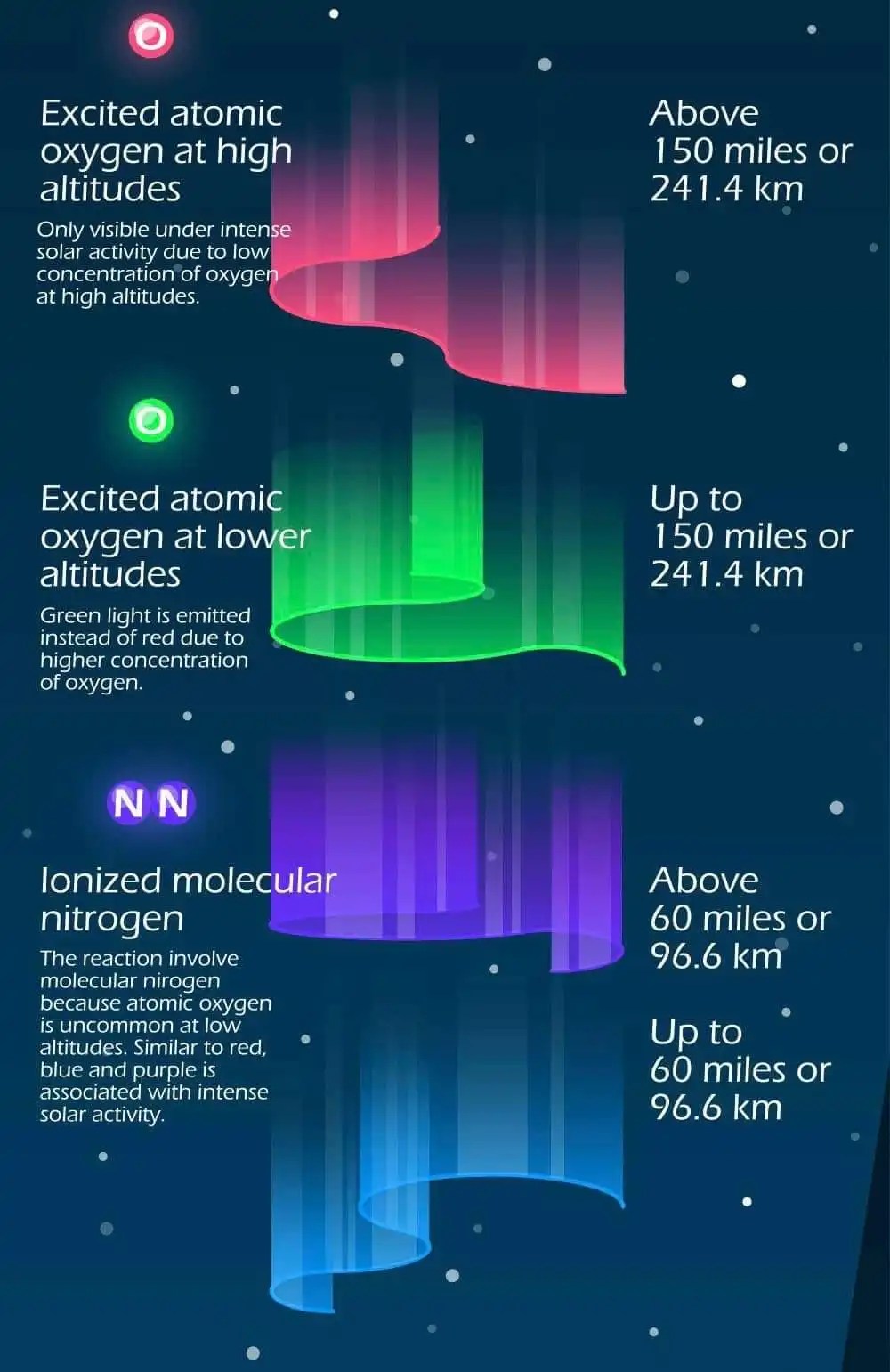
Our sun is the main reason for an aurora display. Particles energized by the sun race toward Earth, colliding with our upper atmosphere. Earth’s magnetic field divert this energy towards the north and south poles. As these energized particles enter Earth’s atmosphere, they excite gas atoms and molecules. The colors observed depend on which gas atoms they interact with.
In addition to colorful light bands, sometimes an aurora has black bands that block starlight. The dark regions likely come from electric fields in the upper atmosphere that block electrons from interacting with gases.
I won’t be hurt if you want to stop here and go search for more pictures, but if you’d like to know more about the how and why, read on!
When and where can you see the northern and southern lights also known as the aurora? This page provides a prediction of the aurora’s visibility tonight and tomorrow night in the charts below. The animations further down show what the aurora’s been up to over the last 24 hours and estimates what the next 30 minutes will be like. The aurora’s colorful green, red, and purple light shifts gently and often changes shape like softly blowing curtains.
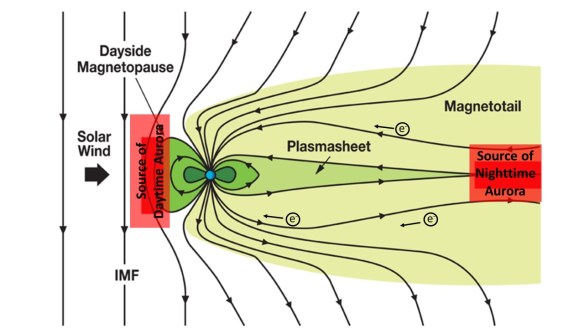
The figure below shows the magnetosphere and the locations where electrons are accelerated (in red). The red region on the right of the figure is where the electrons that produce night-time aurora are accelerated and the source of the processes that generate geomagnetic storms.
Pretty colors are pretty, of course, but why should we care about space weather?
Space weather is a global issue. Unlike terrestrial weather events, like a hurricane, space weather has the potential to impact not only the United States, but wider geographic regions. These complex events can have significant economic consequences and have the potential to negatively affect numerous sectors, including communications, satellite and airline operations, manned space flights, navigation and surveying systems, as well as the electric power grid.
Aaaand in case you haven’t had enough about auroras in particular and space weather in general, NOAA has a fun dashboard for you!
Sometimes you might look at the world and see only the meh, the drab, the muddy exteriors of your surroundings. It’s Tuesday, I get it.
But when the light is just right or you’re a little less tired and you take an extra moment to look deeper, you may find magic just waiting to be discovered.
Here’s one example; click through for photos, which are amazing.
Every winter, when sunlight hits at the right angle, visitors to Virginia’s First Landing State Park are treated to a mesmerizing rainbow light show courtesy of the park’s bald cypress swamp.
I ran across this article and immediately wanted to know more. You too? Here you go!
If you happen to visit First Landing State Park at just the right time, you might see people transfixed at the edge of one of the cypress swamps. I’ve been there and excitedly said aloud, “Whaaaaaaaaaaaaat?!?!” to no one in particular, while wearing a very silly grin. Why you ask? Because I saw this rainbow water for the first time.







You must be logged in to post a comment.