January 1st marked the day when a number of literary and other works entered the public domain. This means that anyone can use these works for free without permission. Here’s an article with all the exciting details:
The books will be available via the Internet Archive, Hathi Trust, and Google Books.
The Great Gatsby is getting the most press (expect more film and book adaptations soon, I’d guess), but there are a lot of other works entering the public playground.
If you’ve ever wanted to do a gender-swapped mashup of Mrs. Dalloway and Kafka’s The Trial set to “Back Biting Woman’s Blues,” your time is now!
Here’s a selection of what’s on offer (via Hyperallergic):
Books
• F. Scott Fitzgerald, The Great Gatsby • Virginia Woolf, Mrs. Dalloway • Ernest Hemingway, In Our Time • Franz Kafka, The Trial (in German) • Theodore Dreiser, An American Tragedy • John Dos Passos, Manhattan Transfer • Alain Locke, The New Negro (collecting works from writers including W.E.B. du Bois, Countee Cullen, Langston Hughes, Zora Neale Hurston, Claude McKay, Jean Toomer, and Eric Walrond) • Sinclair Lewis, Arrowsmith • Agatha Christie, The Secret of Chimneys • Aldous Huxley, Those Barren Leaves • W. Somerset Maugham, The Painted Veil • Dorothy Scarborough, On the Trail of Negro Folk-Songs • Edith Wharton, The Writing of Fiction • Etsu Inagaki Sugimoto, A Daughter of the Samurai
Films
• Harold Lloyd’s The Freshman • The Merry Widow • Stella Dallas • Buster Keaton’s Go West • His People • Lovers in Quarantine • Pretty Ladies • The Unholy Three
Music
• Always, by Irving Berlin • Sweet Georgia Brown, by Ben Bernie, Maceo Pinkard & Kenneth Casey • Works by Gertrude ‘Ma’ Rainey, the “Mother of the Blues,” including “Army Camp Harmony Blues” (with Hooks Tilford) and “Shave ’Em Dry” (with William Jackson) • “Looking for a Boy” by George & Ira Gershwin (from the musical Tip-Toes) • “Manhattan” by Lorenz Hart & Richard Rodgers • “Ukulele Lady” by Gus Kahn & Richard Whiting • “Yes Sir, That’s My Baby” by Gus Kahn & Walter Donaldson • Works by ‘Jelly Roll’ Morton, including “Shreveport Stomps” and “Milenberg Joys” (with Paul Mares, Walter Melrose, & Leon Roppolo) • Works by W.C. Handy, including “Friendless Blues” (with Mercedes Gilbert), “Bright Star of Hope” (with Lillian A. Thorsten), and “When the Black Man Has a Nation of His Own” (with J.M. Miller) • Works by Duke Ellington, including “Jig Walk” and “With You” (both with Joseph “Jo” Trent) • Works by ‘Fats’ Waller, including “Anybody Here Want To Try My Cabbage” (with Andrea “Andy” Razaf), “Ball and Chain Blues” (with Andrea “Andy” Razaf), and “Campmeetin’ Stomp“ • Works by Bessie Smith including “Dixie Flyer Blues“, “Tired of Voting Blues“, and “Telephone Blues“ • Works by Lovie Austin, including “Back Biting Woman’s Blues“, “Southern Woman’s Blues“, and “Tennessee Blues“ • Works by Sidney Bechet, including “Waltz of Love” (with Spencer Williams), “Naggin’ at Me” (with Rousseau Simmons), and “Dreams of To-morrow” (with Rousseau Simmons) • Works by Fletcher Henderson, including “Screaming the Blues” (with Fay Barnes) • Works by Sippie Wallace, including “Can Anybody Take Sweet Mama’s Place” (with Clarence Williams) • Works by Mrs. H.H.A. (Amy) Beach, including “Lord of the Worlds Above“, Op. 109 (words by Isaac Watts, 1674–1748), “The Greenwood“, Op. 110 (words by William Lisle Bowles, 1762–1850), “The Singer“, Op. 117 (words by Muna Lee, 1895–1965), and “Song in the Hills“, Op. 117, No. 3 (words by Muna Lee, 1895–1965)
The internet is a strange, wild, and sometimes twisted thing, but (today’s obvious understatement) it can certainly be useful.
Take the matter of finding era-appropriate names for characters. If you’ve ever needed to know whether Madison would be a good name for a baby girl born in the U.S. during the 1890s, this handy resource from the Social Security Administration is here to help!
Short answer: no. You’d be better off with Edna, Ethel, Bessie or Minnie. But check out some of the other options on the site. If your character was born in Alabama in the year 2000, Madison would be right on target (it was the third most popular name that year!) And if you’re wondering why I sometimes use my initials, check out #3!
* Brought to you by Obscure Information for Writers, Inc. (not a real thing, except oh wait, that’s basically the internet in a nutshell;).
I know we’re still deep in Covid winter and things are still 110% not good. But. The vaccine! The holidays! The New Year! At this point, I will take all the hope I can get:) While saying goodbye to 2020 is not the end of our problems, I do hope that it is the beginning of the end.
In that spirit I made a “So Long, 2020” word search puzzle. Stay safe, stay well, and enjoy!
It’s been a while, but let’s just chalk that up to 2020 and move on, shall we?
Speaking of, it’s been a year, hasn’t it? We haven’t seen friends, family, or done anything more exciting than rescue feral kittens in months.*
Like so many of you, I miss my family. I miss my friends. I miss not knowing the latest hot news in epidemiology;)
I wanted to write about how things were going. I wanted to write something encouraging. I wanted to write, period.
But.
I just didn’t have it in me. And sometimes that just has to be ok. So I worked, managed and generally tried to keep my fashizzma together while the world did 2020.
I haven’t been writing. I haven’t been to the workshop. My sewing machine crapped out on me. I have been reading, at first to study a couple of new genres I wanted to understand from a writer’s perspective, but then I just wanted happy endings.
You know, those things that used to be a luxury but now feel like a necessity. At least to me.
But I’m slowly coming out of it. Fall is sliding into the cold sleep of winter but paradoxically, I’m waking up.
I had a story idea the other day. It wasn’t all that good, but whatever. Thank you, brain.
I’m also doing what a lot of people are doing. Buckling down, cooking, making masks, the quintessential pandemic pastimes.
And I had the urge to share. So I’m here today to share my favorite DIY mask pattern.
* * *
Mask Talk
Despite dramatic progress on the scientific front, we don’t have as many tools in the fight against Covid-19 as we’d like (I know, stating the obvious). What we can do, right now, is socially distance, wash our hands, and wear masks. Why masks? Check out this cool NYT interactive or this handy explainer to see why masks are effective.
Short answer, breathing other people’s spooge is nasty. Masks help.
There are a lot of ways to buy masks these days, and it’s certainly possible to find a variety of options for sale. But if you, like me, enjoy being able to customize your style, size and fabric, then this pattern may be for you.
In the early days of the pandemic a lot of civic-minded makers designed and shared mask patterns. One of the best I found for me and Mr. Man (whose face has a striking set of cheekbones), was this pattern by Tom Bihn (check out the videos and notes).
I’m sure I’m not alone in the search for a mask that fits my face, is comfortable and also effective. For me and Mr. Man, the Tom Bihn design is that mask. This spring, the company was agile enough to add mask production to their line, but also generous enough to share the pattern.
I like the shape and structure of that mask, but wanted a filter. The modifications Rachel posted are helpful, but I realized that the top seam was too thick for me. It added more bulk than was comfortable and all that fabric didn’t quite shape to my face.
Was that something I could fix? It was. Would Tom Bihn be open to me sharing this new version? Yes!
* * *
The TBv3+ (Cue Rainbows and Dramatic Music!)
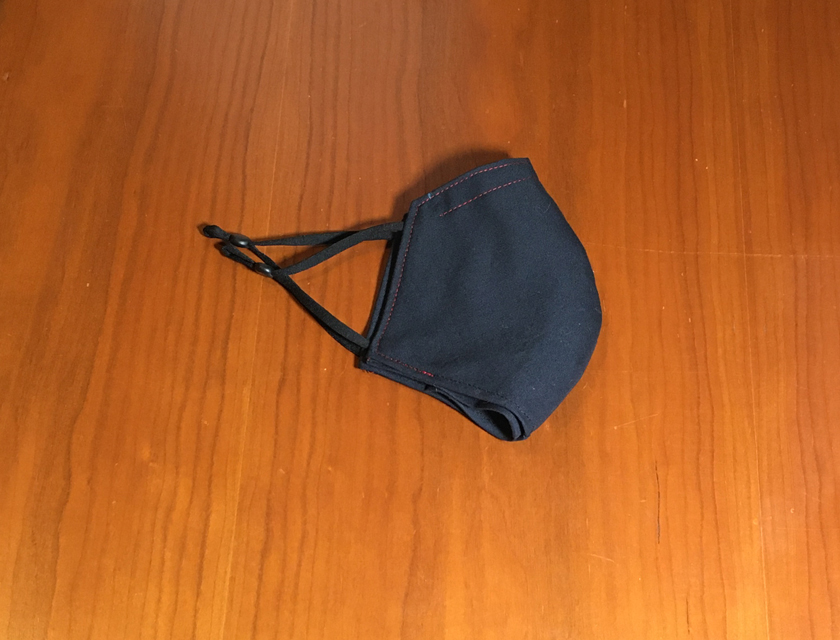
I give you my modified mask pattern, the TBv3+ with a flat top seam and bottom filter pocket.**
I’ve streamlined the process a bit from my first versions, so hopefully the pattern will be relatively straightforward. I’m not set up for sewing videos but here are some photos to help you get started!
And we begin!
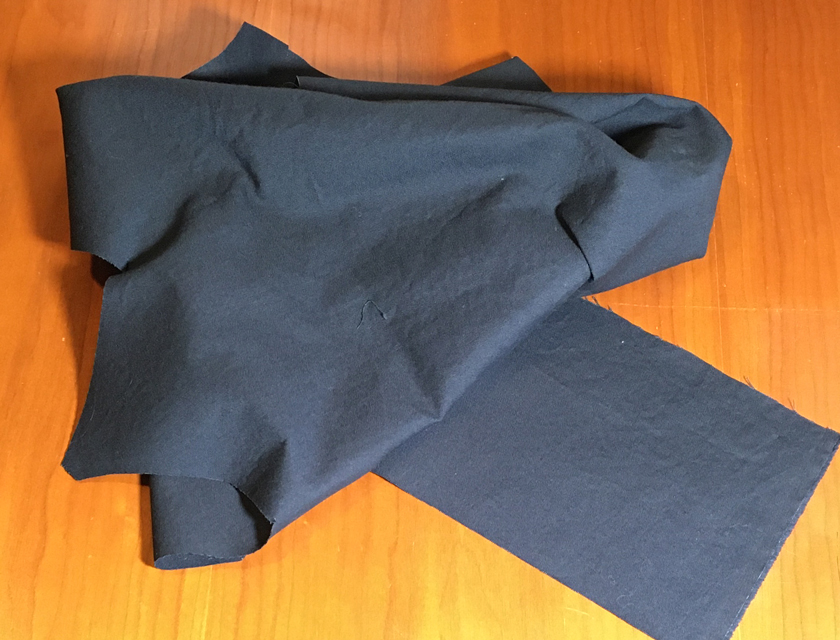
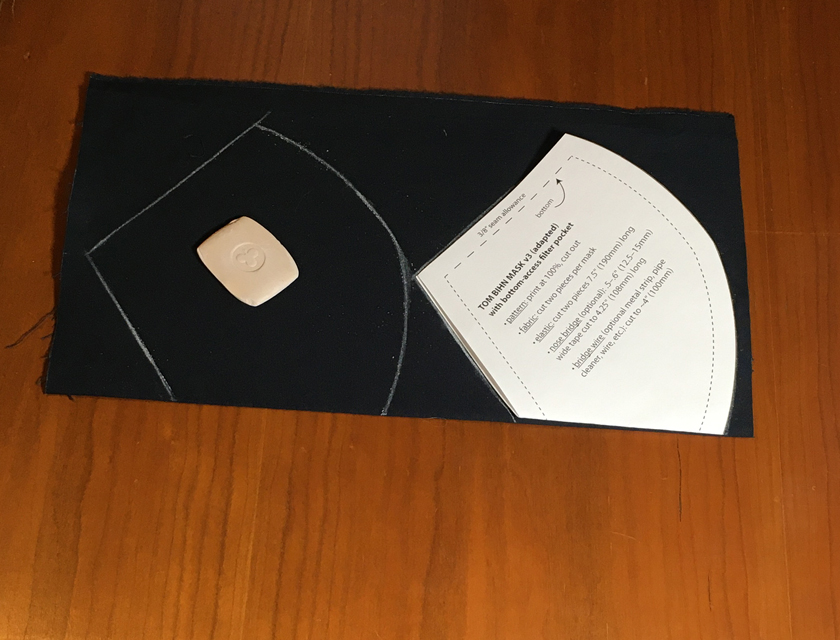
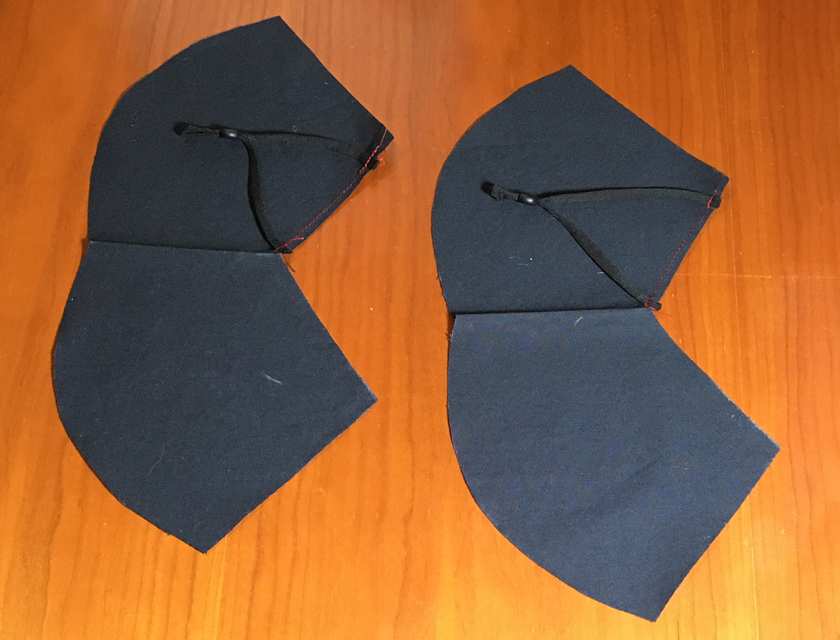
print & cut out pattern, fold it & fabric in half, trace pattern
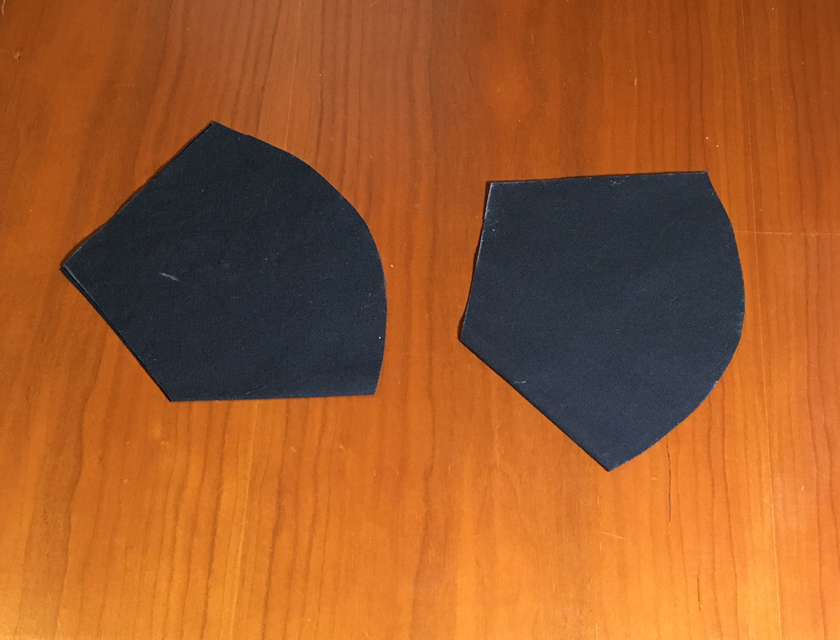
cut out two pieces
looks good, right?
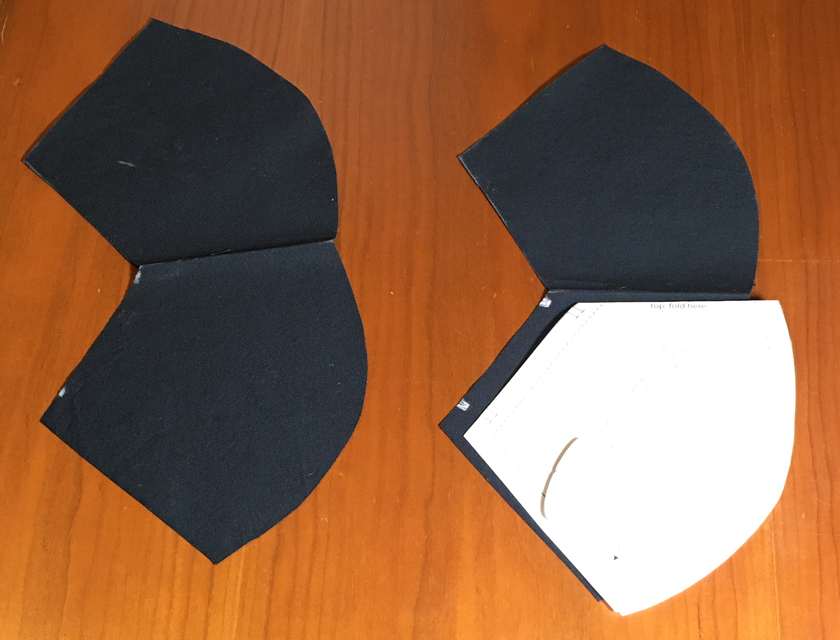
mark elastic anchor points
find pesky elastic
attach elastic
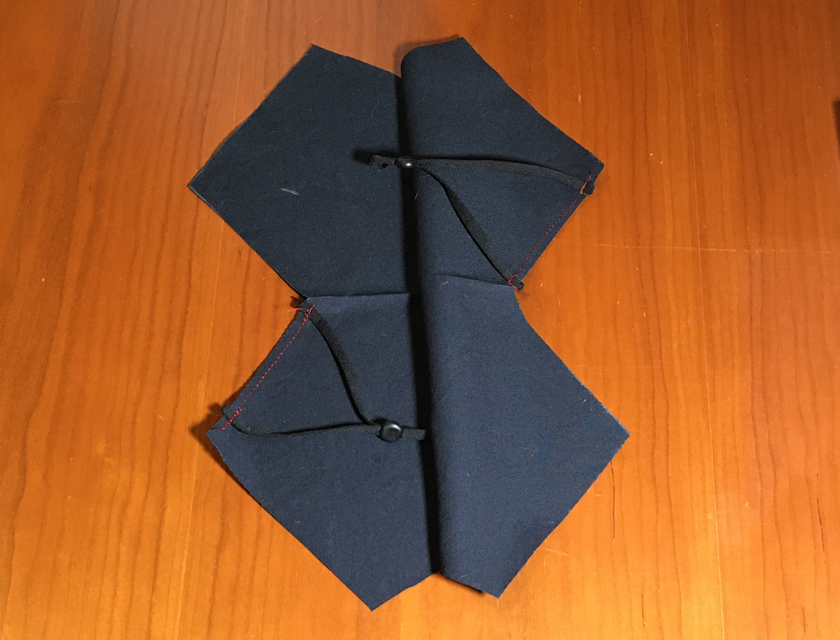
align pieces
pair, with elastic inside
come on baby, hold together!
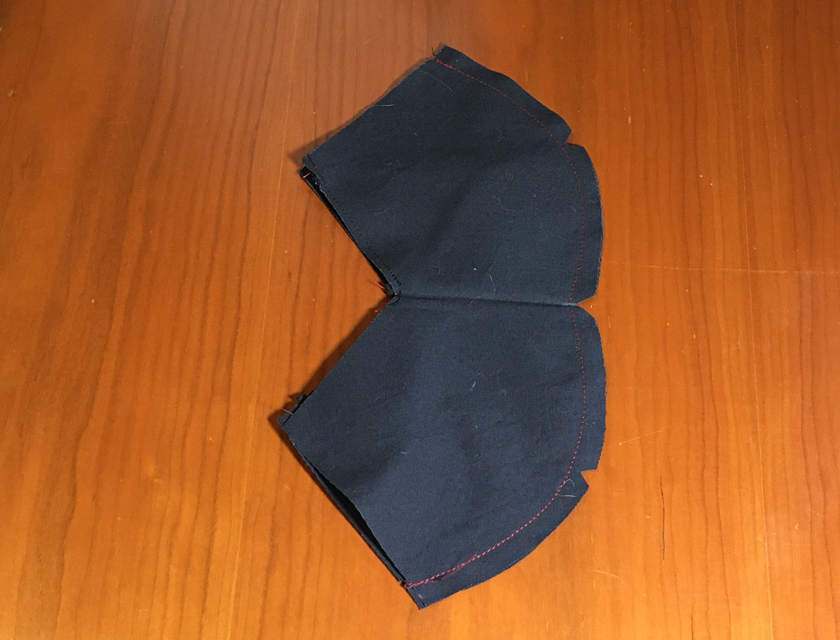
sew sides together
clip seam
hem bottom edges
stitch sides
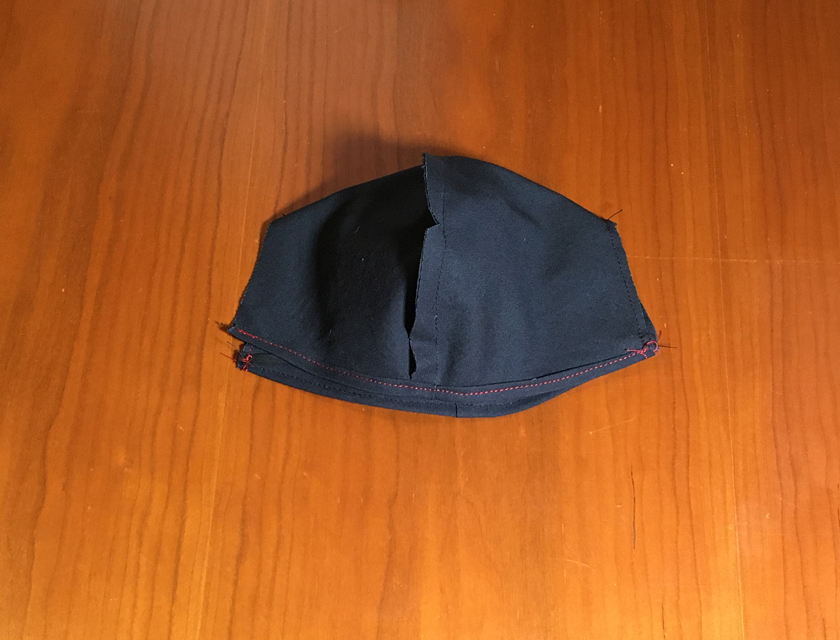
invert; almost there!
top stitch
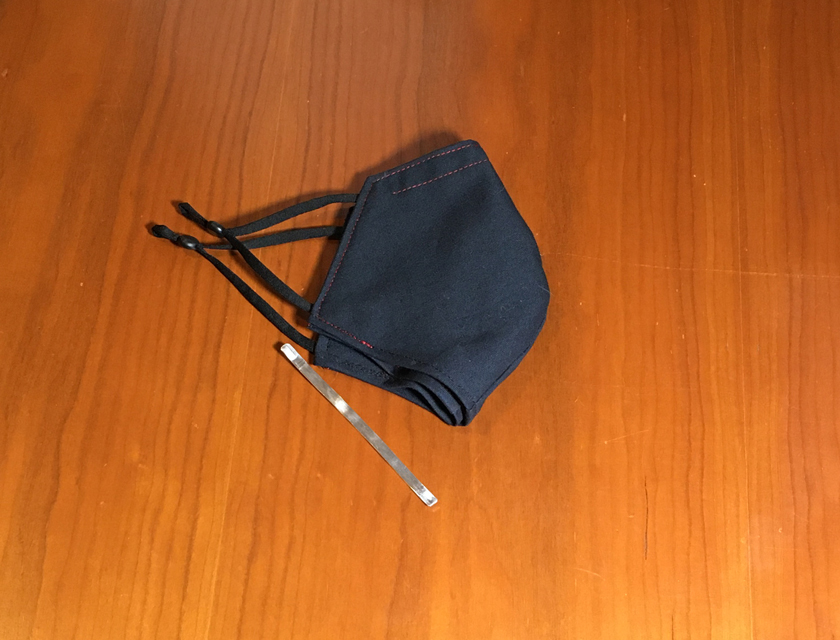
find pesky nose wire
insert wire from the inside
voila! revel in your accomplishment!
* * *
An Excessive Number of Notes:
— This mask is a medium size and fits me well. It’s a bit tight for Mr. Man (those cheekbones!) so for him I add 3/8” to the bottom seam and go from there. This extra bit of fabric is enough to cover his chin and keep the mask in place while he’s talking. If that still isn’t big enough for you, consider printing the pattern at 110%, which will give you more room all around.
— Fabric density does matter, so hold any potential candidate up to the light. If you can see individual fibers and holes between them, it’s not a great option. If it’s all you’ve got, bolster your protection with an extra layer of filter.
— Want different fabrics inside and out? Fold the paper pattern in half along the top seam line, then add 3/8” to the top seam. Cut out two pieces from your front fabric and two from the interior fabric. Stitch together at the top seam and proceed from there. You’ll have a thicker top seam (as with the original TB pattern) but it may be worth it to you if you like a smooth inner lining (Mr. Man requested this approach; some fuzzier fabrics were interfering with his Movember).
— I flip things around a lot (I was probably 30 before I realized that my goofy childhood habit of flipping things was actually a touch of dyslexia, kudos to my parents and teachers for making it work), so one thing I have to watch out for with this pattern is where to put the elastic. It can feel backward to start sewing on the right/outside of the fabric, but that’s the way to do it. Stitch away!
— On nose bridges: The first draft of this pattern added an external fabric nose bridge to the outside of the mask in the final step. It works and makes it very easy to change out the nose wire, but it does add more fabric and is a bit fiddly. By the time I finalized the pattern I’d shifted to adding one additional stitch line, centered below the top seam. If you leave a half inch or so on either side, it’s fairly easy to slip a nose wire into the resulting pocket from the inside of the mask. That’s what I do now.
with nose bridge fabric and without; guess which one is easier
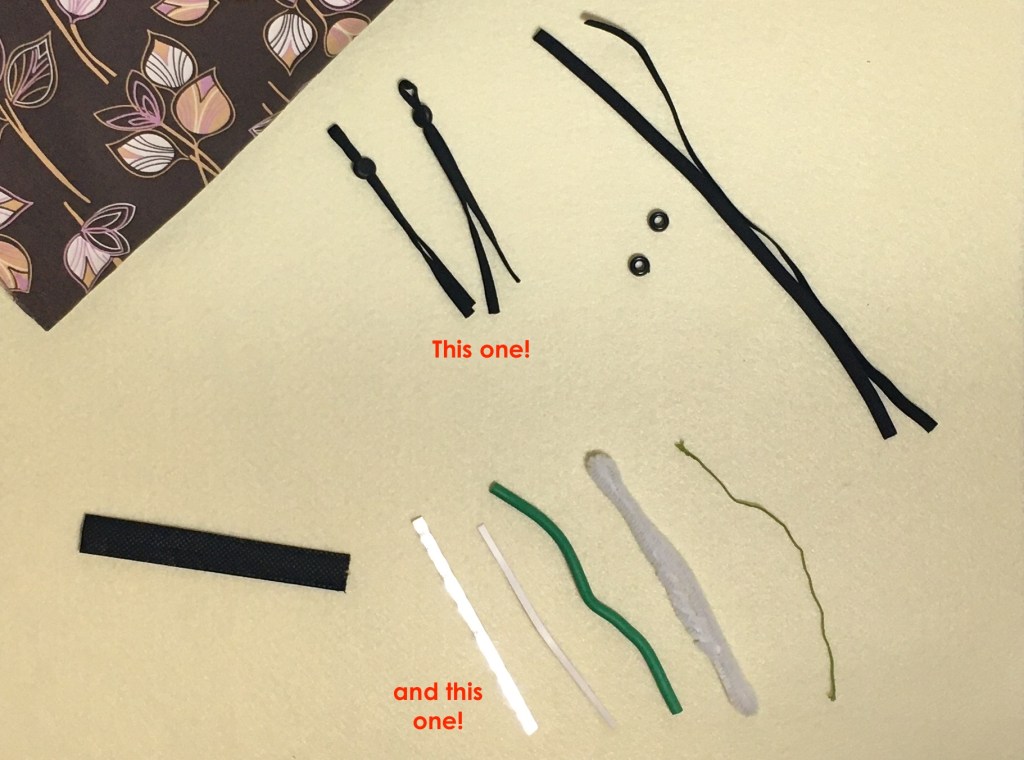
— On nose wires: Of all the options I tried, a thin strip of aluminum was the best. I ordered rolls of aluminum because it was so much cheaper than the pre-cut version, but if I had to do it over again I’d go with pre-cut. Freshly cut aluminum is sharp, y’all, and sanding it down is tedious. Other options I’ve tried in descending order of effectiveness: heavy-duty floral wire in foam (effective but annoying to slide in), the industrial twist-ties from Vistaprint masks (good but not quite stiff enough), doubled-over pipe cleaners (weak), thin floral wire (very weak). You may have other options.
some possible wire and elastic options
— On elastic: lots of options here too, from the thick white kind harvested from an old fitted sheet to pre-cut resizable versions. I’m using the latter now because it’s faster and less annoying, but I had good luck with 6mm elastic from my local fabric store, with or without little plastic pony beads (what do ponies have to do with it, I wonder?) for sizing adjustments. (If you go with the pony beads, add an inch or so to the elastic length and tie a knot on the end to keep the bead from slipping off in the middle of Costco. Ask me how I know!)
— Is that it? Probably not, but hopefully it’s enough to get you started. If you have questions, check out the linked TB videos or let me know.
Even More Notes:
* Granted, it’s been a lot of kittens. A kindle of kittens, even! Cute as heck, but consider supporting your local animal rescue organizations; Humane Society and neutering program closures have started a wave of ferals and strays, and winter. is. coming.
** The usual caveats apply: no mask is 100% effective, fabric density matters, adding a filter helps, cover both nose and mouth while wearing, wash after wearing, social distance, wash your hands a lot, etc. Fun times, am I right?
* * *
Congratulations, you’ve worked your way through all this text! As a thank you, here’s an Inspiring Quote from someone who lived through much worse than this year and used it to create things both astonishing and beautiful.
Stay healthy, stay safe!
* * *
Obligatorily Inspiring Quote!
The world is indeed full of peril, and in it there are many dark places; but still there is much that is fair, and though in all lands love is now mingled with grief, it grows perhaps the greater.
Today I’m going to share a secret: I’m not writing.
It’s not much of a secret, really, but I’ve been avoiding it all the same. Not writing means no NaNoWriMo, no new short stories, no new crazy ideas for novels, at least none that have made it onto the page. The day job is still busy and I’m active on other fronts, but when it comes to writing I’m just… taking a break.
That should be ok, refilling the well, letting the fields lie fallow and all that, but I’ll be honest, it doesn’t always feel that way. That’s a big part of why I haven’t posted here. But here’s the thing. You can’t be super productive all the time, or I can’t, anyway. Sometimes I need time to step back, take a breath, and get ready for the next round.
Part of that is admitting when I need a break to refresh. The other part is remembering that despite all the not-so-awesome in the world, there is also magic:)
So excited to see my favorite Murderbot and the Wayfarers series get some love, and I’m looking forward to checking out some of the others on the roster. For more reading material, check out Tor.com’s full list of nominees. Enjoy!
That’s right, today is the summer solstice. At 15:54 Universal Time (that’s 11:54 a.m. in my neck of the woods), summer officially starts in the northern hemisphere! For more on the analemma, or figure-eight described by the sun as it arcs across the sky (think the calendar Tom Hanks etched on a rock in Castaway, or check out this composite photo from NASA). And NatGeo has a nice, detailed piece on the solstice here: What is the summer solstice? The answer might surprise you.
What is summer? So many things, not least light, glorious light to do as you will. Or, you know, mess up bedtime;)
In winter I get up at night
And dress by yellow candle-light.
In summer, quite the other way,
I have to go to bed by day.
Hooray, my space pirate draft is complete! At almost 18,000 words, it’s the longest “short” story I’ve written to date. Ok, fine, it’s a novella and I’m ok with that.
I’ll need to go back over it, check a few things, get a degree in orbital mechanics (not really) and answer that age-old question, “Do donuts stay fresh longer in space?” Inquiring minds want to know! In the meantime, the draft is on its way to beta readers.
I like it, hope they do too!
Finish each day and be done with it. You have done what you could. Some blunders and absurdities no doubt crept in; forget them as soon as you can. Tomorrow is a new day. You shall begin it serenely and with too high a spirit to be encumbered with your old nonsense.
― Ralph Waldo Emerson
I was planning to post a bit on the triumph of hope over cynicism, the shared sense of powerlessness at the root of frustrations across the political spectrum, and how to address that sense through constructive action in response to the constant barrage of no-good news, but I can’t find it.
So instead you get this:)
Neko says hello. (Ok, really she says, “Seriously, human? I’m sleeping here!” Because she’s a cat, and that’s how cats roll.)

















You must be logged in to post a comment.