Feeds:
Posts
Comments

Kitty’s Eye View

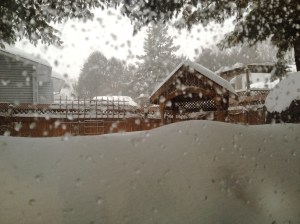
Here’s a cat’s eye view of the snow from yesterday’s storm.

FebStorm
We’ve had record-breaking amounts of snow (50cm, or almost 20 inches!), stuck buses, cars in the ditch and people snowshoeing in the streets. The aforementioned kitties decided to sleep through it by the fire.

Smart kitties:)

Today’s free fiction comes from Ann Leckie of Ancillary fame and more. “Hesperia and Glory” was her first SF&F sale, and she blogs about the story and her experience writing it as part of the Clarion West writers workshop:

…all the best advice in the world (and trust me, it was fabulous advice for the story I appeared to have written) isn’t useful if it’s not for your story.

“Hesperia and Glory” is available free as part of a special issue of Subterranean Magazine guest-edited by John Scalzi. Also in this issue, stories by Rachel Swirsky, Jo Walton, Elizabeth Bear and more.

Heck, since I’m at it, let me link two other Leckie stories I read in the past few weeks, both in the Imperial Radch universe:

Night’s Slow Poison from Tor.com
She Commands Me and I Obey from Strange Horizons

Enjoy!

What’s this, what’s this? Libraries that will let you check out musical instruments plus have a librarian trained to help patrons with the tricky bits? That’s something I like.

Pennsylvania Libraries Will Let You Check Out a Ukulele
There’s a strange sound emerging from some Pennsylvania libraries. It’s not the sound of pages turning or scanners scanning—it’s the distinctive dainty, nimble strum that comes from a ukulele.

Even in the age of the internet libraries are incredible resources, and this just adds to the awesome. Not that I play ukelele, but that’s kind of the point. Libraries let you sample a wide variety of knowledge, experience, and perspectives. Yesterday a Moroccan cookbook, today space opera, tomorrow ukelele:)

How great is that?

It’s snowing! It’s pretty! All is right with the world.

The past few weeks of above-freezing temperatures and no snow have been, for lack of a better word, weird. It reminds me of the time I spent in Arizona, and my first warm Christmas. Seventy degrees on Christmas? In the Northern Hemisphere? Weird. I thought I’d be happy to get away from the cold and snow but I guess childhood imprinting isn’t so easy to escape.

I’ve also been thinking about the desert for a story I’m working on. Remembering the dry expanse stretching to the horizon, tenacious scrub clinging to the sides of dry riverbeds and the clarity of the air at dawn. Thinking about the challenges of crossing such a place in an era before the things Americans tend to take for granted, like functional highways, a network of gas stations and cars that didn’t blow a tire every 50 miles. And I stumbled across this fascinating article in the Smithsonian’s Air & Space magazine, about a network of alien markings giant concrete arrows crisscrossing the continent.
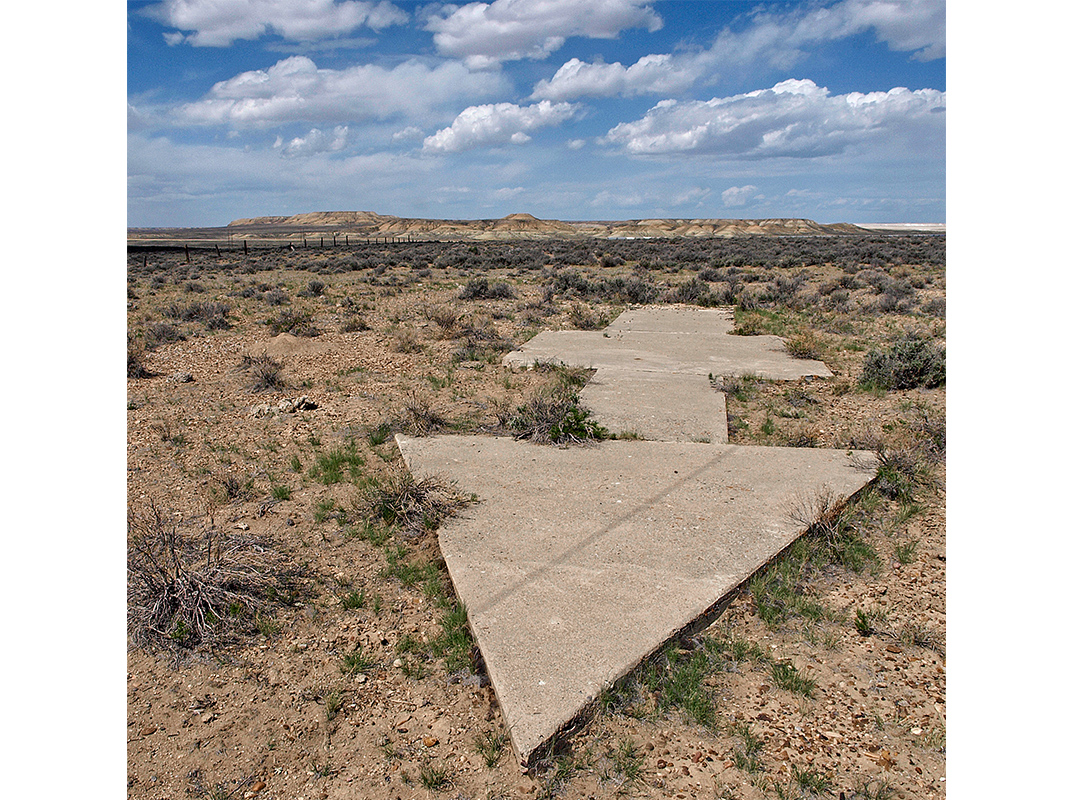
giant arrow


Before satellites, real-time GPS or other modern navigation systems, pilots had to be able to see where they were going. They couldn’t fly at night or in bad weather, and figuring out where they were was a complicated affair involving tools like a compass, maps (on paper!) and a bit of guesswork.

Some towns painted their names in oversized block letters on rooftops to help pilots get their bearings. And sometimes—like when navigational delays slowed down transcontinental air mail delivery* after 1920**—the government saw the need for a more comprehensive solution to the problem and stepped in. In this case they built a system of 70-foot-long concrete arrows pointing the way:

The government built a path of 70-foot-long concrete arrows every few miles from coast to coast, each painted yellow and topped with a 51-foot steel tower that had a rotating beacon. Using the path, an airmail pilot needed only half the time to deliver a letter from New York to San Francisco.

Eventually technology caught up with our demands and the markers were abandoned. Where are these markers now? An intrepid couple named Brian and Charlotte Smith wanted to know the answer and embarked on A Quest (because let’s face it, it’s hard to get anything significant done without A Quest).

They go on road trips to investigate these remnants of a bygone era, and now you can too. With the help of drone lessons from their nine-year old grandson, they’ve assembled photos and a database of marker locations.

The core idea of this story resonates with me. It’s the same childhood fascination I had for the Pony Express or the challenges of nineteenth-century explorers. For me, it’s hard to read a piece like this and not conjure up a daring young Lady Adventurer winging her way across an untamed landscape on a new world, with nothing but a few isolated markers to keep her on track.***

Marvelous!

—–

* FYI, I love the USPS and public libraries and Eisenhower’s Interstate Highway System. These and other basic infrastructure**** projects help make us a better connected, better educated country and have impacted everything from social mobility to what we eat for dinner.

** Before 1920, if you wanted to send a letter to your cool aunt in San Francisco, for example, it went via methods like stagecoach or boat or train. Slooooooow. Or you could send a telegram and tell the whole world your business… like Twitter, actually.

*** A lot like Beryl Markham, actually.

**** (A footnote within a footnote. Does that make it a toenote?) I just want to include the definition of infrastructure and ask lawmakers responsible for assigning project funds, how is this optional?

Infrastructure: The basic physical and organizational structures and facilities (e.g., buildings, roads, and power supplies) needed for the operation of a society or enterprise.
Today’s free fiction is a Best of 2015 collection from Tor.com. Available in PDF, EPUB & MOBI formats, the book download requires free login. Note that these and all other Tor.com stories are available free online but it’s great to get a prepackaged anthology as a jumping off point.

Some of the Best from Tor.com 2015

The stories were acquired by editors Ellen Datlow, Claire Eddy, Carl Engle-Laird, Liz Gorinsky, David G. Hartwell, Patrick Nielsen Hayden, Beth Meacham, Marco Palmieri, and Ann VanderMeer.

Enjoy!

West with the Night

Today’s #ThingILike* is West with the Night, a fabulous piece of non-fiction first published in 1942 by bush pilot, adventurer and racehorse trainer Beryl Markham. I picked it up in a second-hand store on the strength of the title and the back cover blurb. I’d never heard of the author, but when Ernest Hemingway says he wishes he could write so well, I pay attention. Glad I did.

“Did you read Beryl Markham’s book, West with the Night? I knew her fairly well in Africa and never would have suspected that she could and would put pen to paper except to write in her flyer’s log book. As it is, she has written so well, and marvelously well, that I was completely ashamed of myself as a writer. I felt that I was simply a carpenter with words, picking up whatever was furnished on the job and nailing them together and sometimes making an okay pig pen. But [she] can write rings around all of us who consider ourselves writers. The only parts of it that I know about personally, on account of having been there at the time and heard the other people’s stories, are absolutely true . . . I wish you would get it and read it because it is really a bloody wonderful book.”
— Ernest Hemingway

Recommended.
* Again, items in this series of Things I Like are linked for your information; no sponsors, no kickbacks, just a sampling of things that I find useful or fun or funny or sweet.

Nature’s Rothko

Hey, we’ve got freezing rain today, that’s super fun. We also have glitter, the Newfoundland and Labrador term for “freezing rain that accretes as ice on branches and wires.” It’s chilly and wet and grey, reminding me a lot of Boston, actually. My east-facing windows have glazed over and the cats are curled up by the fire. I’m wishing for a cup of hot chocolate and a good book, but work must win out. For now.

This weather is terrible for driving (or walking, or power grids) but it has given me a faux Rothko, painted by nature:)

IMG_0027

The 2015 Locus Recommended Reading List

It’s the beginning of a new year and that, among other things, means year-end wrap-ups and award seasons. Locus Magazine, which has covered the science fiction and fantasy field since 1968, released its list of recommended reading for 2015. It is extensive. It covers material from novels to shorts, fantasy to non-fiction, and there seems to be something for everyone. The full list includes links or references for all entries so check it out if you want the full shebang.

If you’re short on available funds or want to sample an author before you dig deeper into their repertoire, then check out my abbreviated version below. It links to all of the list’s freely available stories (I think, although it’s a big collection and I may have missed one or two).

There’s a lot of excellent material here. I’ve read some of these pieces already but not all, and I look forward to catching up. Do check out the novels and other purchasable items too, if you have the wherewithal (and if you don’t, I highly recommend a library card!).

Enjoy!


NOVELLAS
‘‘Waters of Versailles’’, Kelly Robson (Tor.com 6/10/15)

NOVELETTES
‘‘And You Shall Know Her by the Trail of Dead’’, Brooke Bolander (Lightspeed 2/15)
‘‘Islands off the Coast of Capitola, 1978’’, David Herter (Tor.com 7/8/15)
‘‘Machine Learning’’, Nancy Kress (Future Visions)
‘‘Another Word for World’’, Ann Leckie (Future Visions)
‘‘Coming of the Light’’, Chen Qiufan (Clarkesworld 3/15)
‘‘Fabulous Beasts’’, Priya Sharma (Tor.com 7/27/15)
‘‘The Long Goodnight of Violet Wild’’, Catherynne M. Valente (Clarkesworld 1/15, 3/15)

SHORT STORIES
‘‘The Great Silence’’, Allora & Calzadilla & Ted Chiang (e-flux journal 56th Venice Biennale 5/8/2015)
‘‘Soteriology and Stephen Greenwood’’, Julia August (Unlikely Stories 10/15)
‘‘City of Ash’’, Paolo Bacigalupi (Matter 7/27/15)
‘‘Snow’’, Dale Bailey (Nightmare 6/15)
‘‘Unearthly Landscape by a Lady’’, Rebecca Campbell (Beneath Ceaseless Skies 10/15/15)
‘‘Hold-Time Violations’’, John Chu (Tor.com 10/7/15)
‘‘Three Cups of Grief, by Starlight’’, Aliette de Bodard (Clarkesworld 1/15)
‘‘Please Undo This Hurt’’, Seth Dickinson (Tor.com 9/16/15)
‘‘Madeleine’’, Amal El-Mohtar (Lightspeed 6/15)
‘‘A Shot of Salt Water’’, Lisa L. Hannett (The Dark 5/15)
‘‘Let Baser Things Devise’’, Berrien C. Henderson (Clarkesworld 4/15)
‘‘The Apartment Dweller’s Bestiary’’, Kij Johnson (Clarkesworld 1/15)
‘‘Cat Pictures Please’’, Naomi Kritzer (Clarkesworld 1/15)
‘‘Variations on an Apple’’, Yoon Ha Lee (Tor.com 10/14/15)
‘‘archival testimony fragments / minersong’’, Rose Lemberg (Uncanny 1-2/15)
‘‘The Game of Smash and Recovery’’, Kelly Link (Strange Horizons 10/17/15)
‘‘Descent’’, Carmen Maria Machado (Nightmare 2/15)
‘‘Hello, Hello’’, Seanan McGuire (Future Visions)
‘‘When Your Child Strays From God’’, Sam J. Miller (Clarkesworld 7/15)
‘‘The Smog Society’’, Chen Qiufan (Lightspeed 8/15)
‘‘The Empress in Her Glory’’, Robert Reed (Clarkesworld 4/15)
‘‘The Three Resurrections of Jessica Churchill’’, Kelly Robson (Clarkesworld 2/15)
‘‘Today I Am Paul’’, Martin L. Shoemaker (Clarkesworld 8/15)
‘‘The Karen Joy Fowler Book Club’’, Nike Sulway (Lightspeed 10/15)
‘‘The Pyramid of Krakow’’, Michael Swanwick (Tor.com 9/30/15)
‘‘The Lily and the Horn’’, Catherynne M. Valente (Fantasy 12/15)
‘‘Pocosin’’, Ursula Vernon (Apex 1/15)
‘‘Kaiju maximus®: ‘So Various, So Beautiful, So New’’’, Kai Ashante Wilson (Fantasy 12/15)
‘‘Hungry Daughters of Starving Mothers’’, Alyssa Wong (Nightmare 10/15)
‘‘Seven Wonders of a Once and Future World’’, Caroline M. Yoachim (Lightspeed 9/15)

Baking: Banana Bread

I have recently discovered that stalwart of public television, The Great British Baking Show (known on the other side of the Pond as The Great British Bake Off). I don’t usually do reality programming but I was drawn in by the general aura of positivity, the educational content (so that’s how you cool angel food cake!), and of course, the food.

So I’m in a baking mood. This week I pulled out a classic recipe for Banana Bread.

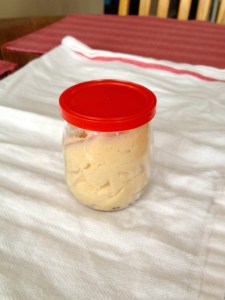
For some reason teenaged me loved making banana bread. Maybe because it was easy and good, or because there always seemed to be over-ripe bananas in the house. I serve warm slices with Maple Cinnamon Butter (looking fine in a reusable Riviera Petit Pot with pretty new lid! I’d include a picture of the bread but, well, I ate it:).

Banana Bread

3 very ripe bananas, mashed, or 2 bananas and one apple, peeled and chopped fine or grated
2 eggs, well beaten
1/4 cup plain yogurt or 1/4 cup melted butter
1 tsp. vanilla
3/4 cup (150 grams) brown sugar
1/2 tsp. cinnamon
1/4 tsp. nutmeg
2 cups (250 grams) flour
1 tsp. salt
1 tsp. baking soda
1/2 cup chopped walnuts (optional)

1. Preheat oven to 350°F.
2. Butter a standard loaf pan, or four mini loaf pans.
3. Mix the fruit and eggs together in a large bowl. Add yogurt or butter, vanilla, sugar, cinnamon and nutmeg. Sift the flour, salt, and baking soda together, then stir into the banana mixture. Add the walnuts (optional) and stir until combined.
4. Pour batter into pan. If you’re feeling decadent (and I usually am) top the batter with more cinnamon, nutmeg, and brown sugar, plus extra nuts or oatmeal if you like it crunchy. Bake for 55-60 minutes (35 minutes if you opt for the mini loaves) or until a knife or toothpick inserted into the center comes out clean. Remove from the pan to a rack to cool.

MapleCinnamonButter

The Hero’s Journey

Storytelling is a fundamentally human pursuit. (Not to say that we’re the only ones who do it, because it’s possible that ant and bee pheromones communicate the route to food in the form of a tale that resonates with those particular species, but…) In fundamental ways that touch on history to parenting to neuroscience and everything in between, we are our stories. The origins of some classic fairytales, for instance, go back thousands of years.

How our essential stories came to be, what they say to us, and about us, and how they continue to resonate, are all fundamental questions for writers. One way to think about the path of a story, where it goes and what it is meant to do, is through the Hero’s Journey. The TED Radio Hour on NPR did a nice series on this:

…why are we drawn to stories about heroes? And what do they tell us about ourselves?

There are other ways to tell a story, of course, but as the fundamental underpinnings of tales from The Odyssey to Star Wars, this framework provides a fascinating and concrete way to communicate through fiction.