It’s nice to think that one can have an impact in the world, even at an everyday level. I had that feeling today, when I found an article at The Atlantic I wanted to share but the sharee wasn’t a subscriber.
“That’s too bad,” I thought. “Such a shame that this publication isn’t taking The New York Times approach, allowing subscribers to share a certain number of articles per month with anyone. I mean, I wrote them that well-thought out pitch for such a program a couple of months ago, making the case that it adds value to current members while also expanding their potential subscriber base… Hang on a sec…”
/click, click click. o hello my beauty
They actually did it. I’m sure I can’t take full credit for inspiring this change, but it’s nice to think that my efforts may have helped make it happen.
I’m rushing through lunch with a quick PB&J. We use natural peanut butter that has an annoying tendency to separate and require a sloppy stirring session before said butter can be spread.
Or at least, that’s how my PB life used to be.
I ran across a comment the other day that recommended storing the peanut butter jar upside down. The author suggested it would change my sandwich life.
The Origins, Spectral Interpretation, Resource Identification, Security-Regolith Explorer (OSIRIS-REx) is the first U.S. spacecraft to collect a sample from an asteroid. OSIRIS-REx traveled to near-Earth asteroid Bennu and is bringing a small sample to Earth for study…
The mission, developed by scientists at the University of Arizona, will give us more information about how the early solar system formed and about how life began. It will also help us better understand asteroids that could impact Earth in the future.
The plan is for the return capsule to land at the Defense Department’s Utah Test and Training Range. If successful, humanity will have the opportunity to study pristine asteroid material.
Interested in videos, activities, and other information about the mission? Here you go:
After the autumnal equinox, days become shorter than nights as the Sun continues to rise later and nightfall arrives earlier. This ends with the winter solstice, after which days start to grow longer once again.
The word “equinox” comes from Latin aequus, meaning “equal,” and nox, ”night.” On the equinox, day and night are roughly equal in length.
Let me preface this musing with the statement that I know very little about art, art history, Rembrandt, Dutch social history of the 17th century, or most related issues.
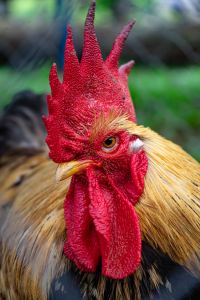
I do, however, know that dead chickens and fashion don’t usually mix.
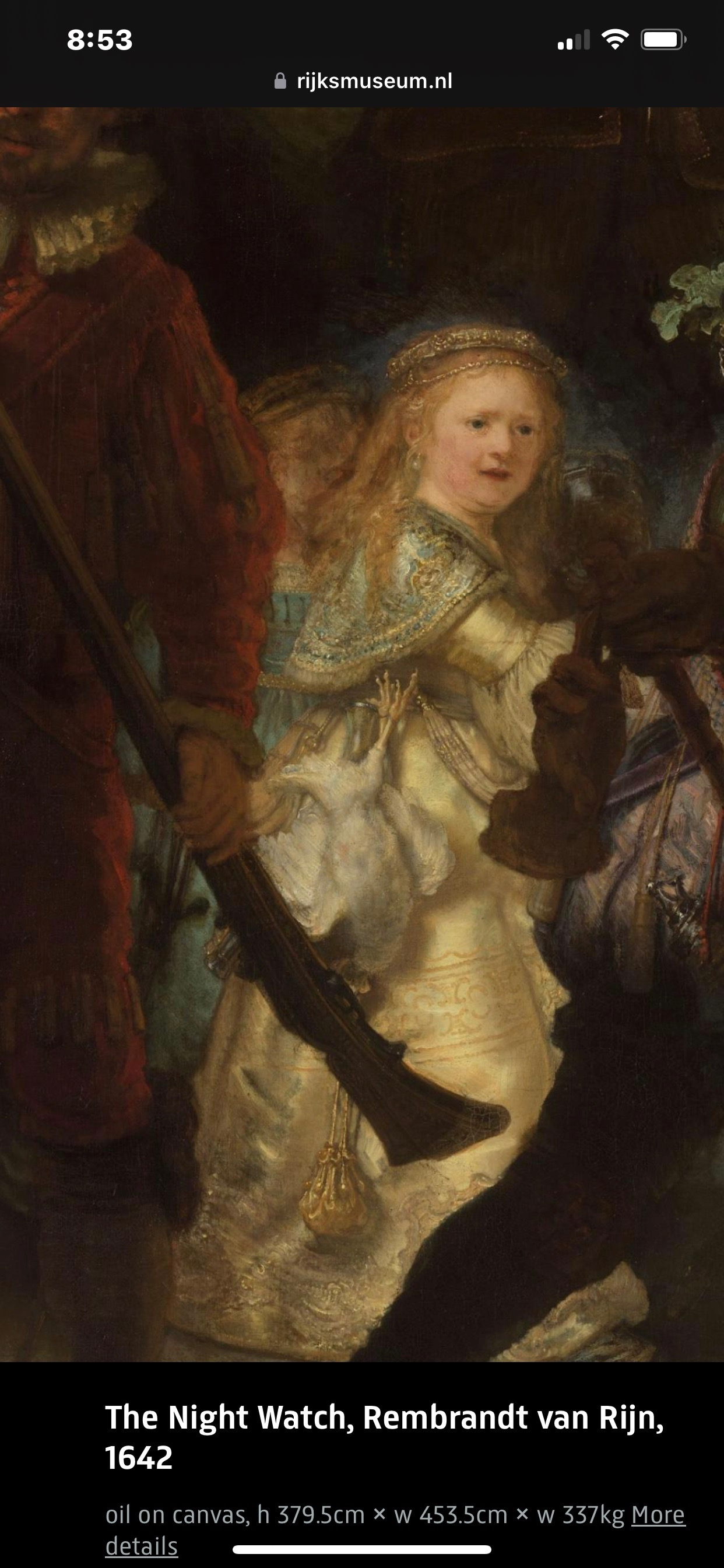
Two of my parental units visited the Rijksmuseum this summer and saw The Night Watch, which inspired a recent discussion about the painting’s history, size and purpose. I pulled up the digital version on the museum’s website so that we could examine the details. The page was still up on my phone when I opened my browser today, and I decided to zoom in on the strangest element in the picture: a well-dressed woman in the midst of a group of heavily armed and armored men, her figure, clothing and purse, all glowing as if under a spotlight.
I take that back. She wasn’t the strangest thing about this picture. The strangest thing was that the aforementioned well-dressed woman was wearing… a chicken?
One thing I love about the move to digitize many museum holdings is that you can see details not usually visible, unless you are viewing the art in person. Using the Rijksmuseum’s Rijksstudio, I was able to zoom in on the subject in question and inspect her unusual accessory. Here it is:
Detail from The Night Watch, Rembrandt van Rijn, 1642, via the Rijksmuseum’s Rijksstudio
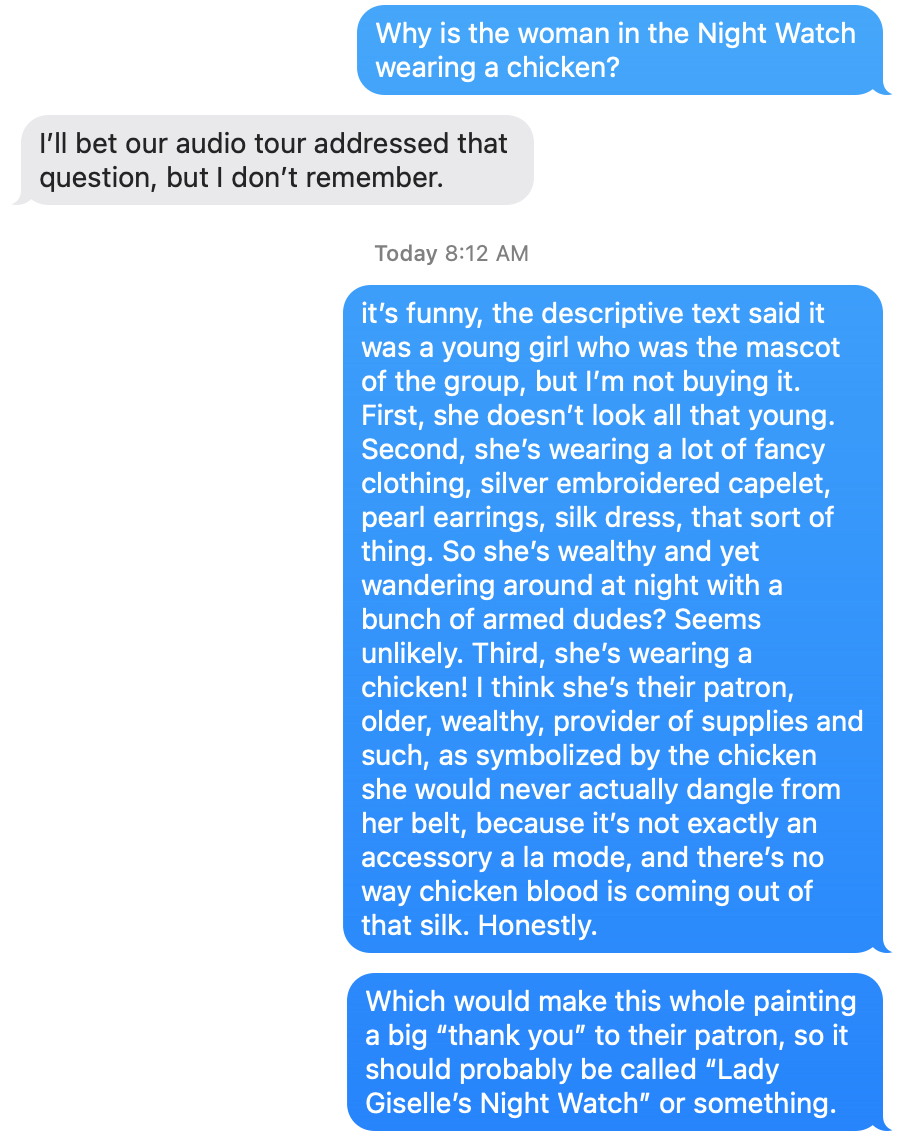
That inspired this exchange with my father:
Again, I know very little about art history and am probably wrong about every single bit of this. I am having fun speculating on the importance of that well-dressed woman, her prominently featured silk purse, and of course, her chicken.
Other people are some of the best, most interesting sources for story ideas, if you can find your way behind their facades.
Most of us would prefer to avoid awkward conversations with strangers, however.
PostSecret is one way to get a glimpse of the former without the latter.
You are invited to anonymously contribute a secret to a group art project. Your secret can be a regret, fear, betrayal, desire, confession or childhood humiliation. Reveal anything – as long as it is true and you have never shared it with anyone before.
Some secrets are funny, some poignant, and all are reminders that every person you meet is a complex, ever-changing world of their own.
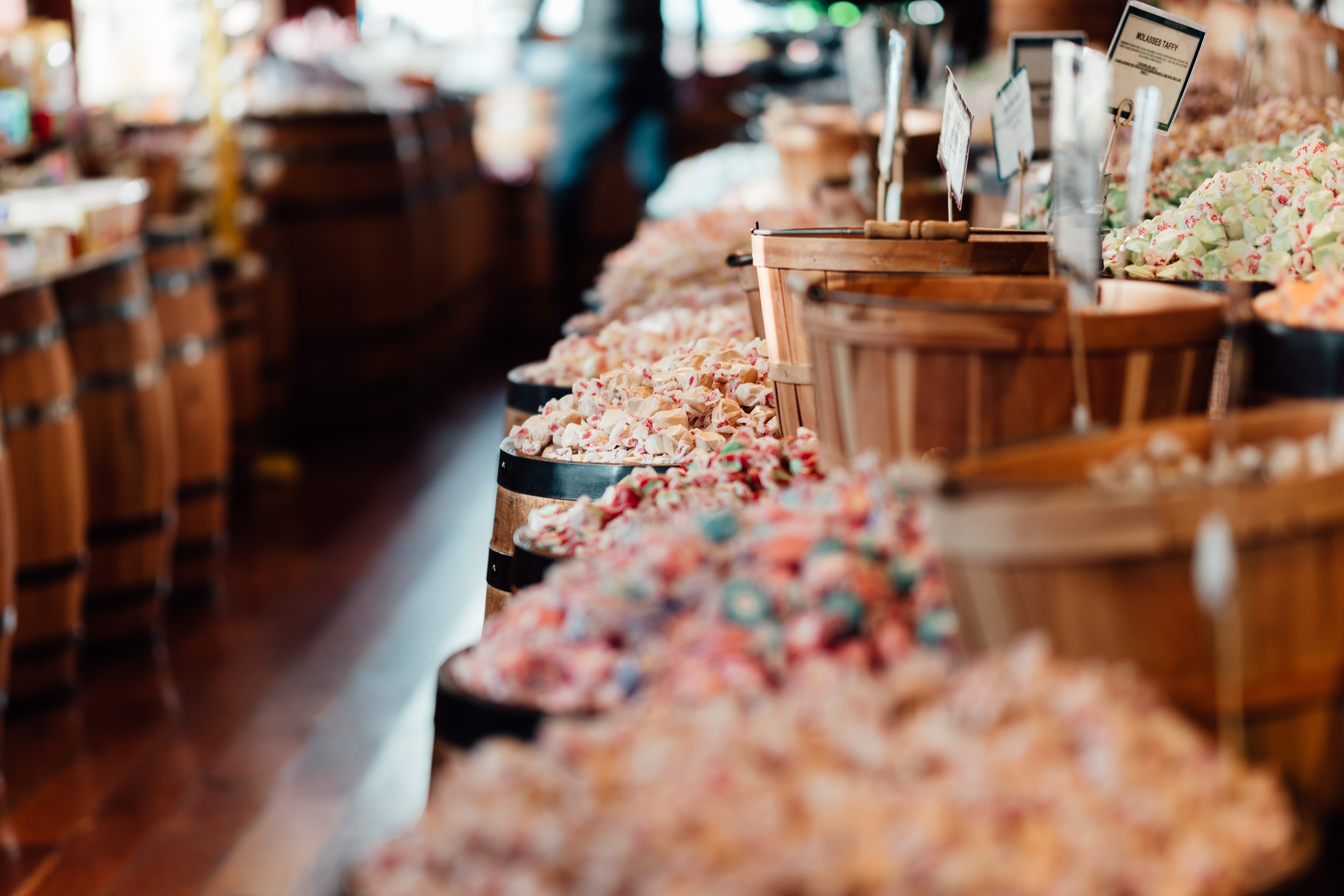
It’s starting to feel like fall here now, but still early enough that it feels right to cast my eyes back to a childhood summer treat: saltwater taffy.
Ever wondered what makes taffy both so sticky and so slippery?
When measuring how the taffy responded to applied forces, Chan and their colleagues found taffy occupies the intriguing middle ground between solid and liquid material.
Ever wondered “how the ingredients and confectioning process contribute to the rheology of saltwater taffy”? Read on!
“In some sense, oil droplets and air bubbles are like rubber balls. When deformed in the taffy, they tend to return to their original, spherical shape because of surface tension. In other words, emulsification and aeration make taffy more elastic, hence, chewier.”
Also and alas, no saltwater is used in the making of saltwater taffy.









You must be logged in to post a comment.