Today, I wrote a 200-word story (a double drabble?) inspired by modern politics, and those who are willing to sacrifice everything for power.
The muted roar of the crowd echoed through the green room. He gave himself a final check in the mirror and checked for consensus updates.
:: Tie too tight, one response said.
He loosened the half Windsor.
:: Hair too perfect, another said.
A quick head toss fixed that.
:: Walk more like a gorilla.
What the hell was he supposed to do with that kind of feedback? He expanded his stance, arms bent at the elbow, and strutted side to side.
His reflection sighed.
:: Accept all changes?
The button flashed green on his behavioral adjustment interface.
He stared at the screen. He used to enjoy this job. Before they promised him power. All he had to do was agree to a chip in his head and external control of his every move.
Was it worth it?
The crowd cheered his campaign’s warmup act. What a difference from the old days, when sincerely held speeches were met with yawns. Now all he had to do was read three-word slogans from the crowd-sourced teleprompter.
Booker’s speech officially surpassed the previous record set in 1957 by noted segregationist Strom Thurmond, who filibustered for 24 hours and 18 minutes to oppose the Civil Rights Act.
I’ll post my story tomorrow. Today, I want to celebrate the fact that we have representatives who will stand up for their people and beliefs, and share their conviction and purpose with us all.
But where do we get the strange custom of playing pranks on April 1? The short answer is that nobody knows for sure. All we know is that the custom was known in Renaissance Europe, and probably has roots older than that.
The article goes into detail (a lot more detail), but if you just want to get into the spirit of things, here’s one outlet’s list of the 30 Best April Fools’ Pranks 2025.
And if this is your kind of thing, go forth and be funny!
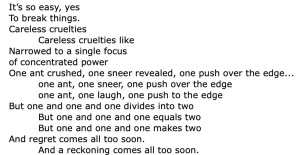
A recent poem, the result of the dumpster fire that is currently the news and a memory of a bully with a magnifying glass on a hot summer day:
It’s so easy, yes
to break things.
Careless cruelties
Narrowed to a single focus
of concentrated power.
One ant crushed, one sneer revealed, one push over the edge…
But one and one and one divides into two
and regret comes all too soon.
I also thought it might be interesting to show my work. Here’s what a typical poem draft looks like for me. The indented lines are the alternatives tested as I wrote my way through.
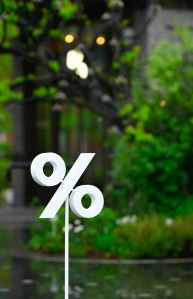
The 70% rule: If you’re roughly 70% happy with a piece of writing you’ve produced, you should publish it. If you’re 70% satisfied with a product you’ve created, launch it.
Do I believe this, as in, do I think that 70% is “good enough”? Not entirely.
Would I be more productive if I did? Absolutely.
And is most of my reluctance to sign onto this rule based in my little problem with perfectionism? Again, absolutely.
I do very much agree with the general idea:
I’m convinced it’s also the way to cultivate a particular kind of sane, action-focused, peaceful-but-energised approach to life that’s becoming more essential by the day. At the risk of offending any sticklers for traditional mathematics, I’m even tempted to argue that 70% is actually better than 100%, at least in this context.
So I think I’ll try to work my way down toward 70%. Will I get there? Maybe not, but when it comes to clearing away barriers to productivity, every step counts.
Dressing up cats is generally not acceptable (just ask a cat), but there are exceptions to every rule. And because we’re going to get a snowstorm this weekend, allow me to share this adorable snow cat. Honestly, who doesn’t need to see this right now?
A cool cat named Fitz, who lives in Canada, loves to get all bundled up in a nice warm coat and his oversized “bat-eared” hat to go for snowy sled rides that are provided by his human Heidi in the winter.
On the off chance that you feel uninspired, or as if you lack the necessary requirements to make art, I give you Tatsuo Horiuchi. This retiree decided that he would start with what he had and go from there.
While most digital artists opt to use Photoshop or other similar digital imaging software, 77-year-old Japanese artist Tatsuo Horiuchi chooses to work with Microsoft Excel to produce his beautiful works of art. His “paintings” are remarkably intricate works that mimic traditional Japanese paintings that offer scenic views of natural landscapes rich with cultural motifs.
And the next time I think I can’t art without more (fill in the blank), I’ll remember this.








You must be logged in to post a comment.