Roger didn’t like his drawings. He didn’t feel that he had any drawing talent. But then a girl named Zoe moved next door and handed him a magic black pen.
The lesson? Sometimes it helps to take things literally.
One of the best ways to understand art and think about developing your own abilities is to study those who came before. That applies to writers, musicians, painters and more. I’m going to go out on a pretty short limb and say that every master crafter out there had a “see Spot run” or “macaroni and string” phase.
The problem is that we don’t see that, we see their masterpieces. And that can be inspiring but also discouraging. How did they make the leap from macaroni to the Mona Lisa*?
That’s an excellent if somewhat off-base question. Because for most artists, that transition isn’t a leap at all. It’s more of a journey, and anyone can go on one of those. (Consider how often you hear someone being called an overnight success, and they laugh and say, “Yeah, but it took years.”)
Here’s an example from the art world.
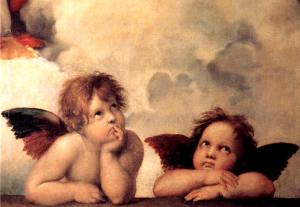
Raphael is now considered one of the three great masters from the High Renaissance. (Leonardo da Vinci and Michelangelo being the other two, so he had a high bar to reach. My point is that he didn’t start out at the top.)
Where did he begin, how did he improve, and what lessons does his progress give to aspiring artists out there?
This video provides an in-depth look at the what, when and how of it all. Hopefully it can also provide some encouragement to anyone working to improve, regardless of their art form.
And while it’s true that talent helps and that there are child prodigies out there (looking at you, Mozart!), most who achieve excellence do it exactly the way you are doing it: setting goals, studying what works, and practice, practice, practice.
* A note on the title: I know that the Mona Lisa was Leonardo da Vinci’s masterpiece, and Raphael painted a lot of Madonnas, but given that titling this piece “From Macaroni to Madonna” seemed more likely to evoke ’80s pop music rather than classical art, I went with this instead. (Although to be honest, I’m feeling a little bad about this decision and may change it later!)
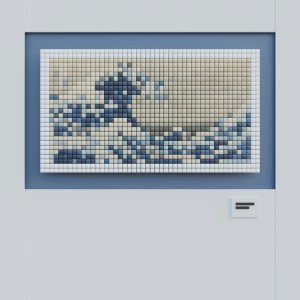
Sitting in my office in NYC, I sent a CNC machine in a guy’s workshop in Wisconsin a 40 by 25 pixel drawing and watched it flip hand painted wooden blocks across a grid, one by one, until the glorious smiling 404 Media logo appeared—then watched it slowly erase, like a giant Etch A Sketch, moving on to the next drawing.
“You shall, I question not, find a way to the top if you diligently seek for it; for nature hath placed nothing so high that it is out of the reach of industry and valor.”
“For only after, can one nail down, examine, explain. To try to know beforehand is to freeze and kill. Self-consciousness is the enemy of all art, be it acting, writing, painting, or living itself, which is the greatest art of all.”
On the off chance that you feel uninspired, or as if you lack the necessary requirements to make art, I give you Tatsuo Horiuchi. This retiree decided that he would start with what he had and go from there.
While most digital artists opt to use Photoshop or other similar digital imaging software, 77-year-old Japanese artist Tatsuo Horiuchi chooses to work with Microsoft Excel to produce his beautiful works of art. His “paintings” are remarkably intricate works that mimic traditional Japanese paintings that offer scenic views of natural landscapes rich with cultural motifs.
And the next time I think I can’t art without more (fill in the blank), I’ll remember this.
“Don’t throw any of yourself away. Don’t worry about a grand scheme or unified vision for your work. Don’t worry about unity — what unifies your work is the fact that you made it. One day, you’ll look back and it will all make sense.”
You must be logged in to post a comment.