Feeds:
Posts
Comments

Posts Tagged ‘data’

Some days you come across something on the web that helps you remember why people thought it was a good idea in the first place. For today’s entry into that ledger, I present Any Human Ever.

Any Human Ever: one life from over 100 billion

So: what would happen if stories were drawn from actual data, randomized to give a valid representation of the human story? That’s the question that was stuck in my head, and that drove this project forward. If you could draw a life at random from all of human history, what would it look like? Roll the dice, and see a genuinely random life, depicted as well as the data allow. Do it again and again, and what kind of pointillist painting emerges from all those colorful drops of humanity?

I love this idea. Do statistics have their place? Absolutely. Is this perfect? Maybe not, but I spent some time in grad school arguing for the humanization of data, and that debate solidified my belief that one of the best ways to connect people to ideas is through stories.

Have fun exploring 100 billion of them.

* * *

Read Full Post »

I like the data-driven articles from The Pudding, which include fun topics, great graphics and easy-to-digest research.

And hey, here’s one by Alvin Chang about science fiction!

Who killed the world?

I analyzed the top 200 sci-fi films and tv shows every decade from the 1950s to present day. What I found was that sci-fi narratives from yesteryear were quite different from today’s stories….

Sci-fi is an amazing genre.

It helps us explore our feelings about the unknown, the future, and the possible. It lets us imagine “what if” scenarios, and then build out rich worlds that our minds can occupy. It depicts dystopias we should fend off and utopias we should seek – and it teases us with the scintillating possibility that humans may actually be able to build the world we want.

But over the last few generations, it’s been harder for us to imagine this better world – and our sci-fi reflects that.

And while that may be so, sci-fi is also a critical part of highlighting society’s important problems. That’s the first step to finding a fix.

* * *

Read Full Post »

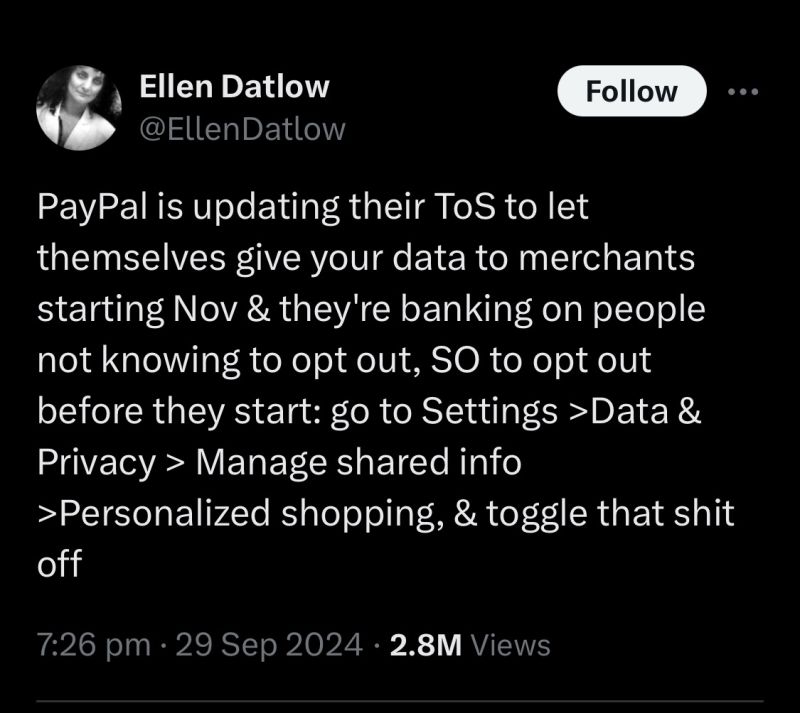
Sadly, today’s post is not about the fun kind of shenanigans, but the type of under-the-radar data grab that companies so often try to perpetrate upon us. Today’s alert is about PayPal, and this post from Ellen Datlow sets up the problem and happily, also provides a solution:

These options may differ depending on your location, but this push to share your data is very much an issue for anyone using PayPal US. I suggest you check your settings to be sure.

Thanks, Ellen!

* * *

Photo by Chris Yang on Unsplash

Read Full Post »

Ok, Google, now this is cool:) For anyone who has ever wanted to take the long (very long) view, there’s a new tool from Google.*

The Google Earth Engine gives users access to satellite imagery from as far back as 1984, and to build timelapse imagery that capture changes across the years.

Google Earth Engine combines a multi-petabyte catalog of satellite imagery and geospatial datasets with planetary-scale analysis capabilities and makes it available for scientists, researchers, and developers to detect changes, map trends, and quantify differences on the Earth’s surface.

Want to see what a timelapse looks like? Here is a short introductory video:

Want to make your own? No problem. Explore the built-in Timelapse features, integrate ready-to-use datasets on demographics, climate, imagery and more, or use your own code. (Check out the case studies from a variety of organizations focused on climate, health, and science, including this one on malaria risk mapping.)

You can also set up a tour to view more than one location. It’s fun, educational, persuasive, and easy to use. And because it’s Google, all this goodness is freely available. Now that U.S. government data may become less accessible, people and organizations interested in the long view need all the access they can get.


* Sadly, I’m not affiliated with Google, just a fan. Although like MIT and Slate and Scout and ASU (among others), Google would be a terrific sponsor for thoughtful new science fiction, don’t you think?

Read Full Post »