The good news is that there is a lot of up and coming fiction addressing issues of climate, change, and the environment. (The bad news is that we need it.)
Grist/Fix: Solutions Lab has a new climate fiction issue out, with discussions about the role of fiction in fixing reality and a dozen new stories from their “Imagine 2200: Climate Fiction for Future Ancestors” short story contest to get us started.
I recently finished a book that should have checked all my boxes, but in the end… didn’t. The characters started off interesting but came down with a case of the stupids and never fully recovered.* The characters also spent most of their time floating around like bobbers on an unbaited line. When they eventually found their purpose it was too late, and the book finished before actually ending.
When a story is like that I find my mind stays twisted up in it, fidgeting with its edges, trying to work out how it should have fit together rather than how it did. Like a jumbled Rubik’s Cube made of words. A stream flowing in the wrong direction. Or an itch I can’t scratch.
Sometimes that itch gets to the point where I find I have to Do Something about it.
Once upon a time I read a British coming-of-age novel called I Capture the Castle by Dodie Smith. I remember it as charming and it mostly worked for me, at least until the end. I finished the book and thought, “Nope, I’m afraid that won’t do.” And as an exercise for the annoyed problem-solver at the back of my mind, I rewrote the final chapters.
I moved a stack of Jim Butcher books yesterday and happened upon that new ending. It now sits on my bookshelf next to the original book.
I bound everything in gold-stamped cover stock and ribbon that year.
Sometimes what you need is to step back and think, “This little piece of the world could be better.” And then work to make it so.
* This is, of course, just my opinion. At some point you may read the same book and think, “That was the most brilliant and lyrical story ever.” That’s cool too.
Octavia Butler’s alternate realities and ‘speculative fiction’ reveal striking, and often devastating parallels to the world we live in today. She was a deep observer of the human condition, perplexed and inspired by our propensity towards self-destruction. Butler was also fascinated by the cyclical nature of history, and often looked to the past when writing about the future. Along with her warning is her message of hope – a hope conjured by centuries of survival and persistence. For every society that perishes in her books comes a story of rebuilding, of repair.
* * *
I was also interested to see this piece on largely forgotten female composers, complete with interactive map. I’m not a classical music buff, but I didn’t even know Amadeus had a sister, much less one who was also a child music prodigy. Now I do, and I’m better for it.
Two siblings, both considered child prodigies, dazzled audiences across Europe together in the 18th century, leaving a trail of positive reviews in their wake. But while Wolfgang Amadeus Mozart went on to be celebrated as one of the world’s greatest composers, the accomplishments of his sister – Maria Anna – were quickly forgotten after she was forced to halt her career when she came of age.
How about a bit of free fiction today? I’m still on day job vacation but had to take a meeting. Thankfully, my work day was nothing like this piece by David Shultz over at Diabolical Plots:
Kondo barked his orders. “Rocco, cover the east window. Valiant, you’re on ammo detail. Pepsi, keep an eye on market changes. Luna, get me a full asset list.”
a unit of distance used in astronomy, equal to about 3.26 light years (3.086 × 10¹³ kilometers). One parsec corresponds to the distance at which the mean radius of the earth’s orbit subtends an angle of one second of arc.
A parsec is a measurement of distance, not time. Twelve of those do not a winning Kessel Run make, but, as millions of fans (and yes, dollars) attest, no one cares. The story works.
These are the things I think about when I’m stuck on a plot point, or deep in historical or technical weeds.
Here’s a brief piece by Kate Wilhelm of Clarion Workshop fame, on writing and what to avoid. A little harsh? Possibly. But it still looks like good advice.
One year Damon and I arrived to teach the last two weeks of the six-week Clarion Writers Workshop with a list of stories we forbade the students to pursue. We explained each item on the list and said don’t do it again.
I love good writing. And humor. And science fiction. And epistolary fiction, because telling stories through letters is fun. Imagine how happy I was when I found this short story* combining all of the above:
To be clear: I am busy. For at least the next two years. Because getting to do research in the super-techy lab requires a doctorate these days, an obscene pile of peer-reviewed publications, and the networking abilities of a ninja. I am busy with those things. Namely finishing the doctorate. Thwarting an alien invasion? Not on my to-do list.
So that thing where I came to the lab this morning to find your phosphorescent eggs floating in alien amniotic fluid in the vacuum chamber? Not cool.
— Sam F. Weiss
* For the young or those with delicate sensibilities, this piece contains swearing. Like, a lot. To be fair, I’d say it’s warranted. Grad school, you know. And oh yes, also aliens.
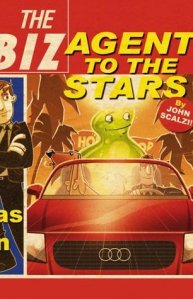
Here’s a heaping helping of free fiction, with a side of motivation. John Scalzi’s first novel is posted free to read on his site. It’s the web version, with each chapter its own link and charmingly antiquated page design, but the novel is fun.
After a long day of work sometimes you just want to dust yourself off, meet an alien at the corner bar, and laugh a little. At least I do:)
Scalzi refers to this as his practice novel, but it’s well written and entertaining. (If you’d rather get the full version, the book was eventually published via traditional means, so visit your favorite retailer.) It’s also a great example of what can be done if you just knuckle up to the keyboard and see what comes out.
Busy day today, and none of the three ideas I had for this post came together. Instead, have some fiction, this time read to you by Levar Burton. (You know, the Jeopardy host, and oh yes, Roots and Star Trek and Reading Rainbow and a few other things as well;)
His podcast is Levar Burton Reads, and he picks some of the best speculative short* fiction out there. So when you have a few minutes, sit back, listen, and relax.
If we think about science fiction (sf) in terms of the genre’s connections to pressing issues in 21st-century culture, no topic is more urgent than climate change and the ways it promises to transform all aspects of human life, from where we live to how we cultivate our food to what energy sources will fuel our industries.
…
Preparedness discourse responds to change, understood as disaster, through strategies of containment. But science fiction offers something much more. It offers us a way of thinking and perceiving, a toolbox of methods for conceptualizing, intervening in, and living through rapid and widespread change — and the possibility to direct it toward an open future that we (re)make.
Here’s to thinking new thoughts, building new worlds, and making them.








You must be logged in to post a comment.