Many people, myself among them, feel better at the mere sight of a book.”
― Jane Smiley
Me too:)
Posted in Writing, tagged #ThingsILike, artists, books, inspiration, Jane Smiley, quotes, Thoughts, Writers, writing, yay on April 15, 2016| Leave a Comment »
Many people, myself among them, feel better at the mere sight of a book.”
― Jane Smiley
Me too:)
Posted in Likes, Writing, tagged #redwoods, artists, inspiration, JK Rowling, Motivation, persistence, quotes, rejection, Thoughts, work, Writers, writing, yay on April 6, 2016| Leave a Comment »
Life is not supposed to be neat. And it’s a comfort. It’s a comfort to all of us who have messed up. And then you find your way back…
— JK Rowling
Posted in Likes, Writing, tagged Bruce Lee, creativity, failure, inspiration, persistence, quotes, Thoughts, work, Writers, writing on March 30, 2016| Leave a Comment »
Don’t fear failure. — Not failure, but low aim, is the crime. In great attempts it is glorious even to fail.
— Bruce Lee
Posted in Likes, tagged #ThingsILike, creativity, finishing, inspiration, Ireland, Motivation, persistence, problem solving, quotes, Robert Frost, Thoughts on March 18, 2016| Leave a Comment »
I’m banging my head against a data problem so I’ll have to set aside the in-depth and incisive essay on the mating habits of Salarian scientists I had planned (so sad, but maybe next week;).
Instead, today’s thing I like is this image and the sheer effort the landscape represents. It’s also a shout-out to my Irish relatives (currently recovering from St. Patrick’s Day) and to the fact that people have been solving problems for millennia. Look at those walls, that can’t have been easy:)
The best way out is always through.
― Robert Frost
So, persistence for the win. With that in mind, back to work!
Posted in Likes, Writing, tagged #HipsShouldBeUnbreakable, Confucius, encouragement, family, finishing, inspiration, Motivation, perseverance, persistence, quotes, Thoughts on March 9, 2016| Leave a Comment »
For my mother and anyone else facing a challenge today:
It does not matter how slowly you go as long as you do not stop.
― Confucius
Posted in Likes, Writing, tagged #ThingsILike, Andy Weir, Antoine de Saint-Exupéry, awesome, books, creativity, DIY, Fiction, Golden Age, innovation, inspiration, JK Rowling, NASA, Popular Science, quotes, science, science fiction, sff, space, speculative fiction, Thoughts, Tyler Jacks, Weasley clock, Writers, writing on March 4, 2016| Leave a Comment »
A friend with a shared love for Harry Potter sent me a link the other day. Some creative and determined person decided to make a Weasley clock.*
The magical ‘Harry Potter’ location clock exists in DIY form
For those who may have missed this detail from the HP book and/or movie, the Weasley clock is a magical JK Rowling invention that tracks each Weasley family member’s location and displays it on an antique clock face.
Rowling thought it up, and a Muggle made it real. How cool is that?
So with thanks to my friend, today’s installment of #ThingsILike is the real-world power of fiction.
*
“If you just focus on what you know, you’re blinding yourself to new opportunities.”
— Tyler Jacks, MIT
There are a lot of discussions of this topic out there, both contemporary and historical, but it’s a point I like to touch on periodically. A writer imagines a thing and someone else finds a way to make it real.
That’s magic right there.
This applies to specific items like the clock but also to everything from emotional states to broader goals. Want to generate ideas, stir up communal interest, and apply creativity to complex problems like living in space long-term? Tap the power of fiction:
The White House Wants To Use Science Fiction To Settle The Solar System
How to get into space? Excite the minds of young (and not so young) people with stirring tales of adventures in space. This applies to stories from Asimov, Clarke and other Golden Age of Science Fiction authors, but also to more recent blockbusters like Andy Weir’s The Martian.
The latter was particularly good at building future versions of current technologies, and NASA was happy to help Weir build his fictional (for now) world from the Popular Science article on the support NASA gave Ridley Scott as he turned the book into a blockbuster movie:
If you want to understand why it is that NASA loves The Martian and is so gung ho for this movie, you have to realize that this movie more or less presents exactly their future vision, minus all the drama.
*
I’ve cited this quote before but it’s so fitting I’ll use it again:
If you want to build a ship, don’t drum up people to collect wood and don’t assign them tasks and work, but rather teach them to long for the endless immensity of the sea.
— Antoine de Saint-Exupéry
That’s the power of fiction.
———
* There may be other such clocks out there (in fact, I hope there are) but this is the version that caught my attention. Feel free to build more!
Posted in Likes, tagged #firefall, #ThingsILike, awesome, effing amazing, inspiration, national parks, nature, photography, Serengeti, Stephen Wilkes, Thoughts, yay, Yosemite on February 19, 2016| Leave a Comment »
I have two #ThingsILike today, because I couldn’t choose between them. All I can say is wow!
‘When People Can See Time’: Photographer Captures Day, Night In One Image

Posted in Likes, Writing, tagged #amwritingscifi, #LadyAdventurers, airmail, creativity, flight, genre fiction, history, infrastructure, inspiration, navigation, quest, science fiction, sff, Smithsonian, speculative fiction, Thoughts, travel, USPS, wayfinding, work, writing on February 10, 2016| 1 Comment »
It’s snowing! It’s pretty! All is right with the world.
The past few weeks of above-freezing temperatures and no snow have been, for lack of a better word, weird. It reminds me of the time I spent in Arizona, and my first warm Christmas. Seventy degrees on Christmas? In the Northern Hemisphere? Weird. I thought I’d be happy to get away from the cold and snow but I guess childhood imprinting isn’t so easy to escape.
I’ve also been thinking about the desert for a story I’m working on. Remembering the dry expanse stretching to the horizon, tenacious scrub clinging to the sides of dry riverbeds and the clarity of the air at dawn. Thinking about the challenges of crossing such a place in an era before the things Americans tend to take for granted, like functional highways, a network of gas stations and cars that didn’t blow a tire every 50 miles. And I stumbled across this fascinating article in the Smithsonian’s Air & Space magazine, about a network of alien markings giant concrete arrows crisscrossing the continent.
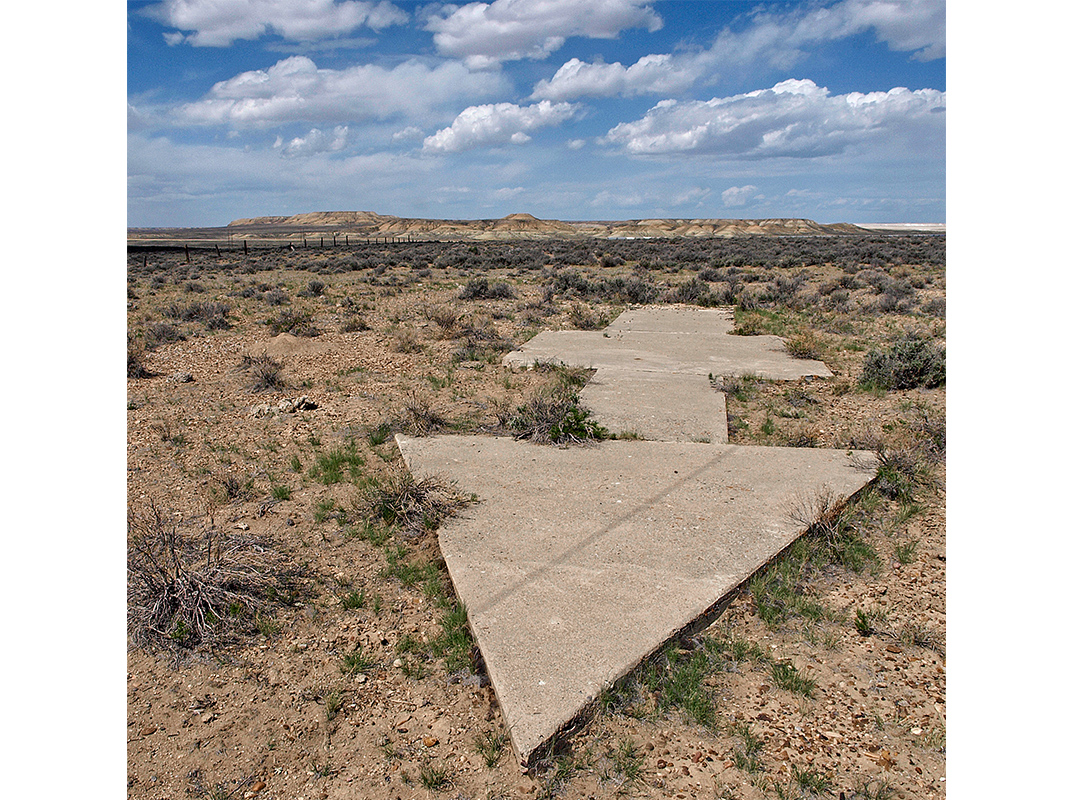
Before satellites, real-time GPS or other modern navigation systems, pilots had to be able to see where they were going. They couldn’t fly at night or in bad weather, and figuring out where they were was a complicated affair involving tools like a compass, maps (on paper!) and a bit of guesswork.
Some towns painted their names in oversized block letters on rooftops to help pilots get their bearings. And sometimes—like when navigational delays slowed down transcontinental air mail delivery* after 1920**—the government saw the need for a more comprehensive solution to the problem and stepped in. In this case they built a system of 70-foot-long concrete arrows pointing the way:
The government built a path of 70-foot-long concrete arrows every few miles from coast to coast, each painted yellow and topped with a 51-foot steel tower that had a rotating beacon. Using the path, an airmail pilot needed only half the time to deliver a letter from New York to San Francisco.
Eventually technology caught up with our demands and the markers were abandoned. Where are these markers now? An intrepid couple named Brian and Charlotte Smith wanted to know the answer and embarked on A Quest (because let’s face it, it’s hard to get anything significant done without A Quest).
They go on road trips to investigate these remnants of a bygone era, and now you can too. With the help of drone lessons from their nine-year old grandson, they’ve assembled photos and a database of marker locations.
The core idea of this story resonates with me. It’s the same childhood fascination I had for the Pony Express or the challenges of nineteenth-century explorers. For me, it’s hard to read a piece like this and not conjure up a daring young Lady Adventurer winging her way across an untamed landscape on a new world, with nothing but a few isolated markers to keep her on track.***
Marvelous!
—–
* FYI, I love the USPS and public libraries and Eisenhower’s Interstate Highway System. These and other basic infrastructure**** projects help make us a better connected, better educated country and have impacted everything from social mobility to what we eat for dinner.
** Before 1920, if you wanted to send a letter to your cool aunt in San Francisco, for example, it went via methods like stagecoach or boat or train. Slooooooow. Or you could send a telegram and tell the whole world your business… like Twitter, actually.
*** A lot like Beryl Markham, actually.
**** (A footnote within a footnote. Does that make it a toenote?) I just want to include the definition of infrastructure and ask lawmakers responsible for assigning project funds, how is this optional?
Infrastructure: The basic physical and organizational structures and facilities (e.g., buildings, roads, and power supplies) needed for the operation of a society or enterprise.
Posted in Writing, tagged #WritingWednesday, creativity, entertainment, Fiction, history, inspiration, literature, NPR, speculative fiction, Thoughts, Writers, writing on January 27, 2016| Leave a Comment »
Storytelling is a fundamentally human pursuit. (Not to say that we’re the only ones who do it, because it’s possible that ant and bee pheromones communicate the route to food in the form of a tale that resonates with those particular species, but…) In fundamental ways that touch on history to parenting to neuroscience and everything in between, we are our stories. The origins of some classic fairytales, for instance, go back thousands of years.
How our essential stories came to be, what they say to us, and about us, and how they continue to resonate, are all fundamental questions for writers. One way to think about the path of a story, where it goes and what it is meant to do, is through the Hero’s Journey. The TED Radio Hour on NPR did a nice series on this:
…why are we drawn to stories about heroes? And what do they tell us about ourselves?
There are other ways to tell a story, of course, but as the fundamental underpinnings of tales from The Odyssey to Star Wars, this framework provides a fascinating and concrete way to communicate through fiction.
Posted in Entertainment, tagged artists, arts, Chris Hadfield, creativity, David Bowie, death, inspiration, Motivation, NASA, science, science fiction, space, Thoughts on January 11, 2016| Leave a Comment »
Bowie was a great artist and an inspiration to so many, including those of us in the science and science fiction communities. A lot will be written about him in the next while so I’ll just leave you with one small sign of his influence, on and off the planet.


You must be logged in to post a comment.