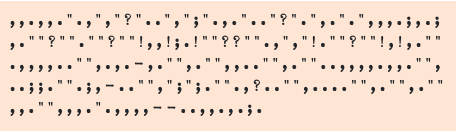
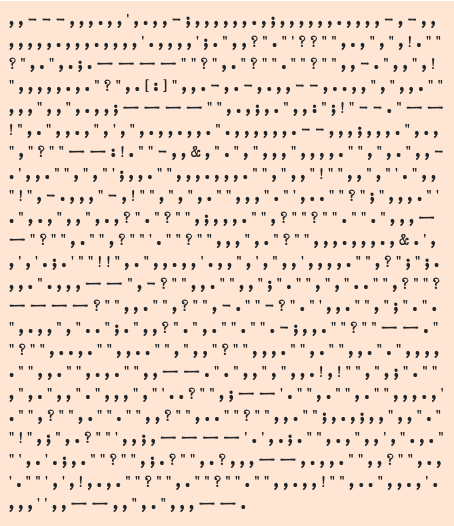
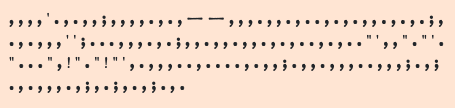
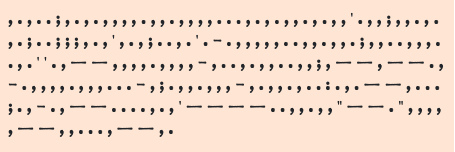
My second thought was to see how that story compared to other authors’ work. I visited Project Gutenberg and evaluated first chapters from a selection of famous and/or cherished books.
Now that was interesting, both for the differences in punctuation and for the variety and length of chapters. (Nineteenth-century authors also loved commas, it seems. Is it time to hang up my keyboard and pick up a quill?)
Pride and Prejudice, Jane Austen
The Secret Garden, Frances Hodgson Burnett
The Count of Monte Cristo, Alexandre Dumas
Great Expectations, Charles Dickens
Ulysses, James Joyce
The Wonderful Wizard of Oz, L. Frank Baum
Frankenstein, Mary Wollstonecraft Shelley
The Souls of Black Folks, W.E.B Du Bois
The Adventures of Sherlock Holmes, Arthur Conan Doyle
This approach certainly provides a new perspective on the building blocks underpinning different authors, eras and genres of writing. Will it help my writing? Maybe, maybe not, but it was fun.
Note: This post is long but both Ray Bradbury and Jane Austen make an appearance, so there’s that.
* * *
We keep a little pad of paper stuck to the side of the fridge to use as a grocery list. Every couple of weeks I get tired of crossing things out and trying to remember what we actually bought and what I only think we bought, and I start fresh. Yesterday I pulled the latest iteration of the list off the pad and turned to toss it in the recycling bin, when the back of the sheet caught my attention. It was blank.
Not a big surprise there, think of all the Post-its you’ve used one side of in the last decades. But! It struck me how much times have changed. Wealth is a continually moving target, and so are our measures of it.
I mean you’re warm in winter and cool in summer and can watch the World Series on TV. You can do anything in the world. You literally live better than Rockefeller. His unparalleled fortune couldn’t buy what we now take for granted, whether the field is—to name just a few—transportation, entertainment, communication or medical services. Rockefeller certainly had power and fame; he could not, however, live as well as my neighbors now do.
In the case of paper, we’ve got both more and better.
Once upon a time, people had to use both sides of the paper. Heck, once upon a time, people didn’t have paper, and after its invention it took centuries to become what we think of today: cheap, high quality, readily available, reliable information storage, bird cage liner, and paper plane in waiting.
Even after paper became widespread in the Western world, wood pulp paper was terrible. Like, sheets of nasty grey pulp held together with weird glues and chemicals that slowly (or not so slowly) destroyed itself.
“Unfortunately, early wood-based paper deteriorated as time passed, meaning that much of the output of newspapers and books from this period either has disintegrated or is in poor condition; some has been photographed or digitized (scanned). The acid nature of the paper, caused by the use of alum, produced what has been called a slow fire, slowly converting the paper to ash.”
Depending on the circumstances, writers also did their best to use every inch of a page. Part of that was the paper itself, and part was the cost of postage. (Insert obligatory statement of love for modern postal services here!)
Click through to see a letter from Jane Austen to her sister Cassandra using cross writing, designed to condense as much information as possible onto a given sheet:
A crossed letter written by Mrs. F. L. Bridgeman to Fanny West, December 15, 1837. Public domain, via Wikimedia Commons
* * *
It turns out that paper wasn’t quite as expensive as I’d thought, but the good stuff still wasn’t cheap.
Based on paper purchases by individuals from the 1570s to the 1640s, paper was “roughly a penny for six sheets… To put this in perspective, the average laborer making 6-12 pence a day could purchase up to 75 sheets of paper with a day’s wages. (Was early modern writing paper expensive? – The Collation)
Later, Regency-ish England did have additional duties that made quality paper, particularly in book-sized quantities, more expensive.
“The excise duty on paper was a frequent problem for all printers and publishers. The reorganisation of the duty in 1794, whereby it was charged by weight rather than ream, had the effect of making the burden heavier”
In researching this I came across a wealth of fascinating economic information. For example, what was one shilling worth in London during the mid-1700s? So many things!
Dinner in a steakhouse – beef, bread and beer, plus tip
Sign-on bonus for army recruitment: The king’s Shilling
Admission to Vauxhall Gardens
Admission to Ranelagh Gardens (although it could be as much as 2 guineas on masquerade nights)
A dish of beef at Vauxhall
1lb of perfumed soap
Postage of a one page letter from London to New York
How did we get here? Right, a grocery list, and my appreciation that so many of us now have access to things like affordable paper, postal service, and oh yes, literacy!
If you’ve ever wondered what Jane Austen ate, or if the menus in her books were true to life, this is the link for you. Here’s the book the article highlights.
And if you’ve ever thought about what life was like on the other side of the scullery door, check out Longbourn by Jo Baker.
In this irresistibly imagined belowstairs answer to Pride and Prejudice, the servants take center stage. Sarah, the orphaned housemaid, spends her days scrubbing the laundry, polishing the floors, and emptying the chamber pots for the Bennet household. But there is just as much romance, heartbreak, and intrigue downstairs at Longbourn as there is upstairs.
I found the world below-stairs fascinating, and not just because I’m the sort of person who likes to learn about practical and medicinal plant properties, or what chilblains felt like.
It’s good to give every person a chance to be the main character, you know?
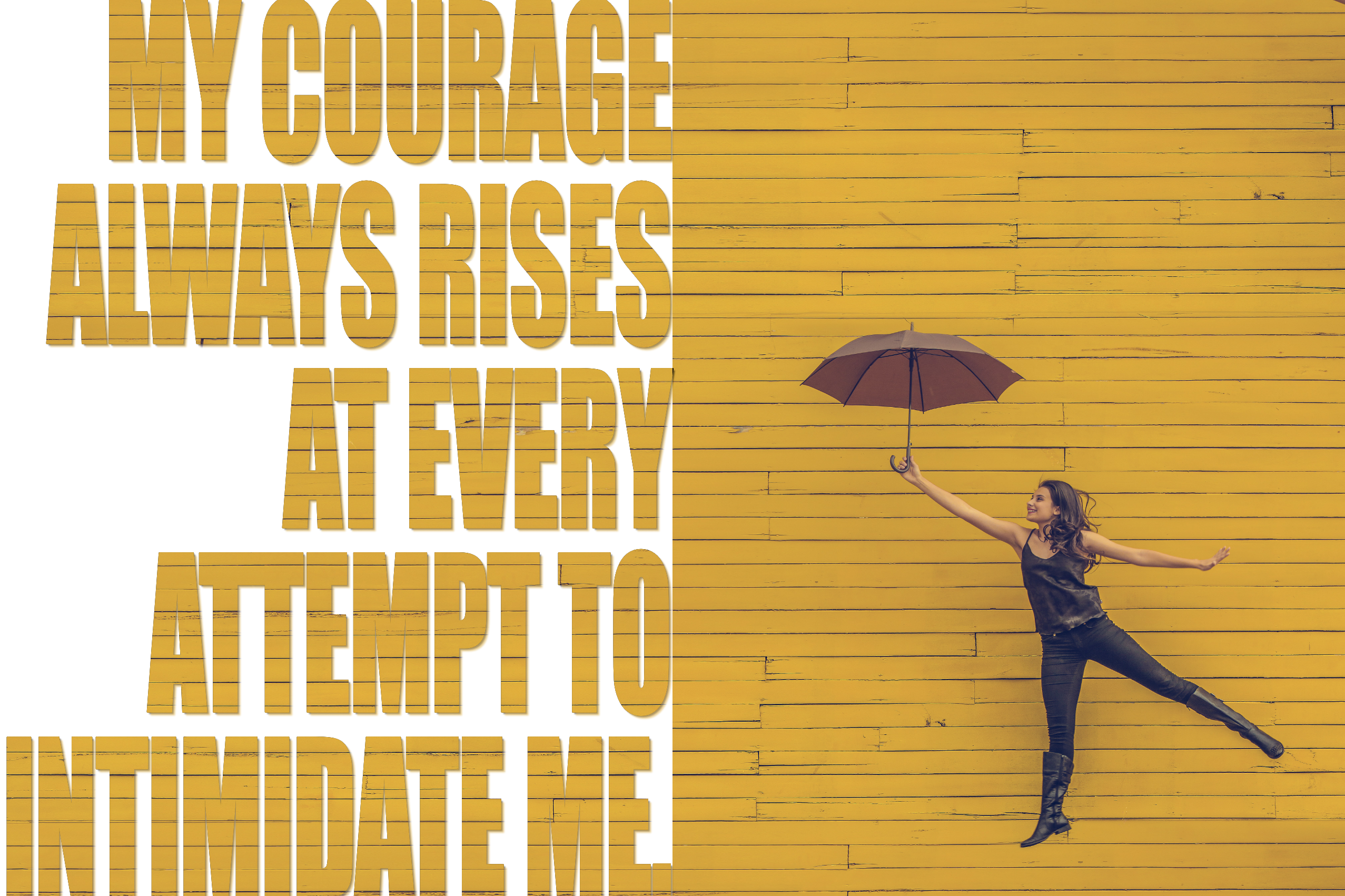
No writing today, but I did learn a little more Affinity Photo. I spent some of the afternoon playing with images and one of the things I made was this poster with Pride and Prejudice text overlay.
Now it’s time for pizza (which does not intimidate me)!










You must be logged in to post a comment.