Feeds:
Posts
Comments

Posts Tagged ‘Octavia Butler’

My mother sent me an article about Octavia Butler, one of a number I’ve seen recently in the wake of the LA fires. Butler was an award-winning sci-fi and fantasy author know for her all-too-realistic versions of the future. Although she died in 2006, a week of devastating fires in LA fit right in with her vision of 2025.

In fact, she was once asked how she was able to predict the problems of the future as accurately as she did, and her answer is a telling lesson for writers but also for people who want to make a difference.

“A Few Rules for Predicting the Future” by Octavia E. Butler – Seven Good Things

“I didn’t make up the problems,” I pointed out. “All I did was look around at the problems we’re neglecting now and give them about 30 years to grow into full-fledged disasters.”

Ouch.

But that’s not all Butler said. I recommend you read the essay in full. It’s not long, but it packs a punch.

“Okay,” the young man challenged. “So what’s the answer?”

“There isn’t one,” I told him.

“No answer? You mean we’re just doomed?” He smiled as though he thought this might be a joke.

“No,” I said. “I mean there’s no single answer that will solve all of our future problems. There’s no magic bullet. Instead there are thousands of answers, at least. You can be one of them if you choose to be.”

I so choose, and I hope you do, too.

* * *

Photo by Luwadlin Bosman on Unsplash

Read Full Post »

“First forget inspiration. Habit is more dependable. Habit will sustain you whether you’re inspired or not. Habit will help you finish and polish your stories. Inspiration won’t. Habit is persistence in practice. You don’t start out writing good stuff. You start out writing crap and thinking it’s good stuff, and then gradually you get better at it. That’s why I say one of the most valuable traits is persistence.”

― Octavia E. Butler

* * *

Photo by Jon Tyson on Unsplash

Read Full Post »

Today is International Women’s Day, and I’m feeling fine. If you’re interested in learning more about the sorts of women who are often shunned by history, check out this sampling of women who dared greatly:

Historical awesome:

And in a bit of modern-day awesome, NASA has named the Perseverance landing site after Octavia Butler. How cool is that?

Speaking of NASA:

Inspiration much? Yes, thanks!

* * *

In related news, we finally watched Terminator: Dark Fate and enjoyed the heck out of it. I’ll admit to avoiding it, a bit. Lackluster reviews, messed-up timeline issues (which earlier movies were we supposed to ignore and which not? oy), plus the “Yeah, you’re not the threat. It’s your womb” series concept kept me from watching it sooner. 

Now that I have, what did I think?

Let’s just say that the ladies kick ass.

* * *

Photo by Jen Theodore on Unsplash

Read Full Post »

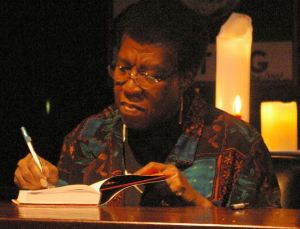
Yesterday it was Black History Month and today it is Women’s History Month. It seems like the perfect day to spotlight American science fiction writer Octavia Butler. 

Nikolas Coukouma, CC BY-SA 2.5 https://creativecommons.org/licenses/by-sa/2.5, via Wikimedia Commons

* * *

Who was she?

Octavia Estelle Butler (June 22, 1947 – February 24, 2006) was an American science fiction author. A multiple recipient of both the Hugo and Nebula awards, she became in 1995 the first science-fiction writer to receive a MacArthur Fellowship.

— Octavia E. Butler – Wikipedia

* * *

What makes her work special?

I think the first Butler book I read was The Parable of the Sower, found in the interesting section of the family’s bookshelves. It had a woman’s name and a black image on the cover. Count me in, I said. And then it got interesting.

This was no whitewashed far future in space, or something like Heinlein’s more recognizable near-ish futures. We begin in a devastated California, raw and gritty and often painful, but with hope and purpose to bind it together into a larger whole. 

This NPR show talks about her work and what made it remarkable:

Octavia Butler: Visionary Fiction‬

She was a deep observer of the human condition, perplexed and inspired by our propensity towards self-destruction. Butler was also fascinated by the cyclical nature of history, and often looked to the past when writing about the future. Along with her warnings is her message of hope — a hope conjured by centuries of survival and persistence. For every society that perished in her books, came a story of rebuilding, of repair.

* * *

Where to start?

She became the first science fiction author to be granted a MacArthur fellowship, and the first Black woman to win Hugo and Nebula awards. Today her influence spans literature, genres and media.

— The Essential Octavia Butler – The New York Times

These links lay out her work and explore her growth as a writer. Explore more to get a better sense of what she wrote and why.

Where to Start with Octavia Butler | The New York Public Library

“‘Devil Girl from Mars’: Why I Write Science Fiction”

In 1998, Butler delivered an address at the Massachusetts Institute of Technology. She describes the thinking behind several of her works of fiction and her motivations for writing. It is essential reading for understanding the social consciousness behind the beloved writer’s oeuvre. 

NYPL

* * *

I won’t lie. Butler’s work is good but can be challenging, not least because of the way it takes a visceral look at who we are and what we can be (both the good and the bad). In many ways, I think of her writing as a more realistic, more historically-informed vision of our future than many of the rah rah space travel versions of sci-fi. Unless we change, that is.

Read Full Post »

Or, what I read with my morning tea. Entertainment, edification, and associated weirdness? Yep, these articles have it all. Enjoy!

And via the good people at io9:


Read Full Post »