Feeds:
Posts
Comments

Posts Tagged ‘science’

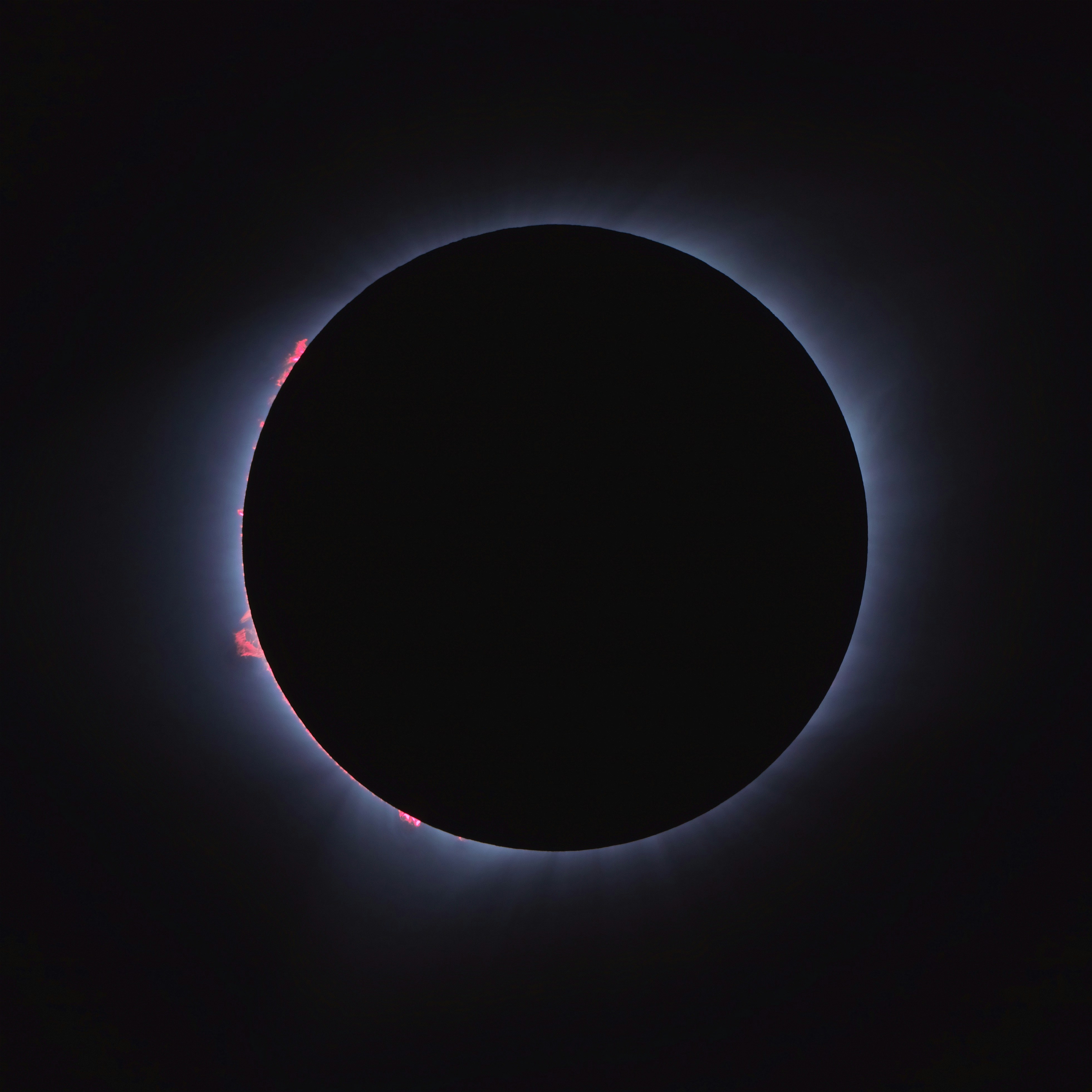
If you are anywhere near the path of totality for the big event on Monday, April 8th, are you eclipse ready? I will argue that one of the most important parts of such prep is to ensure that you have a plan for safe eclipse viewing. This article may be of help:

Are Your Solar Eclipse Glasses Fake? Here’s How to Check | Scientific American

Legitimate eclipse glasses are at least 1,000 times darker than the darkest sunglasses you can buy….

While lab tests are the best way to determine whether glasses meet the ISO standard, Fienberg says there is a three-part test people can do at home if they’re concerned their eclipse viewers aren’t up to the task.

First, put your glasses on indoors and look around. The only things you should be able to see are very bright lights, such as a halogen bulb or a smartphone flashlight.

Then, if the glasses pass the indoor test, bring them outside—but don’t look at the sun just yet. Look around: it should be too dark to see distant hills, trees or even the ground.

If that second test is passed, keep the glasses on and quickly glance at the sun. You should comfortably see a bright, sharp-edged round disk. If your glasses pass all three tests, they are probably safe to wear. Still, Fienberg points out that it’s best to use them for only a few seconds every minute or so during the eclipse…

Here’s a reference for Suppliers of Safe Solar Viewers & Filters | Solar Eclipse Across America.

Your eyes need eclipse protection, but did you know that your phone/camera does too?

How to photograph the eclipse, according to NASA | Popular Science

Speaking of NASA, NASA needs your smartphone during April’s solar eclipse. Go citizen scientists!

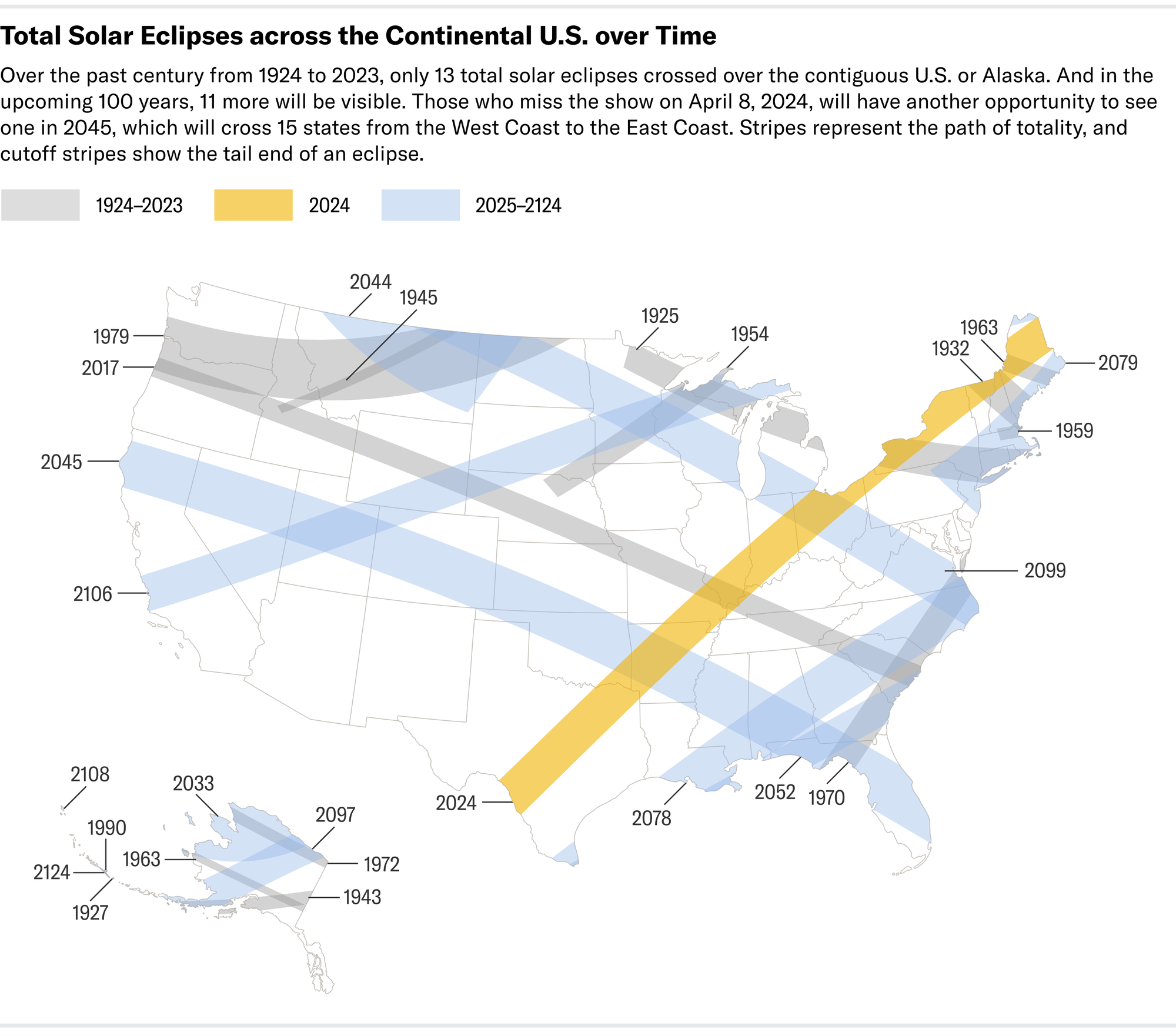
And if you’re already looking forward to upcoming total solar eclipses, here’s a map to help you plan:

Map of total solar eclipses across the Continental US over time
From Scientific American: See Where Future U.S. Eclipses Will be Visible
Credit: Shuyao Xiao; Source: NASA (data)

2106, here we come!

* * *

Photo by Jason Howell on Unsplash

Read Full Post »

Want to get away for a year or so? This job might be for you!

Martians Wanted: NASA Opens Call for Simulated Yearlong Mars Mission – NASA

NASA is seeking applicants to participate in its next simulated one-year Mars surface mission to help inform the agency’s plans for human exploration of the Red Planet.

NASA is looking for healthy, motivated U.S. citizens or permanent residents who are non-smokers, 30-55 years old, and proficient in English for effective communication between crewmates and mission control. Applicants should have a strong desire for unique, rewarding adventures and interest in contributing to NASA’s work to prepare for the first human journey to Mars.

The deadline for applicants is Tuesday, April 2.

https://chapea.nasa.gov

* * *

Photo by Benjamin Recinos on Unsplash

Read Full Post »

Today, an essay by Cecilia Tan in Uncanny magazine: A Novel Is an Empathy Engine.

The idea that story can have an effect on the humans that consume it is not new. It’s well accepted across many cultures, and well supported by studies, that children’s development is aided by hearing stories, with benefits ranging from emotional development and improved communication skills to increased vocabulary and social maturity. But adults are also affected and changed by story.

* * *

Photo by Nav Rashmi Kalsi on Unsplash

Read Full Post »

I have not read Brian Klaas’s Fluke, the book on which the article below is based, but this line made an impression in my busy day.

The big idea: what if every little thing you do changes history?

One hundred million years ago, a shrew-like creature got infected with a retrovirus, eventually leading to the placenta and, by extension, the reason why we don’t lay eggs.

* * *

Photo by Domino on Unsplash

Read Full Post »

If you’ve seen any space news this past week, you may already know that Ingenuity, the adorable little helicopter that has exceeded all expectations in its exploration of Mars, has ended its mission.

After Three Years on Mars, NASA’s Ingenuity Helicopter Mission Ends – NASA

Originally designed as a technology demonstration to perform up to five experimental test flights over 30 days, the first aircraft on another world operated from the Martian surface for almost three years, performed 72 flights, and flew more than 14 times farther than planned while logging more than two hours of total flight time.

Ingenuity arrived on Mars with the Perseverance rover almost two years ago. It began as a limited technology demonstration but quickly became a scout for the rover’s mission and a fan favorite. Now, after 72 flights, a difficult landing has caused irreparable damage to its rotor blades.

Here’s what NASA Administrator Bill Nelson had to say about the end, and what the plucky little project managed to accomplish.

* * *

Ingenuity, and its swatch from the original Wright flyer, will remain on the Martian surface as a testament to how far we’ve come.

“That remarkable helicopter flew higher and farther than we ever imagined and helped NASA do what we do best – make the impossible, possible.”

— Bill Nelson, NASA Administrator

This weekend join me in raising a glass to the first powered, controlled flight on another world, and to the little ‘copter that could.

Thanks, Ingenuity.

* * *

original from NASA

Read Full Post »

Winter has finally arrived in the Northeast, and it is making a serious splash.

We wanted a white Christmas, but that didn’t happen around here; Nature is making up for it now. We’ve had multiple storms this week complete with snow, sleet, ice and rain (sometimes all at once) and expect a significant snowstorm to hit this weekend.

That has me investigating weather reports, flexing my shoveling muscles, and generally catching up on all things snow. Here are a few of the interesting articles I found:

Science of Snow | National Snow and Ice Data Center

Snow forecasts are better than they used to be, and they continue to improve, but snow forecasting remains a difficult challenge for meteorologists. One reason is that during intense snows, the heaviest snowfall can occur in surprisingly narrow bands, and on a smaller scale than observing networks and forecast zones can see. Also, the extremely small temperature differences that define the boundary line between rain and snow make large differences in snow forecasts. This is part of the fun and frustration that makes snow forecasting so interesting.

Winter storm hits East Coast. What’s in a snowflake? (transcript)

“So a snowflake that was more than a foot across. Is that, like, even possible?”

How to Shovel Snow Safely – This Old House

Freezing temperatures often bring snow, sleet, and ice. And removing that messy wintry mix from your walkways and driveways is no easy feat. Here is the best way to shovel snow to prevent injury and lessen your workload.

What’s Wrong With This Snowflake? (transcript)

Koop thinks ice crystals are masterpieces of natural beauty. Unfortunately, he says, “This beauty is sometimes corrupted.”

Seeing Snowflakes As ‘Hieroglyphs from the Sky’ (transcript)

“It’s been said that snowflakes are like hieroglyphs from the sky…,” says Libbrecht, an astrophysicist and chairman of the physics department at the California Institute of Technology. “In the shape of the crystal is encoded the conditions under which it grew.”

And for when snow stops being fun and starts getting real: United States Power Outage Map.

Time to charge up our phones, laptops, power banks and car. Stay safe and warm!

* * *

Photo by Donnie Rosie on Unsplash

Read Full Post »

It’s Monday, I’m back at work, and while things are moving along fine I’d be lying if I said I didn’t wonder what a day in space would be like instead. 

Let’s take a little break and go to Mars, shall we?

NASA’s Curiosity Rover Captures a Martian Day, From Dawn to Dusk – NASA Mars Exploration

Rover drivers normally rely on Curiosity’s Hazcams to spot rocks, slopes, and other hazards that may be risky to traverse. But because the rover’s other activities were intentionally scaled back just prior to conjunction, the team decided to use the Hazcams to record 12 hours of snapshots for the first time, hoping to capture clouds or dust devils that could reveal more about the Red Planet’s weather.

NASA

* * *

Photo by Juli Kosolapova on Unsplash

Read Full Post »

Christmas Eve, when Santa is racing around the world distributing presents, seems like an excellent time to think back to the experience of the holiday as a young child. If Christmas was part of your family tradition, do you remember what it was like to believe in Santa Claus? 

I do, and despite the ever-present pressures of reality, that sense of wonder is part of why I write.

Making Sense of Santa, as a Science Reporter and a Parent ‹ Literary Hub

“When I was a kid, did you try to get me to believe in Santa?” I recently asked my parents. My father, a mathematician, scoffed. “Of course not,” he said. “We told you he was a mythological being that represented generosity and good cheer.”

Still, every December, my mother hung stockings above the chimney with care. And every Christmas Eve, she made sure cookies were left on a festively decorated plate, as though she truly believed St. Nick would soon be there.

* * *

Photo by LuAnn Hunt on Unsplash

Read Full Post »

Life Skills

I spent a lot of time as a kid learning skills that were technically unnecessary for me, but would have been essential to my ancestors. Skills like weaving, making cough syrup or dyeing wool using local herbs, flint knapping, bow making, that sort of thing (yes, my parents were very tolerant!). One of the skills I never did manage (and I bet the local fire department was grateful) was making a fire using only friction.

If you’ve seen Tom Hanks try this in Castaway, you’ll know that it isn’t as easy as it looks. 

If this is the sort of thing that catches your attention, as it does mine, this article might interest you.

Lighting a fire using friction requires an understanding of some physics principles − but there are ways to make the process easier

Fire by friction is a testament to human ingenuity, contributing to the development of early technology and a later understanding of physics, chemistry and heat transfer.

* * *

Photo by Benjamin DeYoung on Unsplash

Read Full Post »

Purr-fect

Oh look, NASA just sent the first Ultra-HD video through deep space using a laser communications system.

NASA’s Tech Demo Streams First Video From Deep Space via Laser

Me: Cool cool cool. It’s a test, right? 

Other Me: That’s right. 

Me: So this experiment marks the progress humanity has made in reaching out to the stars. I wonder which video NASA used?

Other Me: This one. I think it perfectly encapsulates the usefulness of laser technology in general, and where we are as a species right now in particular.

* * *

Read Full Post »

« Newer Posts - Older Posts »