Feeds:
Posts
Comments

Archive for the ‘Likes’ Category

A friend with a shared love for Harry Potter sent me a link the other day. Some creative and determined person decided to make a Weasley clock.*
The magical ‘Harry Potter’ location clock exists in DIY form

For those who may have missed this detail from the HP book and/or movie, the Weasley clock is a magical JK Rowling invention that tracks each Weasley family member’s location and displays it on an antique clock face.

Rowling thought it up, and a Muggle made it real. How cool is that?

So with thanks to my friend, today’s installment of #ThingsILike is the real-world power of fiction.

*

“If you just focus on what you know, you’re blinding yourself to new opportunities.”
— Tyler Jacks, MIT

There are a lot of discussions of this topic out there, both contemporary and historical, but it’s a point I like to touch on periodically. A writer imagines a thing and someone else finds a way to make it real.

That’s magic right there.

This applies to specific items like the clock but also to everything from emotional states to broader goals. Want to generate ideas, stir up communal interest, and apply creativity to complex problems like living in space long-term? Tap the power of fiction:
The White House Wants To Use Science Fiction To Settle The Solar System

How to get into space? Excite the minds of young (and not so young) people with stirring tales of adventures in space. This applies to stories from Asimov, Clarke and other Golden Age of Science Fiction authors, but also to more recent blockbusters like Andy Weir’s The Martian.

The latter was particularly good at building future versions of current technologies, and NASA was happy to help Weir build his fictional (for now) world from the Popular Science article on the support NASA gave Ridley Scott as he turned the book into a blockbuster movie:

If you want to understand why it is that NASA loves The Martian and is so gung ho for this movie, you have to realize that this movie more or less presents exactly their future vision, minus all the drama.

*

I’ve cited this quote before but it’s so fitting I’ll use it again:

If you want to build a ship, don’t drum up people to collect wood and don’t assign them tasks and work, but rather teach them to long for the endless immensity of the sea.

— Antoine de Saint-Exupéry

That’s the power of fiction.

———

* There may be other such clocks out there (in fact, I hope there are) but this is the version that caught my attention. Feel free to build more!

Read Full Post »

26 Monkeys, Also The Abyss, by Kij Johnson (no relation:)

Winner of the 2009 World Fantasy Award.
Winner of the 2008 Asimov’s magazine Readers Award for best short story.
Final ballot, 2008 Hugo Award.
Final ballot, 2008 Nebula Award.
Mentioned on Locus Magazine’s 2008 Recommended Reading list.
Read by Diane Severson as a charming audio reading at StarShipSofa.com.

This lovely story is subtle but with great atmosphere, and the ending packs a punch. Find more of Kij’s fiction and poetry on her website.

Happy Leap Day, and enjoy!

Read Full Post »

Today’s entry for #ThingsILike is Impostor Syndrome. Let me be clear, I don’t enjoy feeling like a fraud. What I do like is that I’m not alone when I do. My advisor introduced me to the term in grad school and gave me a gift: he told me that practically everyone at our prestigious and accomplished institution had it. It just wasn’t something people talked about.

Ok, maybe what I really like is the fact that the today’s connectivity means I don’t feel like the only one, be it re: impostor syndrome or sci-fi fandom, POC or what have you. Still, today is as good a time for a pep talk as any. Let’s get to it:)

A lot of people feel like frauds at some point in their lives. The topic came up for me this week because Mary Robinette Kowal has a good piece about it on her site. (If her gaming analogy doesn’t work for you feel free to come up with your own.)

Have you ever felt like a fake, attributed your accomplishments to luck or some external reason, or downplayed your success even though on paper you might look pretty darn impressive? If you’re asking yourself “Who hasn’t?” well, you know about impostor syndrome.

(Quick, here’s a pretty picture to keep your spirits up. That’s you, taking in the view on your way to the top. It only looks like someone else’s behind:)

Impostor syndrome is so common that CalTech has a page on it for its students, and everyone from Forbes to Geek Feminism Wiki to the American Psychological Association wants to help people work through it. (And that’s just from the first Google search page:)

I like Mary’s take on impostor syndrome as a way to tell that you are making progress, working hard, and facing down problems that feel too big to handle. (The key here is “feel.” Feels are fine and all but emotion is interpretation, and not necessarily fact.)

Impostor Syndrome means that you are winning.

I think that’s great.

Speaking of progress and how to make more of it, there’s a great TED talk with relevance here. Rather than seeing challenges as a binary yes or no, can I or can’t I? Carol Dweck argues that it helps to think about targets as yes or not yet. That “yet” is the crucial modifier. The brain is built to learn, you just have to chill out, keep going and give yourself a chance.

Do that, and not yet can become yesterday’s accomplishment. Now I’m off to take my own advice:)

Read Full Post »

Angels

Well, kids, I’ve officially got nothing today. Sure, I wrote and got my exercise in and worked on a couple of projects, but deep thoughtful thoughts? Sorry, nada.

I do have wonderful memories of childhood snow storms, though, so in honor of the fact that is snowing here, I give you a snow angel.


Read Full Post »

One of the best ways to understand writing and how to connect with an audience, I find, is to read. A lot. As I read, I ask myself which stories stick with me and why, which annoy me and why, which suck me in so completely that I forget to think about the how and focus only on the what.

For today’s free fiction we have the winner of the 2010 Hugo Award for Best Short Story, “Bridesicle”* [audio available from Escape Pod], by Will McIntosh. It’s a lovely twist on the classic science fiction theme of cryogenics, and it’s exactly the sort of story that sticks with me.

Originally published in Asimov’s, this touching tale also won the 2010 Asimov’s Reader Poll and was a finalist for the 2010 Nebula Award. If you like the story and want to explore the world further, the author also expanded the story into a full-length novel titled Love Minus Eighty.

Enjoy!


* Update: I originally posted a link to what I thought was a freely available version of the story text but! as it’s copyrighted material the link has been removed. It’s still a great story and it’s still available through Escape Pod, narrated by Amy Sturgis, or check out Love Minus Eighty.

Read Full Post »

I have two #ThingsILike today, because I couldn’t choose between them. All I can say is wow!

‘When People Can See Time’: Photographer Captures Day, Night In One Image


Read Full Post »

What’s this, what’s this? Libraries that will let you check out musical instruments plus have a librarian trained to help patrons with the tricky bits? That’s something I like.

Pennsylvania Libraries Will Let You Check Out a Ukulele
There’s a strange sound emerging from some Pennsylvania libraries. It’s not the sound of pages turning or scanners scanning—it’s the distinctive dainty, nimble strum that comes from a ukulele.

Even in the age of the internet libraries are incredible resources, and this just adds to the awesome. Not that I play ukelele, but that’s kind of the point. Libraries let you sample a wide variety of knowledge, experience, and perspectives. Yesterday a Moroccan cookbook, today space opera, tomorrow ukelele:)

How great is that?

Read Full Post »

It’s snowing! It’s pretty! All is right with the world.

The past few weeks of above-freezing temperatures and no snow have been, for lack of a better word, weird. It reminds me of the time I spent in Arizona, and my first warm Christmas. Seventy degrees on Christmas? In the Northern Hemisphere? Weird. I thought I’d be happy to get away from the cold and snow but I guess childhood imprinting isn’t so easy to escape.

I’ve also been thinking about the desert for a story I’m working on. Remembering the dry expanse stretching to the horizon, tenacious scrub clinging to the sides of dry riverbeds and the clarity of the air at dawn. Thinking about the challenges of crossing such a place in an era before the things Americans tend to take for granted, like functional highways, a network of gas stations and cars that didn’t blow a tire every 50 miles. And I stumbled across this fascinating article in the Smithsonian’s Air & Space magazine, about a network of alien markings giant concrete arrows crisscrossing the continent.
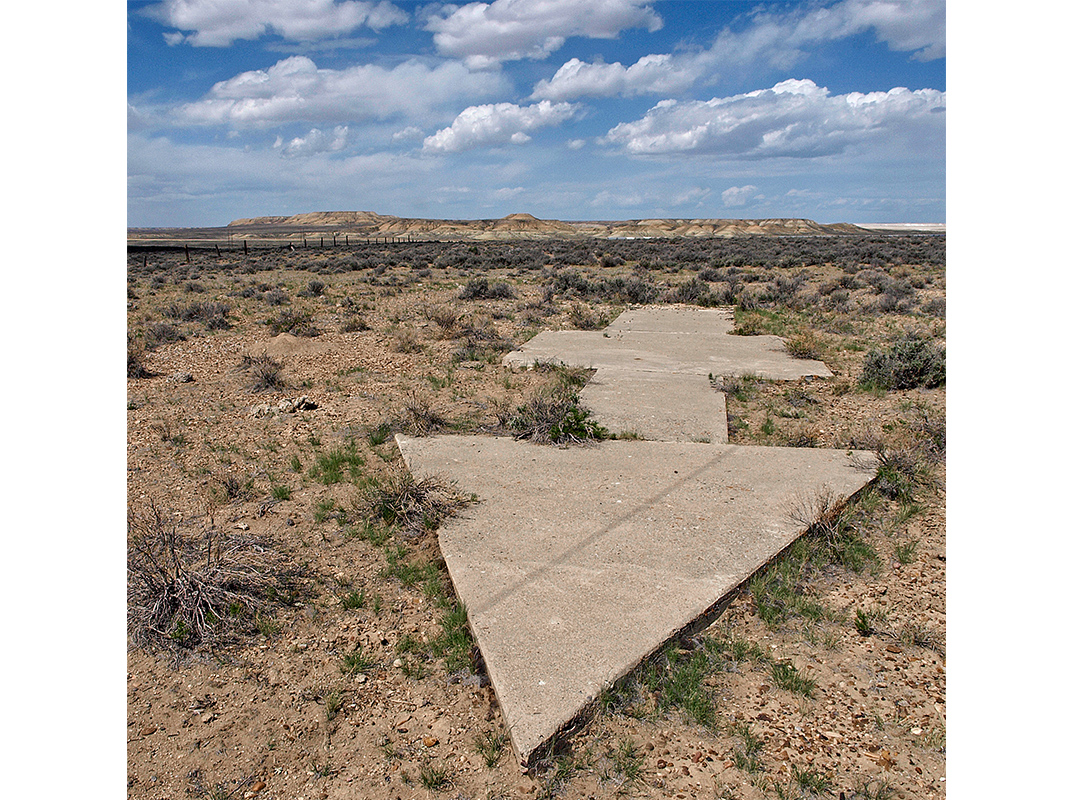
giant arrow


Before satellites, real-time GPS or other modern navigation systems, pilots had to be able to see where they were going. They couldn’t fly at night or in bad weather, and figuring out where they were was a complicated affair involving tools like a compass, maps (on paper!) and a bit of guesswork.

Some towns painted their names in oversized block letters on rooftops to help pilots get their bearings. And sometimes—like when navigational delays slowed down transcontinental air mail delivery* after 1920**—the government saw the need for a more comprehensive solution to the problem and stepped in. In this case they built a system of 70-foot-long concrete arrows pointing the way:

The government built a path of 70-foot-long concrete arrows every few miles from coast to coast, each painted yellow and topped with a 51-foot steel tower that had a rotating beacon. Using the path, an airmail pilot needed only half the time to deliver a letter from New York to San Francisco.

Eventually technology caught up with our demands and the markers were abandoned. Where are these markers now? An intrepid couple named Brian and Charlotte Smith wanted to know the answer and embarked on A Quest (because let’s face it, it’s hard to get anything significant done without A Quest).

They go on road trips to investigate these remnants of a bygone era, and now you can too. With the help of drone lessons from their nine-year old grandson, they’ve assembled photos and a database of marker locations.

The core idea of this story resonates with me. It’s the same childhood fascination I had for the Pony Express or the challenges of nineteenth-century explorers. For me, it’s hard to read a piece like this and not conjure up a daring young Lady Adventurer winging her way across an untamed landscape on a new world, with nothing but a few isolated markers to keep her on track.***

Marvelous!

—–

* FYI, I love the USPS and public libraries and Eisenhower’s Interstate Highway System. These and other basic infrastructure**** projects help make us a better connected, better educated country and have impacted everything from social mobility to what we eat for dinner.

** Before 1920, if you wanted to send a letter to your cool aunt in San Francisco, for example, it went via methods like stagecoach or boat or train. Slooooooow. Or you could send a telegram and tell the whole world your business… like Twitter, actually.

*** A lot like Beryl Markham, actually.

**** (A footnote within a footnote. Does that make it a toenote?) I just want to include the definition of infrastructure and ask lawmakers responsible for assigning project funds, how is this optional?

Infrastructure: The basic physical and organizational structures and facilities (e.g., buildings, roads, and power supplies) needed for the operation of a society or enterprise.

Read Full Post »

Today’s #ThingILike* is West with the Night, a fabulous piece of non-fiction first published in 1942 by bush pilot, adventurer and racehorse trainer Beryl Markham. I picked it up in a second-hand store on the strength of the title and the back cover blurb. I’d never heard of the author, but when Ernest Hemingway says he wishes he could write so well, I pay attention. Glad I did.

“Did you read Beryl Markham’s book, West with the Night? I knew her fairly well in Africa and never would have suspected that she could and would put pen to paper except to write in her flyer’s log book. As it is, she has written so well, and marvelously well, that I was completely ashamed of myself as a writer. I felt that I was simply a carpenter with words, picking up whatever was furnished on the job and nailing them together and sometimes making an okay pig pen. But [she] can write rings around all of us who consider ourselves writers. The only parts of it that I know about personally, on account of having been there at the time and heard the other people’s stories, are absolutely true . . . I wish you would get it and read it because it is really a bloody wonderful book.”
— Ernest Hemingway

Recommended.
* Again, items in this series of Things I Like are linked for your information; no sponsors, no kickbacks, just a sampling of things that I find useful or fun or funny or sweet.

Read Full Post »

I have recently discovered that stalwart of public television, The Great British Baking Show (known on the other side of the Pond as The Great British Bake Off). I don’t usually do reality programming but I was drawn in by the general aura of positivity, the educational content (so that’s how you cool angel food cake!), and of course, the food.

So I’m in a baking mood. This week I pulled out a classic recipe for Banana Bread.

For some reason teenaged me loved making banana bread. Maybe because it was easy and good, or because there always seemed to be over-ripe bananas in the house. I serve warm slices with Maple Cinnamon Butter (looking fine in a reusable Riviera Petit Pot with pretty new lid! I’d include a picture of the bread but, well, I ate it:).

Banana Bread

3 very ripe bananas, mashed, or 2 bananas and one apple, peeled and chopped fine or grated
2 eggs, well beaten
1/4 cup plain yogurt or 1/4 cup melted butter
1 tsp. vanilla
3/4 cup (150 grams) brown sugar
1/2 tsp. cinnamon
1/4 tsp. nutmeg
2 cups (250 grams) flour
1 tsp. salt
1 tsp. baking soda
1/2 cup chopped walnuts (optional)

1. Preheat oven to 350°F.
2. Butter a standard loaf pan, or four mini loaf pans.
3. Mix the fruit and eggs together in a large bowl. Add yogurt or butter, vanilla, sugar, cinnamon and nutmeg. Sift the flour, salt, and baking soda together, then stir into the banana mixture. Add the walnuts (optional) and stir until combined.
4. Pour batter into pan. If you’re feeling decadent (and I usually am) top the batter with more cinnamon, nutmeg, and brown sugar, plus extra nuts or oatmeal if you like it crunchy. Bake for 55-60 minutes (35 minutes if you opt for the mini loaves) or until a knife or toothpick inserted into the center comes out clean. Remove from the pan to a rack to cool.

MapleCinnamonButter

Read Full Post »

« Newer Posts - Older Posts »