Feeds:
Posts
Comments

Posts Tagged ‘history’

Because Presidents’ Day

Happy Presidents’ Day!

If you’re wondering what presidential life and history was like before Twitter, check out:
Because democracy didn’t just miraculously happen and, sadly, is not guaranteed.

Read Full Post »

Slate has invited ten writers to envision the possibilities of a Trump future. As Ben H. Winters, author and the editor of this series explains, “fiction has a special power to clarify, galvanize, prophesy, and warn.” Writers include Héctor Tobar, Ben H. Winters, Nisi Shawl, Saladin Ahmed, Lauren Beukes, Jeff VanderMeer, Kashana Cauley, J. Robert Lennon, Edan Lepucki, and Elizabeth Bear.
Because as the motto says, it’s best to be prepared.

Read Full Post »

Happy Martin Luther King, Jr. Day!

Want to bone up on your history? Kid President is here to help:)


Read Full Post »

Every so often I am struck with the realization that I live in what is, to me, a foreign country. How cool is that?

There I was, about to start up the old treadmill desk and get to work when I looked out the window and had one of those moments. You may know the kind I mean (at least I hope you do), where suddenly everything you see shines with crystal clarity.

Oh, you may think, I hadn’t realized that the neighbor’s maple was quite so magnificent this Fall, and every leaf stands out. I think of it as seeing with a child’s eyes, before “this thing” and “that thing” become a group of “the usual things” that can be ignored without conscious attention.

Do we see each blade of grass when we walk past the lawn? I don’t. In fact, it would be an almost impossible way to live, I think, and I say that with the full knowledge that I am the sort of person who pays attention to the curbs when in Athens. (What? They’re made of marble. And oh yes, The Parthenon;)

I like the everyday, appreciate the curbs and libraries and sidewalk trees that we interact with on a daily basis. The common shapes our daily experience, even as it remains largely invisible. Even so…

I live in a foreign country! Part of my realization was the sudden understanding that I’ve accomplished one of the goals I set when I was a child.

I might have been twelve years old, the details are a bit fuzzy now. There was a group of friends in the room, all of us paging through an atlas (oversized, hardcover, with glossy paper). We argued over where to go, calculated the costs, plotted impossible strategies to get there.

Living in another country seemed the height of adventure. And now here I am.

Canada is lovely and wild, with an often thin edge of civilization anchoring this vast swath of often frigid territory. Approximately 75% of the population lives within 100 miles of the U.S. border, and the continent looks very different up here at night.
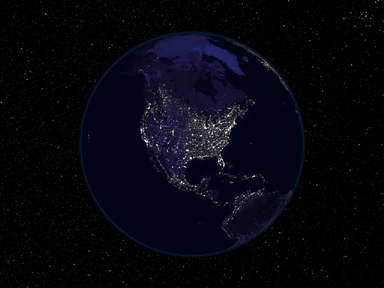
North America at night

That mostly dark bit mostly north of the U.S.? Yeah, not water. I’m waving!

Canadian history is much different than the version I grew up with. It captures an ongoing friction between very different cultures and the relatively peaceable integration of those worlds into a single entity. No flashy Revolution here. There are reasons for signs that list both French and English versions of the word “street.” There are reasons for the populations’ deep-seated love of Tim Horton’s coffee, and gravy-drenched poutine. This country has its own twists, its own heroes, its own storied and shadowed chapters.

It’s true that I can shop for groceries in my native language, read most of the signage and do not need a plane ticket to visit my parents, but I no longer live in the place I was born. It’s also true that even Canadians can be crotchety, the bread often has too much flour in it, and there really is only one road connecting the East and West halves of the country. (And they still won’t shut up about that time they burned down The White House…;) But for me, here and now, it’s all a bit magical.

Pay attention, I remind myself. You just might find that the world is a far more beautiful and astonishing place than you remember. You might also realize that in spite of the knowledge that there is always more to do, if you work hard* and you keep moving even when it feels as though you’re going in circles, dreams can come true.

How cool is that?

. . . . . . . . . . .

* Need some motivation? I recommend the PBS Great Performances documentary Hamilton’s America. Both Alexander Hamilton and Lin-Manuel Miranda are inspirational as heck. It’s available online for U.S. viewers. The rest of us may be lucky enough to catch it on our PBS stations. (See? Not the 51st state after all;)

Read Full Post »

I had a post in mind for today that I thought would be cool but, sadly, it’s not ready. Rather than go with something that’s not right, I’m setting it aside until I can do a good job or come up with something better. So in the end, what did I choose as Today’s Thing I Like? Popcorn:)

Here’s an excerpt from the family cookbook to tell you why.

Popcorn
My whole family can make this with their eyes closed, but Dad really deserves credit for setting new and higher standards for butter and salt consumption. He is blessed with a genetic tolerance for such unhealthy behavior; his blood pressure and cholesterol levels are lower than mine.

For years he’d head to the kitchen after dinner, and a few minutes later I’d hear pop pop! as hot oil turned the first kernels inside out. A few minutes more and we’d be piled on the couch with huge bowls of popcorn and masses of paper towels.

There was no television in the house growing up but at some point we acquired a copy of Star Wars and a video monitor. This was back before Blockbusters popped up down the street (or closed down, for that matter), and there were certainly no DVD players.

The tape was black and white and we watched it on a Beta machine. (Don’t remember Beta? That’s funny, no one else does either.) My brother and I watched that tape until it died, literally came apart from use. To this day I can still reel off an annoying amount of dialog and get excited when I see Star Wars in color. What could be better than a cold drink, a hot bowl of popcorn, and reciting C3PO’s lines with people you love?


Read Full Post »

Today is Memorial Day in the United States. We’ve been watching classic war movies all weekend, Patton and The Longest Day and A Bridge Too Far. I’m thinking of my stepmother’s father, who campaigned in North Africa and Italy. I’m thinking of one uncle who served and came home with his humor and wits intact, and another who did not.

One set of parents is hosting a party to celebrate the hope of returning summer, another set is at the family plot cleaning graves and laying flowers. Both sides of memory are necessary, in my mind.

Part of what writers do is build creative narratives that interpret life, remember the past, reframe the present, and project into the future. Art is interpretation. Memory is selective. What we remember depends on who we are, and who we hope to be. When we stop telling stories, we start forgetting.

Today’s free fiction is Pamela Sargent’s “Too many memories” from Nature’s Futures division.

You already know what Dorothea’s most important insight was — that the reason our client had so much trouble with her memories was that she possessed no narrative structure on which to locate them.

“There’s no framework there,” Dorothea Singh said to me, “nothing to hang the memories on.”

Today, we are that framework.


Read Full Post »

For today’s sampling of free fiction we have a novelette by the great Connie Willis.

Fire Watch” is anchored in a future where time travel is a research tool, and features the same group of historians as in Doomsday Book and To Say Nothing of the Dog. (This novelette is #0.5 in the Oxford Time Travel series.)

Welcome to a world where your academic practicum might include saving a beloved church during the London Blitz. Heck, I wish my History degree had come with a side of time travel:)

Enjoy!


Read Full Post »

It’s snowing! It’s pretty! All is right with the world.

The past few weeks of above-freezing temperatures and no snow have been, for lack of a better word, weird. It reminds me of the time I spent in Arizona, and my first warm Christmas. Seventy degrees on Christmas? In the Northern Hemisphere? Weird. I thought I’d be happy to get away from the cold and snow but I guess childhood imprinting isn’t so easy to escape.

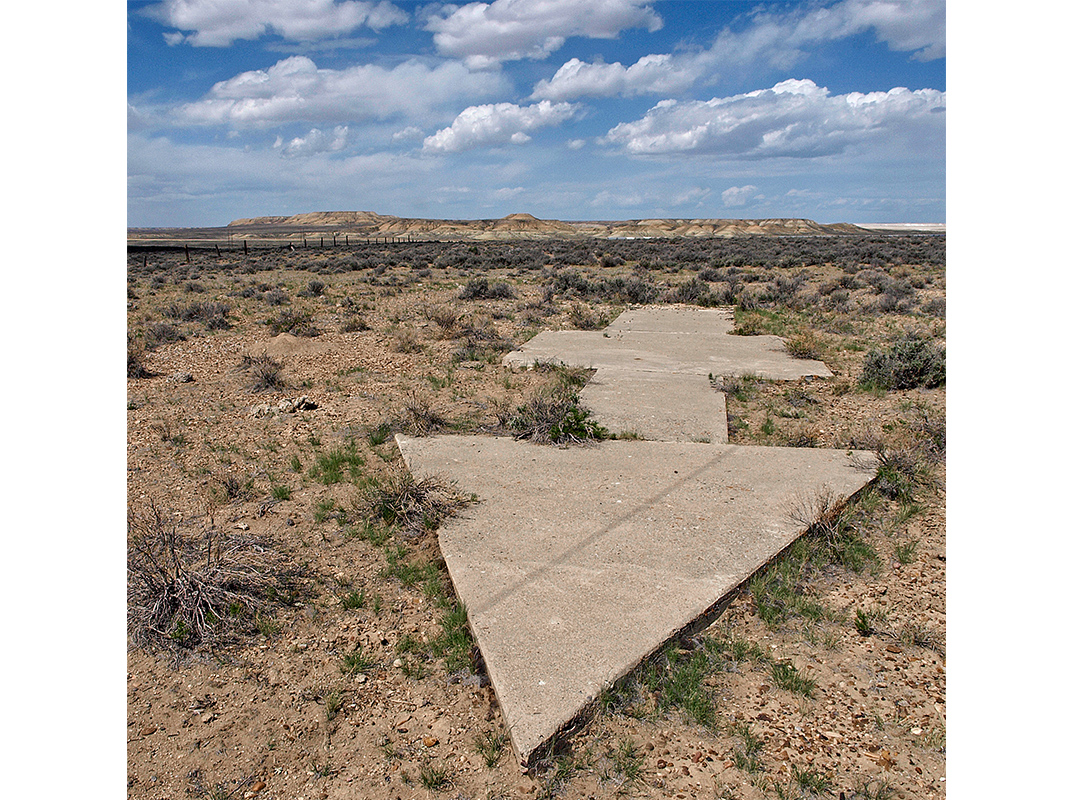
I’ve also been thinking about the desert for a story I’m working on. Remembering the dry expanse stretching to the horizon, tenacious scrub clinging to the sides of dry riverbeds and the clarity of the air at dawn. Thinking about the challenges of crossing such a place in an era before the things Americans tend to take for granted, like functional highways, a network of gas stations and cars that didn’t blow a tire every 50 miles. And I stumbled across this fascinating article in the Smithsonian’s Air & Space magazine, about a network of alien markings giant concrete arrows crisscrossing the continent.

giant arrow


Before satellites, real-time GPS or other modern navigation systems, pilots had to be able to see where they were going. They couldn’t fly at night or in bad weather, and figuring out where they were was a complicated affair involving tools like a compass, maps (on paper!) and a bit of guesswork.

Some towns painted their names in oversized block letters on rooftops to help pilots get their bearings. And sometimes—like when navigational delays slowed down transcontinental air mail delivery* after 1920**—the government saw the need for a more comprehensive solution to the problem and stepped in. In this case they built a system of 70-foot-long concrete arrows pointing the way:

The government built a path of 70-foot-long concrete arrows every few miles from coast to coast, each painted yellow and topped with a 51-foot steel tower that had a rotating beacon. Using the path, an airmail pilot needed only half the time to deliver a letter from New York to San Francisco.

Eventually technology caught up with our demands and the markers were abandoned. Where are these markers now? An intrepid couple named Brian and Charlotte Smith wanted to know the answer and embarked on A Quest (because let’s face it, it’s hard to get anything significant done without A Quest).

They go on road trips to investigate these remnants of a bygone era, and now you can too. With the help of drone lessons from their nine-year old grandson, they’ve assembled photos and a database of marker locations.

The core idea of this story resonates with me. It’s the same childhood fascination I had for the Pony Express or the challenges of nineteenth-century explorers. For me, it’s hard to read a piece like this and not conjure up a daring young Lady Adventurer winging her way across an untamed landscape on a new world, with nothing but a few isolated markers to keep her on track.***

Marvelous!

—–

* FYI, I love the USPS and public libraries and Eisenhower’s Interstate Highway System. These and other basic infrastructure**** projects help make us a better connected, better educated country and have impacted everything from social mobility to what we eat for dinner.

** Before 1920, if you wanted to send a letter to your cool aunt in San Francisco, for example, it went via methods like stagecoach or boat or train. Slooooooow. Or you could send a telegram and tell the whole world your business… like Twitter, actually.

*** A lot like Beryl Markham, actually.

**** (A footnote within a footnote. Does that make it a toenote?) I just want to include the definition of infrastructure and ask lawmakers responsible for assigning project funds, how is this optional?

Infrastructure: The basic physical and organizational structures and facilities (e.g., buildings, roads, and power supplies) needed for the operation of a society or enterprise.

Read Full Post »

Storytelling is a fundamentally human pursuit. (Not to say that we’re the only ones who do it, because it’s possible that ant and bee pheromones communicate the route to food in the form of a tale that resonates with those particular species, but…) In fundamental ways that touch on history to parenting to neuroscience and everything in between, we are our stories. The origins of some classic fairytales, for instance, go back thousands of years.

How our essential stories came to be, what they say to us, and about us, and how they continue to resonate, are all fundamental questions for writers. One way to think about the path of a story, where it goes and what it is meant to do, is through the Hero’s Journey. The TED Radio Hour on NPR did a nice series on this:

…why are we drawn to stories about heroes? And what do they tell us about ourselves?

There are other ways to tell a story, of course, but as the fundamental underpinnings of tales from The Odyssey to Star Wars, this framework provides a fascinating and concrete way to communicate through fiction.

Read Full Post »

My new crush: Miss Fisher’s Murder Mysteries

What: Australian TV series set in the 1920s, featuring a murder-solving “Lady Detective”… which doesn’t really capture it at all:)

Where: Seasons 1 and 2 are available on Netflix (and elsewhere, including my public library, but Netflix works for me). Season 3 recently aired on Australia’s ABC TV.

Why? Because Reasons!

  • The series is based on the books by Kerry Greenwood, and because each episode (at least those I’ve seen to date) is based on its own book, the plot and character arcs tend to be layered and complex.
  • It features a woman (played by the fabulous Essie Davis, interviewed about the series on NPR) who is not afraid of action, bucking authority, family planning, sex, crossing racial or class boundaries, believes whole-heartedly in nonjudgmental good works, tolerance, and enjoying the hell out of life.
  • Great mix of characters and story lines, plus incisive social commentary incorporated in an interesting way.
  • I’ve seen the series described as “competence porn” and while I think the lead character could benefit from a few lessons on how to hang on to one’s pistol and the downsides of scaling buildings in heels, I’d have to agree. She always solves the case, rescues herself and everyone else, and gets the gun back. Also, her skills with a grappling hook are impressive.
  • The clothing gets talked up a lot in reviews of the show and while I’m not a fashion devotee, it’s true, the outfits provide a beautiful and fascinating glimpse into Jazz-age apparel. In this article at The Australian, designer Marion Boyce discusses the process of outfitting the series. Fun fact: Instead of using vintage items, most of the costumes were made for the show, in part because modern humans are differently proportioned than they were even a hundred years ago.
  • Insanely catchy theme song🙂


Read Full Post »

« Newer Posts - Older Posts »