Feeds:
Posts
Comments

Posts Tagged ‘inspiration’

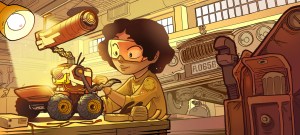
A couple of years ago I wrote about NASA’s excellent graphic novel encouraging folks to imagine themselves on the moon: First Woman: Dream to Reality.

There was a second issue, too, called First Woman: Expanding Our Universe. Both were free and available to the public on NASA’s site. (Which makes sense, because NASA is paid for by US tax dollars, including mine.) Sadly, both have now been removed.

But good news, aspiring explorers! As highlighted over at Space.com, both issues are still available via that bastion of awesome, The Wayback Machine:

Calliefirst – NASA

Issue #1: Dream to Reality follows Callie’s trailblazing path as the first woman on the Moon. Callie and her robot sidekick, RT, overcome setbacks, disappointment, and tragedy along the way. From her childhood dreams of space travel to being selected as an astronaut candidate, Callie takes us on her journey to the Moon.

I don’t always take the time to update older links, but I thought this one was important.

Because if humanity stops inspiring the next generation, humanity stops.

* * *

Read Full Post »

“Don’t put a ceiling on yourself.”

— Oprah Winfrey

* * *

Read Full Post »

2025 marks the one hundred year anniversary of the development of quantum mechanics, and has been named Unesco’s International Year of Quantum Science and Technology.

It is also a good time to mention a poetry contest I came across, from Brilliant Poetry. I haven’t participated in it, but perhaps it will interest you? The contest goal is to “express scientific wonder and discovery through verse” and poems “must find inspiration in the quantum.”

Do I know what that means? I do not, but it might be fun to let my creative voice play with the idea. Hang on, here’s a quick related video.

And this is a much longer explainer: Physicist Brian Cox explains quantum physics in 22 minutes.

Ahem. Now that you have a bit of background, let’s get back to that poetry contest.

What are the rules?

Submit Your Poem

Contest tradeoffs: 

The upside is that there is no entry fee that I can see, and there are cash prizes. Good.

One downside is that by entering, “you give the organizers the right to publish your poem both online and in printed media.” In other words, you’ve essentially given away first world publication rights, so keep that in mind. (On the other hand, the limit is maximum 40 lines, so it may not be a big investment if you’re interested in some experimentation.)

Does this concept tickle your imagination? Submissions close June 20th so you’ve got a bit of time to consider the options, and get into the quantum.

* * *

Read Full Post »

“You can either be judged because you created something or ignored because you left your greatness inside of you. Your call.”

— James Clear

* * *

Read Full Post »

Here’s to moms, those all-too-often-unsung heroines out there doing motherhood every day. 

Unsung Heroes of Motherhood by Wendi Aarons and Johanna Gohmann

… Amanda Hill, who took her rage at trying to reenter the workplace as an older mom and being told they “just aren’t hiring women in your stage of life right now” and funneled it into a brightly colored, expletive-laden cross-stitch project.

Happy Mother’s Day!

* * *

Read Full Post »

I just heard that one of my writer friends is in possession of a shiny new book contract! It’s all still super secret and hush hush, so no details yet, but I think it’s great. (They also read this blog and will know who I’m talking about. Hello!)

They are a fabulous person and a terrific writer. Can’t wait to read the book, and I can’t help but want to celebrate this kind of success… even if for the moment, I have to do it in secret.

* * *

Read Full Post »

It’s Tuesday, ugh, but it’s also spring, so today I’ll be taking a moment to enjoy the bluebells in the forest of Hallerbos.

Join me!

* * *

Read Full Post »

It’s May 4th and you know what that means! It’s Star Wars Day!

Why is Star Wars Day celebrated on May the 4th?

Star Wars Day was created by fans as a sly nod to one of the films’ most popular catchphrases, “May the force be with you.”

And when does science fiction become science fact? A few examples:

Some ‘Star Wars’ stories have already become reality

…at least four important aspects of the “Star Wars” saga are much closer – both in time and space – than Lucas was letting on.

And while it’s true that we’re making progress on the scientific and technological aspects of the Star Wars universe, that’s not the reason we care so much about it. 

Star Wars came to me at a difficult time, and has served as an anchor ever since. Why does the story resonate so strongly with so many people?

A force awakened: why so many find meaning in Star Wars

According to Lucas: “I became fascinated with how culture is transmitted through fairy tales and myth. Fairy tales are about how people learn about good and evil…it’s the most intimate struggle that we cope with – trying to do the right thing and what’s expected of us by society, by our peers, and in our hearts.”

These stories typically appear during times of doubt and can help viewers reclaim the goodness and innocence in themselves, reminding them they can overcome the evil they see in the world. 

And while I normally ignore Episodes I, II and III (IV forever!), this quote from the script of III seems appropriate.

“In a dark place we find ourselves, and a little more knowledge lights our way.”

—Yoda

* * *

Read Full Post »

Every so often I run across story snippets, ideas or lines or just a mood that at one point I committed to paper or pixel.

They are a form of meditation, in a sense, and while some turn into stories or poems or posts, most are just my way of thinking. It’s constructive, but sometimes I find these fragments again and wonder, “What on earth was I thinking?”

And sometimes the idea sets off a new spark and triggers fresh ideas, along a different path. Here’s one such snippet.

When Fluffernutter, our cat of sixteen years, died, we buried her in a shaded spot under the willow in the backyard, down by the creek.

That was our first mistake.

Not checking the grave was the second. 

And not warning the neighbors was our third.

*Note: No kitties were harmed in the making of this post.

* * *

Read Full Post »

I love libraries. Growing up, our local library was a great place to study, read, or wait for the bus, and was a never-ending source of new and interesting information. I’ve moved away but still donate, because I want others to enjoy the benefits I had. Libraries are idea repositories, the physical embodiment of one of humanity’s most impressive accomplishments: the preservation and dissemination of knowledge. The real genius of our current iteration of this concept, however, is that we made so many of our libraries free.

Once upon a time, only the rich could afford books. (Heck, for a long time, few could read at all. And while we’re here, feel free to take a quick detour into the world of traditional bookbinding.) 

Now, we all benefit when we all learn.

To those who say that the world is worse than ever? I give you public spaces filled with the magic of ideas, free for the borrowing.

Libraries are a great source for reading material but can also supply music, movies, information, classes, tools, seeds, eclipse glasses, museum passes, fishing poles, a taxidermied sandhill crane, or help with your taxes.

How cool is that?

Why am I talking about libraries? Because PBS has a new documentary about the evolution of the public library system in the US, and it got me thinking. Here’s a review from another national treasure, NPR:

‘Free For All’ review: This library documentary is worth checking out

…this documentary ends up covering all sorts of ground. The historical beginnings of American libraries, with nods to Ben Franklin and Andrew Carnegie. The growth and importance of tiny branches in rural communities. And, at each stop, a focus on individual libraries, librarians and everyday patrons.

Those in the US can watch the full film here:

Free for All: The Public Library – Independent Lens

How public libraries shaped a nation and remain a beloved sanctuary for Americans today.

If you can’t access the film, here’s a bonus article:

10 Ways Public Libraries Make Our Lives Better

Any answer must begin, of course, with books.

It asks, “With the internet putting a seemingly infinite supply of answers, arguments, and amusements at our fingertips, do we still need libraries?”

I say yes.

* * *

Read Full Post »
« Newer Posts - Older Posts »