It’s a beautiful day here, all blue fall skies and fluffy white clouds, and birds singing in the back yard. What, one might wonder, did the landscape sound like in eons past? Before technology? Even before humans?
There are still a lot of questions to answer, particularly about dinosaurs and other creatures with soft tissue that has not traveled to us through time, but insects? That, we now have a better handle on.
Scientists spent over a decade reconstructing the calls of nine species of ancient insects to create the first accurate Jurassic soundscape.
Something to think about if you are a writer building a soundscape for your world. And having spent much of the weekend with mosquitoes buzzing in my ears, I can only say that insects certainly can make an impression!
The team started by building a homebrew AI-powered facial recognition program called CapuchinAI. They then installed it on a computer outfitted with a camera and touchscreen, loaded it in a protective DIY box, and included a dispenser to dole out dried forest banana slices. When CapuchinAI detects a monkey’s face, the touchscreen turns on. If the monkey triggers it, the machine dispenses a tasty banana slice. Simple as that.
Every hour in every life contains such often-unrecognized potential to affect the world that the great days and thrilling possibilities are combined always in this momentous day.” — Dean Koontz
“I could tell you my adventures—beginning from this morning,” said Alice a little timidly: “but it’s no use going back to yesterday, because I was a different person then.” — Lewis Carroll
Flex your mantle cavities over here, because I’m going to tell you about my favorite books and the science in them, from the astrophysics of Gideon the Ninth to the evolutionary biology of Children of Time. Please bear in mind that my choices (in no particular order, mind you), while they are technically opinion, they are absolutely correct, written in stone, and enforceable by federal law.
In case your to-be-read list needs a bit of a boost:)
“Statues are torn down, buildings with people’s names on them erode. The world is in constant change. The only legacy I recognize is doing good. I’m human, with my terrible faults, but I’m an admirer of good deeds.” — William Shatner
From the Sun’s corona to animal behaviour and human emotions, these rare celestial events continue to provide scientists with valuable insights more than two millennia after they were first observed.
Tomorrow is an interesting day, astronomically speaking. Let me check my list; it’s a long one (and be warned, exclamation marks ahead!).
Let’s see:
solar eclipse, check
meteor shower, check
planetary conjunction, check!
The Eclipse
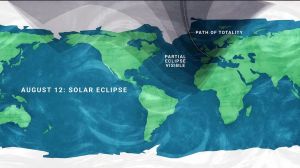
Parts of Western Europe will see a total eclipse, the first visible on mainland Europe in 27 years, but many other places on Earth will have at least a partial version. When and where can you see it? Here’s a look at the timing.
While totality will be visible from parts of Greenland, Iceland and Spain, millions more people across Europe will experience a dramatic partial solar eclipse. Whether you’re chasing the moon’s shadow in Reykjavik or watching the moon take a ‘bite’ out of the sun from London, Paris, or Berlin, timing is everything.
New York City will only see about 9% totality just before 2pm, for example, but if you happen to be in London at 7:13pm, well, 91% totality for you!
The project, entitled “The Prado in the light of the eclipse”, proposes a progressive transformation of the lighting applied to some of the most iconic paintings in the celebrated gallery. Through this shift in light, the video shows how small variations in illumination can radically alter the perception of colours, shapes and the atmosphere of the paintings, revealing details and nuances that everyday light leaves hidden.
That’s already a lot, and we haven’t even talked about meteors or other planets!
The day starts before the Sun comes up. On the morning of August 12, six planets — Jupiter, Mercury, Mars, Uranus, Saturn, and Neptune — will appear spread across the sky.
Do not expect a tight line of bright dots. This is a wide planetary alignment, stretching from the horizon across a large part of the sky. Mars and Saturn will be the easiest planets to spot with the naked eye. Mercury will sit low above the horizon shortly before sunrise. Jupiter will be bright, but very close to the horizon. Uranus and Neptune will need binoculars or a telescope.
Check the link above for times, but for me this would be just after 6am.
It’s going to be a pretty special day, astronomically speaking. Actually, I should have set up this post in terms of time (location dependent, of course!), like so:
early morning: planet parade
early afternoon: solar eclipse
evening: Perseid meteor shower!
If you have a few moments and clear sky, check it out. There’s a lot going on up there!
* * *
A map showing viewing areas of the August 2026 total solar eclipse. NASA/JPL-Caltech
The site’s tagline is “Journeys from fiction drawn on the real world.” That won’t be much use when it comes to Middle Earth or Star Wars, but is very cool when considering more local stories. Like Homer’s The Odyssey. Or Doyle’s Sherlock Holmes. Or Little House on the Prairie, which was somehow not where I expected it to be!
They have lots of classic books and also movies (like Raiders:). Have fun!
“We ought to view ourselves with the same curiosity and openness with which we study a tree, the sky or a thought, because we too are linked to the entire universe.” — Henri Matisse






You must be logged in to post a comment.