Feeds:
Posts
Comments

Posts Tagged ‘writing’

Today I want to spotlight a collection of writing advice. It comes via OWW, the Online Writing Workshop for Science Fiction, Fantasy and Horror. OWW is a fee-based workshop but this advice is available to all.

These short essays discuss topics on writing in general, how to get your work read (if you’re into workshops like OWW, or the free Critters or Codex, for example), and the publishing business overall. I like Nicola Griffith’s piece about avoiding cliches:*

Don’t write “her heart stopped” unless you mean she died. Don’t talk about saucy serving wenches in an inn where the beef stew is thick and hearty and the ale is fresh, nutty, and strong… Why aren’t “serving wenches” ever tired, middle-aged women? Why is the beer rarely yellow, or thin, or cloudy with sediment?

So true.** There’s a reason the average human lives a much longer and healthier life than their ancestors did just a century ago:

In Japan, 72 has become the new 30, as the likelihood of a 72-year-old modern-day person dying is the same as a 30-year-old hunter-gatherer ancestor who lived 1.3 million years ago.

Modern sanitation, medicine and quality infrastructure (for those handy extras like clean drinking water) for the win!

So, keep a weather eye out for dangerous and terrifying pitfalls you have to escape in the nick of time as you navigate the winding path of language clichés:) But keep writing. Remember, all’s well that ends well! (And that’s just about enough of that;)

While we’re on the subject of advice, I’ll supplement the OWW site and my previous posts on writing advice with a link from Brain Pickings. This collection of wisdom is from a variety of writers, genre and otherwise:

#49: Neil Gaiman’s Advice to Aspiring Writers
“You have to finish things — that’s what you learn from, you learn by finishing things.”

Some of this advice may not apply to you; I tend not to relate to Bukowski, for example. But some of it may, and I hope it’s useful.

Since I’m throwing in everything but the kitchen sink today, let me close with this great post from Elizabeth Bear: “everybody’s scared of things that they don’t understand and all the living they don’t do.

Accept that there will be a lot of failures along the way, and that you can come back from nearly any mistake that doesn’t involve making a left turn in front of an oncoming semi.

Excellent advice.

Write, rewrite, finish. Do it again.

…………
* Some of the examples are also about uncomfortable -isms. Racism and sexism, for instance, are more problematic than simple clichés and should be resolved at a deeper level. Obviously.
** As a side note, if you’re curious about what and how people ate in the Western Middle Ages, SF Canada writer Krista D. Ball has a detailed and useful book on realism in fantasy food: What Kings Ate and Wizards Drank.

Read Full Post »

The goal of the Tomorrow Project is to use science fiction to “spark conversations about the future.” This international project taps ideas from today’s emerging technologies, including synthetic biology, nanotechnology, and 3D printing, and spins out possible impacts on future society.

The good news is that it’s not all killer AIs and artificial plagues:) As they so succinctly put it,

Science fiction is a way to think about how we want the future to be.

Anthology Titles:

Enjoy, fellow futurists!

Read Full Post »

Today we have a double dose of free fiction! The first comes from David D. Levine at Tor.com:

Damage” is a tale of desperate times, desperate measures, and the inner life of a fighter spacecraft.

This thoughtful short story of a ship and its master has been nominated for the 2015 Nebula Awards. (If you liked Ann Leckie’s Ancillary trilogy I imagine this could appeal to you as well.) For more on the stories selected for this year’s Nebulas, including select links to full-text versions, check out the complete list of nominees.

The second dose is more like a raging river. Up and Coming is a collection of works by authors eligible for the John W. Campbell Award for Best New Writer in 2016, and is now available for free download. That’s over a million words of fiction!

The anthology is free free free but only until March 31. Get it while it’s available and enjoy:)

Read Full Post »

A friend with a shared love for Harry Potter sent me a link the other day. Some creative and determined person decided to make a Weasley clock.*
The magical ‘Harry Potter’ location clock exists in DIY form

For those who may have missed this detail from the HP book and/or movie, the Weasley clock is a magical JK Rowling invention that tracks each Weasley family member’s location and displays it on an antique clock face.

Rowling thought it up, and a Muggle made it real. How cool is that?

So with thanks to my friend, today’s installment of #ThingsILike is the real-world power of fiction.

*

“If you just focus on what you know, you’re blinding yourself to new opportunities.”
— Tyler Jacks, MIT

There are a lot of discussions of this topic out there, both contemporary and historical, but it’s a point I like to touch on periodically. A writer imagines a thing and someone else finds a way to make it real.

That’s magic right there.

This applies to specific items like the clock but also to everything from emotional states to broader goals. Want to generate ideas, stir up communal interest, and apply creativity to complex problems like living in space long-term? Tap the power of fiction:
The White House Wants To Use Science Fiction To Settle The Solar System

How to get into space? Excite the minds of young (and not so young) people with stirring tales of adventures in space. This applies to stories from Asimov, Clarke and other Golden Age of Science Fiction authors, but also to more recent blockbusters like Andy Weir’s The Martian.

The latter was particularly good at building future versions of current technologies, and NASA was happy to help Weir build his fictional (for now) world from the Popular Science article on the support NASA gave Ridley Scott as he turned the book into a blockbuster movie:

If you want to understand why it is that NASA loves The Martian and is so gung ho for this movie, you have to realize that this movie more or less presents exactly their future vision, minus all the drama.

*

I’ve cited this quote before but it’s so fitting I’ll use it again:

If you want to build a ship, don’t drum up people to collect wood and don’t assign them tasks and work, but rather teach them to long for the endless immensity of the sea.

— Antoine de Saint-Exupéry

That’s the power of fiction.

———

* There may be other such clocks out there (in fact, I hope there are) but this is the version that caught my attention. Feel free to build more!

Read Full Post »

26 Monkeys, Also The Abyss, by Kij Johnson (no relation:)

Winner of the 2009 World Fantasy Award.
Winner of the 2008 Asimov’s magazine Readers Award for best short story.
Final ballot, 2008 Hugo Award.
Final ballot, 2008 Nebula Award.
Mentioned on Locus Magazine’s 2008 Recommended Reading list.
Read by Diane Severson as a charming audio reading at StarShipSofa.com.

This lovely story is subtle but with great atmosphere, and the ending packs a punch. Find more of Kij’s fiction and poetry on her website.

Happy Leap Day, and enjoy!

Read Full Post »

Today’s entry for #ThingsILike is Impostor Syndrome. Let me be clear, I don’t enjoy feeling like a fraud. What I do like is that I’m not alone when I do. My advisor introduced me to the term in grad school and gave me a gift: he told me that practically everyone at our prestigious and accomplished institution had it. It just wasn’t something people talked about.

Ok, maybe what I really like is the fact that the today’s connectivity means I don’t feel like the only one, be it re: impostor syndrome or sci-fi fandom, POC or what have you. Still, today is as good a time for a pep talk as any. Let’s get to it:)

A lot of people feel like frauds at some point in their lives. The topic came up for me this week because Mary Robinette Kowal has a good piece about it on her site. (If her gaming analogy doesn’t work for you feel free to come up with your own.)

Have you ever felt like a fake, attributed your accomplishments to luck or some external reason, or downplayed your success even though on paper you might look pretty darn impressive? If you’re asking yourself “Who hasn’t?” well, you know about impostor syndrome.

(Quick, here’s a pretty picture to keep your spirits up. That’s you, taking in the view on your way to the top. It only looks like someone else’s behind:)

Impostor syndrome is so common that CalTech has a page on it for its students, and everyone from Forbes to Geek Feminism Wiki to the American Psychological Association wants to help people work through it. (And that’s just from the first Google search page:)

I like Mary’s take on impostor syndrome as a way to tell that you are making progress, working hard, and facing down problems that feel too big to handle. (The key here is “feel.” Feels are fine and all but emotion is interpretation, and not necessarily fact.)

Impostor Syndrome means that you are winning.

I think that’s great.

Speaking of progress and how to make more of it, there’s a great TED talk with relevance here. Rather than seeing challenges as a binary yes or no, can I or can’t I? Carol Dweck argues that it helps to think about targets as yes or not yet. That “yet” is the crucial modifier. The brain is built to learn, you just have to chill out, keep going and give yourself a chance.

Do that, and not yet can become yesterday’s accomplishment. Now I’m off to take my own advice:)

Read Full Post »

One of the best ways to understand writing and how to connect with an audience, I find, is to read. A lot. As I read, I ask myself which stories stick with me and why, which annoy me and why, which suck me in so completely that I forget to think about the how and focus only on the what.

For today’s free fiction we have the winner of the 2010 Hugo Award for Best Short Story, “Bridesicle”* [audio available from Escape Pod], by Will McIntosh. It’s a lovely twist on the classic science fiction theme of cryogenics, and it’s exactly the sort of story that sticks with me.

Originally published in Asimov’s, this touching tale also won the 2010 Asimov’s Reader Poll and was a finalist for the 2010 Nebula Award. If you like the story and want to explore the world further, the author also expanded the story into a full-length novel titled Love Minus Eighty.

Enjoy!


* Update: I originally posted a link to what I thought was a freely available version of the story text but! as it’s copyrighted material the link has been removed. It’s still a great story and it’s still available through Escape Pod, narrated by Amy Sturgis, or check out Love Minus Eighty.

Read Full Post »

Today’s free fiction comes from Ann Leckie of Ancillary fame and more. “Hesperia and Glory” was her first SF&F sale, and she blogs about the story and her experience writing it as part of the Clarion West writers workshop:

…all the best advice in the world (and trust me, it was fabulous advice for the story I appeared to have written) isn’t useful if it’s not for your story.

“Hesperia and Glory” is available free as part of a special issue of Subterranean Magazine guest-edited by John Scalzi. Also in this issue, stories by Rachel Swirsky, Jo Walton, Elizabeth Bear and more.

Heck, since I’m at it, let me link two other Leckie stories I read in the past few weeks, both in the Imperial Radch universe:

Night’s Slow Poison from Tor.com
She Commands Me and I Obey from Strange Horizons

Enjoy!

Read Full Post »

It’s snowing! It’s pretty! All is right with the world.

The past few weeks of above-freezing temperatures and no snow have been, for lack of a better word, weird. It reminds me of the time I spent in Arizona, and my first warm Christmas. Seventy degrees on Christmas? In the Northern Hemisphere? Weird. I thought I’d be happy to get away from the cold and snow but I guess childhood imprinting isn’t so easy to escape.

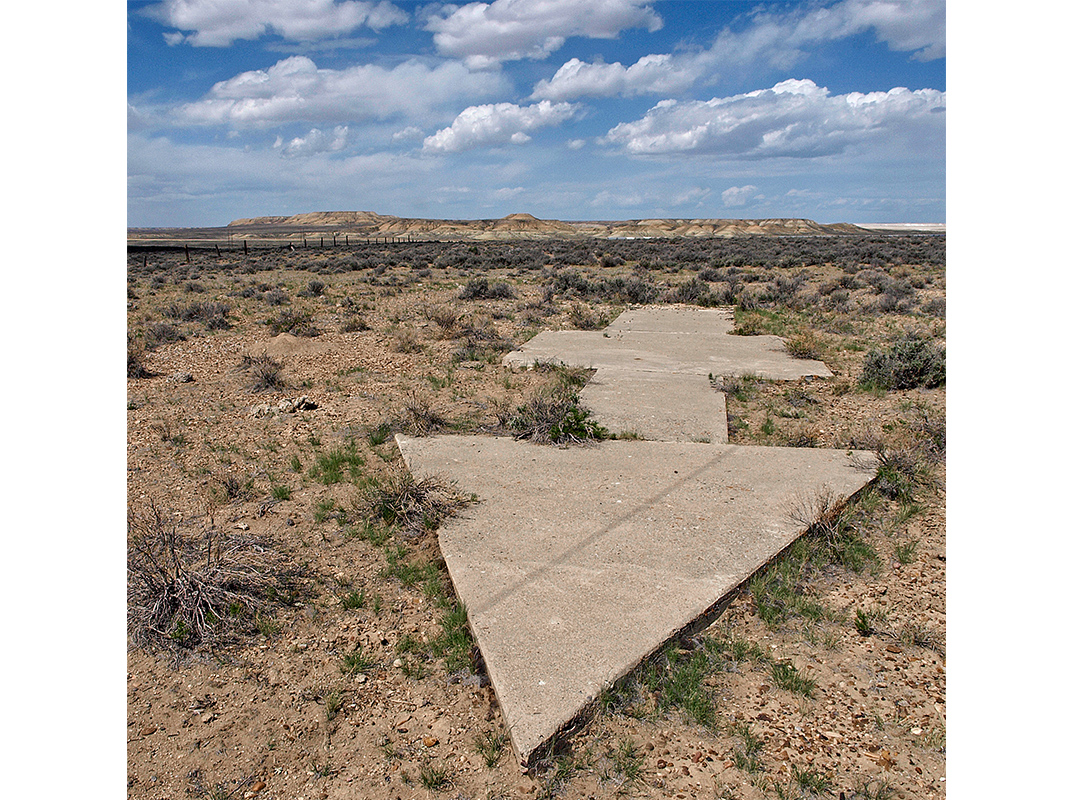
I’ve also been thinking about the desert for a story I’m working on. Remembering the dry expanse stretching to the horizon, tenacious scrub clinging to the sides of dry riverbeds and the clarity of the air at dawn. Thinking about the challenges of crossing such a place in an era before the things Americans tend to take for granted, like functional highways, a network of gas stations and cars that didn’t blow a tire every 50 miles. And I stumbled across this fascinating article in the Smithsonian’s Air & Space magazine, about a network of alien markings giant concrete arrows crisscrossing the continent.

giant arrow


Before satellites, real-time GPS or other modern navigation systems, pilots had to be able to see where they were going. They couldn’t fly at night or in bad weather, and figuring out where they were was a complicated affair involving tools like a compass, maps (on paper!) and a bit of guesswork.

Some towns painted their names in oversized block letters on rooftops to help pilots get their bearings. And sometimes—like when navigational delays slowed down transcontinental air mail delivery* after 1920**—the government saw the need for a more comprehensive solution to the problem and stepped in. In this case they built a system of 70-foot-long concrete arrows pointing the way:

The government built a path of 70-foot-long concrete arrows every few miles from coast to coast, each painted yellow and topped with a 51-foot steel tower that had a rotating beacon. Using the path, an airmail pilot needed only half the time to deliver a letter from New York to San Francisco.

Eventually technology caught up with our demands and the markers were abandoned. Where are these markers now? An intrepid couple named Brian and Charlotte Smith wanted to know the answer and embarked on A Quest (because let’s face it, it’s hard to get anything significant done without A Quest).

They go on road trips to investigate these remnants of a bygone era, and now you can too. With the help of drone lessons from their nine-year old grandson, they’ve assembled photos and a database of marker locations.

The core idea of this story resonates with me. It’s the same childhood fascination I had for the Pony Express or the challenges of nineteenth-century explorers. For me, it’s hard to read a piece like this and not conjure up a daring young Lady Adventurer winging her way across an untamed landscape on a new world, with nothing but a few isolated markers to keep her on track.***

Marvelous!

—–

* FYI, I love the USPS and public libraries and Eisenhower’s Interstate Highway System. These and other basic infrastructure**** projects help make us a better connected, better educated country and have impacted everything from social mobility to what we eat for dinner.

** Before 1920, if you wanted to send a letter to your cool aunt in San Francisco, for example, it went via methods like stagecoach or boat or train. Slooooooow. Or you could send a telegram and tell the whole world your business… like Twitter, actually.

*** A lot like Beryl Markham, actually.

**** (A footnote within a footnote. Does that make it a toenote?) I just want to include the definition of infrastructure and ask lawmakers responsible for assigning project funds, how is this optional?

Infrastructure: The basic physical and organizational structures and facilities (e.g., buildings, roads, and power supplies) needed for the operation of a society or enterprise.

Read Full Post »

Today’s free fiction is a Best of 2015 collection from Tor.com. Available in PDF, EPUB & MOBI formats, the book download requires free login. Note that these and all other Tor.com stories are available free online but it’s great to get a prepackaged anthology as a jumping off point.

Some of the Best from Tor.com 2015

The stories were acquired by editors Ellen Datlow, Claire Eddy, Carl Engle-Laird, Liz Gorinsky, David G. Hartwell, Patrick Nielsen Hayden, Beth Meacham, Marco Palmieri, and Ann VanderMeer.

Enjoy!

Read Full Post »

« Newer Posts - Older Posts »