Today, a recipe that has an important place in our family history.
* * *
Swedish Pancakes (Mike Johnson)
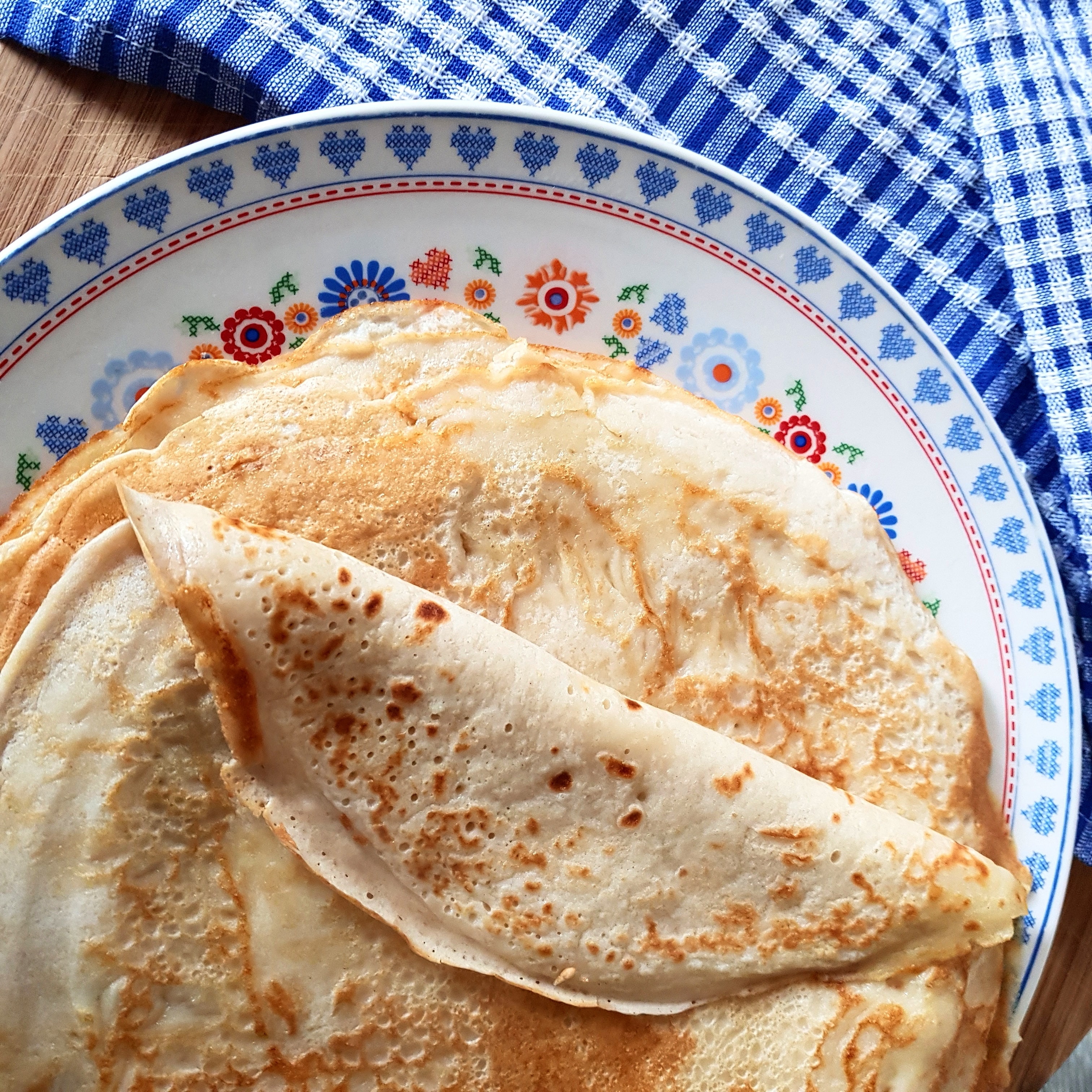
Mike: The history of this recipe begins with Olga, my father’s father’s (far far in Swedish) sister. For most of her life she was a live-in maid and nanny for a rich family across town, from the time when Swedish girls were brought over to replace other ethnicities in the service industry. She also cooked for her brother and his children, and later grandchildren on the weekends. After that she took care of her son. She worked all her life, living with the same family for 30 years and only retiring at 85. She died at the age of 99, tired and more than ready to go.
Jen: My father often spoke of Olga and how she would stand at his grandfather’s stove flipping seven thin pancakes at a time in the special cast iron pan, piling plates high on Sunday mornings. She didn’t have a recipe, just mixed the ingredients together until they “looked right.” Dad finally made up his own and still uses it to play the role of Swedish grandmother, eating over the stove as the rest of us spread butter and sugar and lemon or lingonberries on the pancakes,* then roll them up to eat. Delicious!
Here’s a memory that would have been perfect for Halloween or Thanksgiving, but just came to me when I ran across the video below.
The first thing I planted in a garden (aside from myself) was okra. I’d never eaten it but knew that it was a staple in the South by way of some African food traditions. Once grown, I didn’t know how to cook it. The resulting dish was… ok. (If you’re wondering, I recommend using okra in stew or breading and frying the bejeezus out of it. Very good.)
The first thing I grew that I was really proud of was a pumpkin. This was a year or two later and I was still vertically challenged. That may explain why the pumpkin remains a giant in my mind, but maybe not. I’d read Laura Ingalls Wilder’s books and somewhere in there, probably Farmer Boy, they discuss milk-fed pumpkins. Well, who wouldn’t want to try that?
And it worked. Huge, that’s how I remember this pumpkin. Between the vines and the body the plant took up a whole section of the garden. I would ease down the little hill, through the tall grass and into the tilled area, basking in the hot summer sun while hoping to raise a monster.
A strong, bright, delicious monster, of course. A girl’s got to have standards.
I’m working today but I’d rather be baking. While in Montreal last week I picked up some sugar cookies. Mediocre, not good, stale cookies. They were, to put it mildly, a disappointment.
I hate disappointment. What do I like? Recipes that are satisfying, easy enough to make whenever I want, and showcase flavor rather than perfection. A little flash doesn’t go amiss, either.
We’re watching The Great Canadian Baking Show and I am reminded that there are so many interesting things out there to learn. So while I’m looking for the perfect sugar cookie recipe, I may also start building a list of essential* recipes and methods I don’t already know.
And then start baking.
* * *
* My definition of essential will almost certainly differ from yours, but I’m aiming for techniques that can be used in a wide variety of recipes, help build flexibility into both recipes and bakers regardless of skill level, and eschew fiddly for fun. That said, how have I never made a pithivier? Also, buying puff pastry is absolutely acceptable in my book.
Here is a thing that I love, and the one item I requested from my grandmother’s estate: an artichoke plate.
Artichokes are thorny, tough and difficult to pair with wine. They were at the heart (hehe) of a racketeering scheme in New York in the 1920s and ’30s, which led to a temporary ban and a dramatic upswing in knowledge about, and orders for, the vegetable. They also taste great.
The back of the plate is marked “E & R 0136” but that’s the only information I have. Where was it made, when, and did it come from Ebeling & Reuss or another manufacturer? I don’t know, but I love it anyway.
Disassembling an artichoke flower bud is a messy job, and this plate is the perfect canvas on which to do it. I prefer to serve mine with lemon butter sauce, but there’s also mayonnaise. If you must.
I doubt the dish is valuable from anything other than an emotional standpoint but that’s fine, I won’t be selling it. I have a lot of great memories about artichokes and about my grandmother, and this plate helps me remember both.
Not in a bad way! But some days generating inspired dinner ideas is a pain. So to drum up new recipes I’m going to cook some version of whatever is being served in my current book.
For example, if the characters take a few moments between aliens and heart-pounding explosions to enjoy pancakes or roast chicken or curry, that’s my starting point.
This is a nice combination: Green yaupon + peppermint lemongrass tea* = pretty very good. Maple syrup takes it over the top, because it’s awesome in everything.
You know those days when hoped-for sun never arrives and the design project that should have taken half an hour takes three and the pears you thought would be perfect in a fruit torte are rock hard and the bananas you need today aren’t anywhere near ripe, even after you bake them in a 300F oven for an hour?
It’s that kind of day.
So, ok, not great. But then I came up with not one but two solutions to the design issue and turned the pears into slow-cooked lemon, cinnamon and cardamom pear butter and made blueberry Grand Marnier tortes and I can work around the banana problem, I probably didn’t need the extra sugar anyway.
And you know what? It’s fine if the sun doesn’t come out today.
One of our neighbors has a decades-old grape vine that is both enthusiastic and agile, and it has branched out to surround our shared yards, three fences, and at least two trees. It is also a prolific producer of grapes. Wildlife like them, but sometimes too much. Last year we were a hit with wasps, which I could have done without.
I should have used a higher grape-to-water ratio, but didn’t want to waste the fruit if the recipe was a dud. The juice is just about sweet enough to drink straight and tastes of minerals and a fall afternoon. I suspect these grapes would make fantastic wine.
Have I discovered one of the long-lost vines behind the prized vintages of the Elven Court in Exile?
Yesterday: a pretty fall day + road trip + Les Fruits du Poirier pick-your-own fruit farm = fun 🙂
This particular farm has the usual apples, pears, raspberries, etc. but they also specialize in the less usual. Not everything was in season, but they also grow fruits like haskap, sea buckthorn, gooseberries, and northern kiwi. Yes, that kiwi! The northern variety is smaller than the imported variety you find in stores, but it is sweeter, with thinner skin and no fuzz, which means it doesn’t have to be peeled.
We had to look up half of what we saw, either because we didn’t recognize the plant or because we’d never heard of it before (jostaberry?). We used a click to ID app called Picture This (free to use but you have to navigate a maze of “sign up now!” screens, but I’m sure there are others.
The day was beautiful and it was great to get outside and into the country. Recommended.
I had some plums waiting for a recipe, and I ran across this one for plum torte. The original was a wildly popular New York Times recipe that ran for years. This version is slightly modified and includes comments to help triangulate your own changes.
It’s easy and delicious. There’s a little magic involved. The fruit starts on top but slowly sinks into the batter and turns into a delicious, jammy treat. Of course I added a few minor adjustments.
I made a plum version a few days ago, and today I made a plum with cinnamon, a peach with cinnamon and cardamom, and two mixed berry* tortes with cinnamon and just a splash of Grand Marnier. They also freeze well.
Prep an 8 or 9-inch cake pan. I used a round of parchment paper and buttered the interior, then dusted bottom and sides with a mix of sugar and cinnamon to avoid sticking.
Whisk together the flour, baking powder and salt in a small bowl and set aside.
Cream the sugar and butter until very light and fluffy, about 5–7 minutes with my mixer. I recommend mechanical means unless you want to be there all day.
Add the dry ingredients, eggs and vanilla all at once, and beat until combined, scraping down the sides a couple of times.
Spread the batter into the prepared pan. Arrange the fruit on top of the batter. Sprinkle the top with sugar and cinnamon.
Bake 40 to 50 minutes, until a toothpick inserted into the middle of the cake comes out clean. Cool the cake in its pan for 10 minutes, and then remove. Invert onto a cooling rack, then flip back onto another rack to finish cooling.
Notes
— The recipe called for a springform pan but they aren’t my favorite. (Although it would make cooling easier.) I used a 9” cake pan.
— Fruit options: this recipe has worked with every kind of fruit I’ve tried so far. Plums, peaches and pears are all very good. Pit and quarter lengthwise if small or chop into smaller pieces. Berries are also excellent, and I’ve had great luck with frozen blueberries although starting from frozen added a few minutes to the baking time. For any of these options, if the flavor’s flat then season with a little lemon juice, sugar and cinnamon to taste. Grand Marnier is also very good with berries. Just saying.
— One batch of batter weighs ~475g, in case you’re doubling the recipe.
* * *
* In addition to pints of red raspberries, yellow raspberries, pears, apples, and kiwi, we picked up a haskap pie (no judgement, they were baking and it smelled amazing), and a frozen bag of haskap, red and white currants, raspberries, gooseberries, and Saskatoon berries.
* * *
The tortes. Also, sandwich bread (testing mayonnaise instead of butter) and a double batch of chocolate chip cookie dough. And now I’m ready for a frosty adult beverage.
You must be logged in to post a comment.