Feeds:
Posts
Comments

For today’s dose of free fiction we have a short story by Joe Haldeman. Haldeman is a Science Fiction and Fantasy Hall of Fame inductee (2012), author of The Forever War and many, many other works, and retired MIT writing professor.

“None So Blind” won the Locus and Hugo Awards for 1995’s best short story, and first appeared in Asimov’s Science Fiction Magazine.

Enjoy!


I ran through a number of possibilities for today’s installment of #ThingsILike. Allow me to take you on a tour:
(tl;dr? Limitless is awesome:)

Option #1: Delightfully Precocious Investigative Journalist Hilde Kate Lysiak (Age 9)
Consider, if you will, the nine-year old reporter from Pennsylvania doing her best (and it’s good) to report serious news in her hometown. Hilde Kate Lysiak publishes the Orange Street News from Selinsgrove, PA, and she’s not writing puff pieces about puppies or flowers. Her story went viral when she reported on a murder that took place early April just a few blocks from her house. I can’t wait to see what she can do by the time she gets her driver’s license.

Option #2: Call A Random Swede
I also discovered that Sweden (yes, the country) has its own phone number. Dial the number (it is international, so watch those fees!) and you will be connected to a random Swede.

That’s right, thousands of people have signed up to participate in this program, and incoming calls are randomly shunted to one of them when a call comes through. Call one minute and you might find yourself speaking with a professor in Uppsala, call the next minute and you could be put in touch with a (let’s say) restauranteur from Stockholm or Volvo employee in Arvika.

No guarantees that caller and callee will speak a common language, but that’s part of the fun. There’s just no telling! Suggested topics of conversation include meatballs (yum), darkness (it’s like fine wine in France, they have a lot of the stuff but not everywhere), and feminism (yeah, my family’s ancestral homeland is awesome). All in the name of tourism, of course, but what a great way to humanize another culture.

What’s the number, you ask? Why, it’s + 46 771 793 336 🙂

Option #3: Limitless
Both of the above topics are fun, but in the end I decided to go with something a bit closer to my writerly wheelhouse: Limitless.

The show is based on the movie of the same name. (Time to fess up: I watched the beginning of the movie but somehow never quite made it to the end. It may have had something to do with the initial portrayal of the writer as unmotivated loser. Maybe;)

Here’s a short description from CBS: Limitless is “is a fast-paced drama about Brian Finch, who discovers the brain-boosting power of the mysterious drug NZT and is coerced by the FBI into using his extraordinary cognitive abilities to solve complex cases for them…”

Sounds like a fine (if potentially generic) crime/investigative show. Except that it is nothing like your average CSI.

When I heard the initial chatter about the series my dominant reaction was “meh.” What could they bring to the table as a series? A lot, it turns out. If you’re a fan of deep, serious drama look elsewhere (admittedly, I’m often not), but what the show does, it does very well.

I like speculative fiction and I like humor, and like peanut butter and chocolate, the two are often better together. Limitless is one such case. The writers (and everyone else involved) are blending both humor and serious stakes together into one great whole. Breaking the fourth wall doesn’t begin to capture it. We are always happy to see an episode on the PVR, but we make sure to watch it after dinner. That way we won’t be distracted by an errant tomato and miss a quip, creative visual set piece, or hilarious aside.

Sure, it’s a (mostly) lighthearted TV show, but that doesn’t mean it can’t do fun and interesting things with characters, plot, and presentation. Creative, innovative and downright fun, I’m enjoying the heck out of this show. And as I mentioned, it’s not a show I initially expected to like.

The cast features established faces (including Mary Elizabeth Mastrantonio and Ron Rifkin) and (for me at least) newer ones, including the charismatic and entertaining Jake McDorman. While Bradley Cooper serves as executive producer and sometime guest star, the dynamics between McDorman and Jennifer Carpenter are what anchor the show. I recommend you start at the beginning of Season 1 rather than try to pop in mid-way for best effect.

Why bring this up today? Because I realized that there are only two episodes left in the season and CBS has yet to renew. Prospects look good but after all the television-related heartbreak (of course I’m looking at you Firefly, but there are many more), I wanted to speak up.

If you’re in the market for good, geeky fun dished out with sides of humor and crime-fighting, Limitless is for you.

/recommended

This has been today’s edition of #ThingsILike, sent from my writerly Headquarters (with an exclamation point!).
Life is not supposed to be neat. And it’s a comfort. It’s a comfort to all of us who have messed up. And then you find your way back…

— JK Rowling

For today’s sampling of free fiction we have a novelette by the great Connie Willis.

“Fire Watch” is anchored in a future where time travel is a research tool, and features the same group of historians as in Doomsday Book and To Say Nothing of the Dog. (This novelette is #0.5 in the Oxford Time Travel series.)

Welcome to a world where your academic practicum might include saving a beloved church during the London Blitz. Heck, I wish my History degree had come with a side of time travel:)

Enjoy!


For today’s installment of #ThingsILike, I give you maple syrup. (Honestly, is there anyone out there who does not enjoy this delicious treat from the northern woods?) Lucky me, it looks like this year’s wacky weather patterns have resulted in a veritable tsunami of syrup!

For those of you not intimately familiar with the process of maple syrup production, it goes like this:

[Maple] trees store starch in their trunks and roots before the winter; the starch is then converted to sugar that rises in the sap in late winter and early spring. Maple trees can be tapped by drilling holes into their trunks and collecting the exuded sap, which is processed by heating to evaporate much of the water, leaving the concentrated syrup.

Here’s a video to showing a basic tap and bucket assembly, but I’ve seen outfits with setups running what look like miles of bright blue tubing directly from the trees to the sugar shack.

Even with modern improvements, this isn’t the sort of agricultural process that can be exported to alternate climes. The trees require cold winters and sap production levels depend on spring temperatures finely balanced between colder nights and warmer days.

It turns out that the weather this March has been pretty near perfect, at least if you are a sugar maple. Waking trees drink up groundwater during the day, convert the stored starches in their roots to sugar, and pump the resulting sap up their trunks and into waiting sap buckets.

Collect, boil, repeat, at least until the sap stops running.

Making syrup requires a lot of work and patience. The old fashioned way involves big black kettles and a steady supply of wood to keep the fire going. Even with new, more efficient boilers, reducing sap to syrup takes hours.

My mother took us to a friend’s sugaring party when I was a child. My brother and I ran from tree to tree, hauling half-full buckets through the snowy woods to the kettle and back. The fresh sap tasted like the Entish draughts of my imagination, its clear cool taste instantly refreshing. We also poured hot syrup onto plates of snow to make maple taffy. Freaking amazing.

As luck (or clever planning?) would have it, I am located in the heart of maple syrup country. Quebec and Ontario are the largest maple syrup producers in Canada.

If you happen to be in Ontario this weekend and you love maple syrup as much as I do, you’re in luck. It’s Maple Weekend and I plan to stock up for the year. Because delicious!

Fail Gloriously!

Don’t fear failure. — Not failure, but low aim, is the crime. In great attempts it is glorious even to fail.

— Bruce Lee

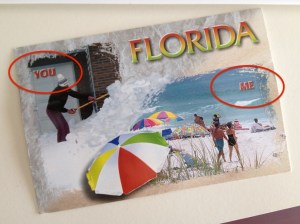
My father and his partner have been off on a delightful trip to Florida and other parts South, and I just received this postcard (bright red circles added for annoyed emphasis):

Srsly


This would be amusing if my front yard did not currently look like this:

Spring

Welcome to Spring, Canadian style. I’ll admit, the card’s not funny, it’s hilarious. Because it’s so true!

Now, where’s my shovel?

Non-Zero Fiction


Ever feel like things just aren’t going your way? My free fiction selection for the day is “Non-Zero Probabilities” by N. K. Jemisin (Clarkesworld, September 2009) ~3400 words.

This 2009 Nebula Award Nominee and 2010 Hugo Award Nominee introduces us to a new New York City, one in which the rules of probability have dramatically changed, and only sometimes for the better:

In the mornings, Adele girds herself for the trip to work as a warrior for battle. First she prays, both to the Christian god of her Irish ancestors and to the orishas of her African ancestors — the latter she is less familiar with, but getting to know. Then she takes a bath with herbs, including dried chickory and allspice, from a mixture given to her by the woman at the local botanica. (She doesn’t know Spanish well, but she’s getting to know that too. Today’s word is suerte.)

…

Enjoy!

Always Through

I’m banging my head against a data problem so I’ll have to set aside the in-depth and incisive essay on the mating habits of Salarian scientists I had planned (so sad, but maybe next week;).

Instead, today’s thing I like is this image and the sheer effort the landscape represents. It’s also a shout-out to my Irish relatives (currently recovering from St. Patrick’s Day) and to the fact that people have been solving problems for millennia. Look at those walls, that can’t have been easy:)

The best way out is always through.
― Robert Frost

So, persistence for the win. With that in mind, back to work!


Today I want to spotlight a collection of writing advice. It comes via OWW, the Online Writing Workshop for Science Fiction, Fantasy and Horror. OWW is a fee-based workshop but this advice is available to all.

These short essays discuss topics on writing in general, how to get your work read (if you’re into workshops like OWW, or the free Critters or Codex, for example), and the publishing business overall. I like Nicola Griffith’s piece about avoiding cliches:*

Don’t write “her heart stopped” unless you mean she died. Don’t talk about saucy serving wenches in an inn where the beef stew is thick and hearty and the ale is fresh, nutty, and strong… Why aren’t “serving wenches” ever tired, middle-aged women? Why is the beer rarely yellow, or thin, or cloudy with sediment?

So true.** There’s a reason the average human lives a much longer and healthier life than their ancestors did just a century ago:

In Japan, 72 has become the new 30, as the likelihood of a 72-year-old modern-day person dying is the same as a 30-year-old hunter-gatherer ancestor who lived 1.3 million years ago.

Modern sanitation, medicine and quality infrastructure (for those handy extras like clean drinking water) for the win!

So, keep a weather eye out for dangerous and terrifying pitfalls you have to escape in the nick of time as you navigate the winding path of language clichés:) But keep writing. Remember, all’s well that ends well! (And that’s just about enough of that;)

While we’re on the subject of advice, I’ll supplement the OWW site and my previous posts on writing advice with a link from Brain Pickings. This collection of wisdom is from a variety of writers, genre and otherwise:

#49: Neil Gaiman’s Advice to Aspiring Writers
“You have to finish things — that’s what you learn from, you learn by finishing things.”

Some of this advice may not apply to you; I tend not to relate to Bukowski, for example. But some of it may, and I hope it’s useful.

Since I’m throwing in everything but the kitchen sink today, let me close with this great post from Elizabeth Bear: “everybody’s scared of things that they don’t understand and all the living they don’t do.”

Accept that there will be a lot of failures along the way, and that you can come back from nearly any mistake that doesn’t involve making a left turn in front of an oncoming semi.

Excellent advice.

Write, rewrite, finish. Do it again.

…………
* Some of the examples are also about uncomfortable -isms. Racism and sexism, for instance, are more problematic than simple clichés and should be resolved at a deeper level. Obviously.
** As a side note, if you’re curious about what and how people ate in the Western Middle Ages, SF Canada writer Krista D. Ball has a detailed and useful book on realism in fantasy food: What Kings Ate and Wizards Drank.