Posts Tagged ‘#ThingsILike’
Shooting Stars
Posted in Likes, tagged #ThingsILike, awesome, inspiration, science, space, travel on April 29, 2017| Leave a Comment »
Long Awaited
Posted in Likes, tagged #finallydonewithwinter, #ThingsILike, flowers, home, mothers, snow, Spring, Thoughts, violets, winter on April 28, 2017| Leave a Comment »
Finally! On Easter the last of our snow melted. We have flowers for the first time since winter arrived. This post is for my mother, who picked violets for her mother, once upon a time.
Happy Spring!

On a Kick
Posted in Food and..., tagged #ThingsILike, baking, cake, creativity, food, fun, home, wedding cake, yay on April 20, 2017| Leave a Comment »
You may have noticed that I’ve been on a baking kick. It’s probably time to give my pancreas a break and go back to salads, but here’s one last* cake for you. Four layers, chocolate, more chocolate and raspberry.

. . . . . . . . .
* Let’s get real, it won’t be the last, but I am planning to slow down the baking. A little:)
This Weekend in Fun
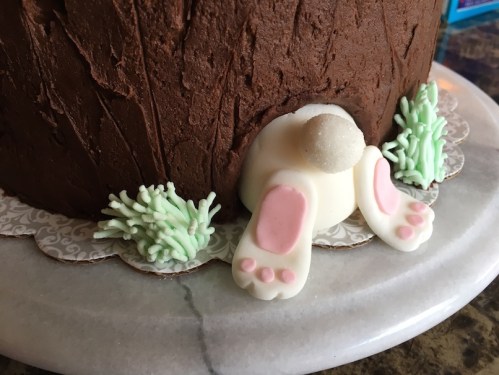
Posted in Food and..., Holidays, tagged #bunnybutt, #ThingsILike, cake, Easter, food, home, yay on April 16, 2017| 2 Comments »
Chocolate frosted meringue mushroom strawberry reduction fondant bunny chocolate cake.
/because awesome:)
Happy Easter!

Yogurt, Plain but not Boring
Posted in Food and..., Likes, Science!, tagged #ThingsILike, awesome, Brød & Taylor, breakfast, DIY, fermentation, fodmap, food, fun, Harold McGee, home, NYT, recipes, science, yogurt on April 11, 2017| 7 Comments »
Making yogurt is easy, affordable, and (if you’re a kitchen nerd like me) fun. It can also give you a much better product than you’ll find in stores. The process is simple: heat milk to get rid of existing bacteria and denature the proteins, cool it, then add good bacteria and give it some time to work. That’s it.
I like writing, so this recipe will be wordier than strictly necessary. Don’t let that make the process feel daunting! It isn’t.
The tricky bits, and there aren’t many, are in the details. It helps to have a thermometer. It helps to have an oversized heavy-bottomed pot, a few things like a canning funnel and conveniently-sized jars, kitchen towels to help keep the yogurt warm as it cultures, and a Post-it to keep you from hitting the oven’s on button with your yogurt inside (ask me how I know!).
None of those things are necessary, however.
Search for information on yogurt-making and you’ll find a variety of alternate recipes and methods, from counter-top to Crockpot. We’ve distilled that information and found a way that makes thick, tangy lactose-free yogurt and works for us. Tweak at will!
Yogurt, Plain but not Boring
Ingredients:
- 1 gallon/4 Liters milk, whole or 2%
- ½ C. plain yogurt with live and active cultures (~2 T. per quart)
1. Scald the milk: add milk to a large pot over low to medium-low heat. Cover and heat to 195℉, or until just simmering with bubbles forming around the edges.
2. Denature the protein: reduce heat to the lowest setting and hold the milk at 190-195℉ for 15 minutes.
3. Cool: remove from heat, uncover and cool to 115℉, or pleasantly warm to the skin.
4. Inoculate: Preheat the oven to 115℉, then turn off. Add a half cup of the milk to your yogurt starter, whisk together, then add the mixture to the milk and whisk until smooth. Leave in pot or move milk to containers. Fill one jar with ½ C. to use as starter for your next batch.
5. Culture: If using jars, place on a cookie sheet. Insulate containers with kitchen towels. Place in oven or other warm spot. Let sit for 6 to 20 hours, then store in the refrigerator.
Transfer the starter to the refrigerator after ~6 hours to keep bacteria healthy. Longer cultures produce thicker and tangier yogurt. If you’re lactose-intolerant, culture for 18 to 20 hours to give the bacteria time to digest the lactose for you. No pills necessary!

Bacteria at work. Yum.
. . . . . . . . . . . . . . . . . .
Those are the basics. For a distillation of the tips and tricks we’ve learned over the years, read on!
Notes:
- You can make yogurt with lower-fat milks but the resulting taste tends to be chalky and not as nice. We use 2% because Mr. Man is reasonable. I prefer whole milk myself;)
- We bump this up to 5+ liters of milk (that’s four bags if you’re in Canada) but keep the amount of starter the same; it works fine.
- For your starter, you want a plain yogurt with minimal additives and no sweeteners. We’ve had the best luck with more industrial-strength brands like Dannon or Stonyfield or (in Canada) Astro or Western than with some of the boutique varieties. There are other culture sources (like chili peppers!) but the grocery store is the easiest way to get started. Whatever you choose, you want bacterial cultures that are tough and ready to work. Rawr!
- The heating and cooling cycles are somewhat time-consuming. I don’t recommend rushing the heating part of this process as that way lies hard-to-clean pans and nasty flavors, but you can speed cooling by sitting the pot in a sink of cold water. Be careful not to splash or otherwise contaminate the milk.
- There are ways to make mesophilic yogurt at room temperature without the heating and cooling cycle but this thermophilic method works for us.
- Precise measurements aren’t required. You need enough starter for the bacteria to get off on the right foot, but as long as you have live cultures and eliminate any competitors by heating the milk, the good bacteria will have room to work. If the yogurt isn’t thickening as fast as you like, feel free to start your next batch with an extra tablespoon or so of starter, or give it another hour or two to set up.
- The longevity of your starter will depend on the strength of the original bacterial strain and how you treat it. We often go six or more months before buying replacement starter, and we make yogurt about once a week. If your finished product isn’t as thick as before, takes longer to set up or (heaven forfend) smells off, it’s time for new starter. We keep the starter in its own container to avoid contamination, try not to let it culture longer than ~6-8 hours, and whisper encouragements. Your mileage may vary.
- The jars we use (see below) are perfectly sized for our needs (Mr. Man strains one for breakfast, I now use two per smoothie) but you can use any option you like so long as it’s clean and non-reactive. You could re-use quart-sized yogurt containers or, if plastic isn’t your thing, mason jars, jam jars or the pot you used to make it.
- If you like additives, add them just before serving. Jam, honey, fruit or other flavors are great additions.
- Straining the yogurt to make a Greek-style thick version is also easy. Use a yogurt strainer, a bag of cheesecloth in a strainer over a bowl or with a filter in your drip coffee maker.
- Strained yogurt is a great base for dip too. I like to add grated cucumber, lemon, minced garlic, salt, pepper and herbed Boursin with a sprinkling of bourbon-smoked paprika.
Optional: for your information only, here is the list of the tools we use to make yogurt:
- 8-quart stainless pot
- remote thermometer
- stainless whisk
- stainless cup measure
- canning funnel
- glass jars with lids
- cookie sheet
- kitchen towels
- yogurt strainer
- one yellow Post-it
We didn’t get all of these things at once, but as we realized we needed them and that we were in it for the yogurt long haul. I’ve found the remote thermometer to be the most useful tool for this, as it lets us be precise and to do other things while the milk is coming to temperature. We use an older version of this one, but there are a lot of options out there. Your needs may vary!
For even more information on the technique and science of making yogurt, I recommend these sources:
- Brød & Taylor: The Science of Great Yogurt
- Harold McGee: The Curious Cook – Yogurt Begins With an Outbreak of Good Bacteria in Your Kitchen
- Cultures for Health: How To Make Homemade Yogurt | Everything You Need to Know!
Morning Over Mars
Posted in Likes, Science!, tagged #ThingsILike, awesome, creativity, inspiration, NASA, persistence, science, travel on March 23, 2017| Leave a Comment »
If the world feels a bit weighty this morning, grab a cup of something hot, sit back and enjoy Mars.
A Regular Guy, A Galactic War & A Dimension-Hopping Tortoise, Oh My!
Posted in Likes, Writing, tagged #ThingsILike, 66, awesome, Fiction, finishing, fun, genre fiction, persistence, science fiction, sff, short stories, speculative fiction, work, Writers, writing, yay on March 15, 2017| 1 Comment »
Hello, and a quick update to say that I’ve got a new story out in the new issue of Andromeda Spaceways Magazine. “The T-4200” is a science fiction adventure featuring a regular guy just trying to save his dimension-hopping tortoise (and oh yes, end a galactic war). As one does!
Given the dynamics of the marketplace, it tends to be much harder to place longer pieces. I’m very happy to have found a home for this novelette, which began life at over 12k and now runs just over 9,000 words.
While ASM is subscription-based (sorry, free fiction lovers!), this entertaining Australian speculative fiction magazine publishes everything from science fiction to fantasy, humor to horror. If you’re in the market for an excellent new source of fresh fiction, check them out, and enjoy!

Some Days, I Do Miss the West
Posted in Likes, tagged #PurpleMountainsMajesty, #ThingsILike, awesome, beauty, inspiration, New Mexico, Sierra Ladrones, US Interior on February 11, 2017| Leave a Comment »
Would you look at that. Purple mountains majesty, indeed.
Taking the (Very) Long View
Posted in Likes, Science!, tagged #amazeballs, #ThingsILike, awesome, climate change, data, demographics, free, fun, geospatial awesome, Google, Google Earth Engine, google maps, health, risk management, satellite imagery, science, space, timelapse, yay on February 9, 2017| Leave a Comment »
Ok, Google, now this is cool:) For anyone who has ever wanted to take the long (very long) view, there’s a new tool from Google.*
The Google Earth Engine gives users access to satellite imagery from as far back as 1984, and to build timelapse imagery that capture changes across the years.
Google Earth Engine combines a multi-petabyte catalog of satellite imagery and geospatial datasets with planetary-scale analysis capabilities and makes it available for scientists, researchers, and developers to detect changes, map trends, and quantify differences on the Earth’s surface.
Want to see what a timelapse looks like? Here is a short introductory video:
Want to make your own? No problem. Explore the built-in Timelapse features, integrate ready-to-use datasets on demographics, climate, imagery and more, or use your own code. (Check out the case studies from a variety of organizations focused on climate, health, and science, including this one on malaria risk mapping.)
You can also set up a tour to view more than one location. It’s fun, educational, persuasive, and easy to use. And because it’s Google, all this goodness is freely available. Now that U.S. government data may become less accessible, people and organizations interested in the long view need all the access they can get.
* Sadly, I’m not affiliated with Google, just a fan. Although like MIT and Slate and Scout and ASU (among others), Google would be a terrific sponsor for thoughtful new science fiction, don’t you think?
-
Recent Posts

She Said, He Said
-
-
Favorite Posts
Archives
Categories
It’s All So Random
What I’m Reading

You must be logged in to post a comment.